Category Archives: America

Ethanol Fuel: How America Should Proceed

I have been interested in ethanol as a motor fuel for years. I came to the conclusion that much of the myth about the so-called inefficiency of ethanol as a motor fuel has been planted by the oil industry.

Technically, ethanol makes an excellent fuel — one that is superior to gasoline in many ways. Is it far less toxic, less explosive and less volatile than gasoline. It does not form sticky goo when stored for a long time. When spilled, it can simply be flushed away with water. If spilled into waterways or ground water, it will easily disperse. It is biodegradable. Ethanol does not require toxic additives to prevent “gunking”, or to increase the fuel’s octane rating (a measure for the fuel’s resistance to premature detonation).

Engines specifically designed to burn ethanol can achieve much higher compression ratios than gasoline engines. This can minimize one disadvantage of ethanol: its energetic density is less than that of gasoline, which means that an engine will burn more ethanol to achieve the same power output of a gasoline engine. However, an engine designed to burn ethanol runs a lot cleaner and cooler than a gasoline engine with the same power output.

Unfortunately, the inefficient way by which ethanol is handled in the U.S. is just plain stupid. It is the result of foul politics and lobbyism. Today, almost all ethanol is made from corn. It is true: this is not efficient. But it does not have to be that way.

Instead, three things should happen:

Continue reading

Related Articles:

TweetReinhard

Daylight Saving Time Makes No Sense

This Sunday we will again do the crazy switch: “Daylight Savings Time”. But the assertion that Daylight “Saving” Time “saves” energy is bunk. It is simply a stupid and anachronistic idea. It serves no documentable purpose and should be done away with.

Not only have the positive effects of DST never been conclusively documented. On the contrary! In recent years, there has been a growing body of scientific evidence showing an increase in energy consumption during DST.

The idea behind DST was that more daylight in the afternoon would reduce the need for artificial lighting, thus cutting down on energy costs.

But as it turns out, more light (and heat) in the afternoon also means an increased demand for air conditioning, which results in a net increase in energy usage. These are the findings of a 2008 study by two University of California, Santa Barbara researchers. “I’ve never had a paper with such a clear and unambiguous finding as this,” said lead researcher Matthew Kotchen.

Studies conducted in Japan, Australia and the State of Indiana have reached similar conclusions.

In the U.S., the situation is rather bizarre: some states switch to DST, others don’t. In the State of Indiana, some counties have DST. Others don’t. So if one drives though the state, the time jumps!

There is similar confusion around the globe. Some countries switch to DST, others don’t. Some (just to top everyone else in terms of absurdity) switch only one half hour forward and back.

Here is a world map showing DST usage:

Legend: DST implemented (blue), DST not implemented (red), DST formerly used but now abolished (orange). Click to enlarge.

Of course, this impacts telecommunications, the travel industry, navigation and international business.

It is idiotic (to say the least!).

By the way: another false myth about DST is that Benjamin Franklin suggested it. Not true! Franklin merely suggested that getting up earlier (with the sun) and going to bed earlier would be more efficient – considering that most illumination in his days came from (expensive) candles and oil lamps.

Franklin is said to have remarked: “Early to bed, and early to rise, makes a man healthy, wealthy and wise”. In 1784, he also published an anonymous letter, which satirically suggested taxing shutters, rationing candles, and waking the public by ringing church bells and firing cannons at sunrise. Of course he was not serious. And he never suggested to move the clocks back and forth.

Here is an organization with the goal of abolishing DST for good: http://www.standardtime.com/

(Adapted from my blog post of 03/07, 2008)

Related Articles:

TweetReinhard

The Los Angeles Air Raid

The Battle of Los Angeles, also known as ‘The Great Los Angeles Air Raid’, is the name given by contemporary sources to the rumored enemy attack and subsequent anti-aircraft artillery barrage which took place from late February 24 to early February 25, 1942 over Los Angeles, California.

Read more details here.

Related Articles:

TweetReinhard

Meeting Maria Altmann

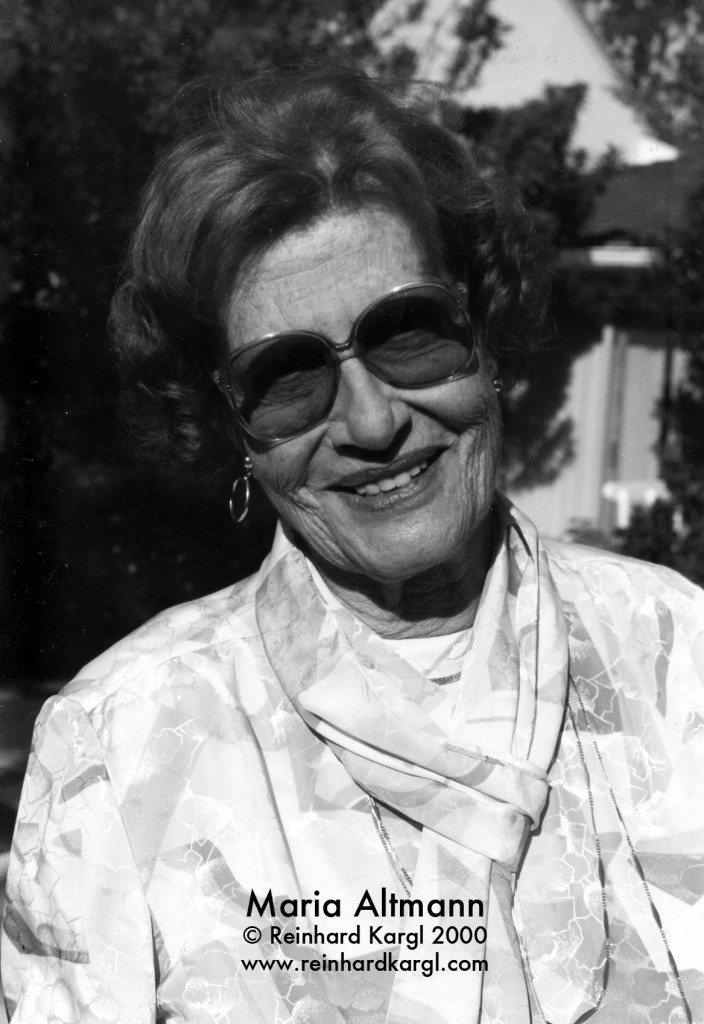
Maria Altmann Portrait
Maria Altmann in her garden. Click to enlarge. © Reinhard Kargl 2000

Maria Altmann, heiress to Gustav Klimt paintings which were later sold for $328 million, has died in Los Angeles on February 7, 2011. She was 94.

When the Austrian state TV network ORF asked me to do an in-depth interview with Maria Altmann in 2000 — after Altmann had sued the Republic of Austria — I was a little apprehensive at first. How would she react to a reporter raised in the country she was suing for the injustices she alleged were done to her family during the Nazi era?

So I phone Mrs. Altmann to test the waters. But my fears prove to be completely unfounded. On the countrary! The moment she hears I was born in Vienna (as she was), Altmann immediately falls into perfect German slightly tinged with a distinct Viennese upper-class accent: “Ach, dann können wir ja auch wienerisch reden!” And she proceeds to tell me enthusiastically of the “wonderful” youth memories she has of the old imperial city by the Danube, the delicious pastries, the architecture, and the music.

She was 84 years old at our first conversation, still very busy working as fashion consultant and designer, interested in art and classical music, well read, highly energetic and articulate. I knew then that I was about to meet a most interesting and remarkable lady.

Since then, Mrs. Altmann’s story has been well publicised. Born into a family of wealthy Jewish industrialists in 1916, she was 22 and freshly married when the First Austrian Republic (the German speaking remnant left over after the disintegration of the Austro-Hungarian Empire), joined the German Third Reich in the Anschluss of 1938. Like many other Jewish residents at the time, Altmann’s (and her husband’s) family assessed the situation correctly and subsequently scattered, leaving almost their entire fortune behind.

Among the family’s possessions were various pictures by the still relatively unknown Gustav Klimt; among them were portraits commissioned by Altmann’s family.
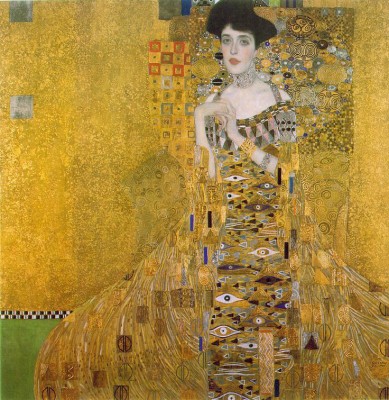
Adele Bloch-Bauer I, by Gustav Klimt, 1907. Oil and golden and silver foil on canvas. 138 × 138 cm. Click to enlarge.

Compared to what happened to others, Altmann considered herself “very lucky”. After her husband’s arrest, his brief detention and the couple’s covert flight from Vienna, the Altmanns were able to make a new, peaceful life in America, where they also achieved financial security.


Anyway, so we decide to shoot the interview at Altmann’s home in Cheviot Hill, a small and neat suburbian residential area in West Los Angeles, where the widowed mother of four children has lived for a long time. We agree to shoot everything in German.

Altmann is well groomed and dressed and exudes an aura of ladylike poise and charm. As usual, I let the cameraman pick the best setting (which he finds in the backyard) and while the crew is setting up, I follow the usual ritual: engage in a little small talk with the subject in private, then go over a broad description of my questions, have the microphones attached, do a light and sound check. Not easy to endure at the age of 84.

The interview goes very well. Altmann gives long answers (luckily I’m not the one who has to edit this) and turns out to be patient and charming. We change tapes several times.

But then, we run into a problem: every home in the area has a yard. And every yard seems to be maintained by Latino “mow and blow” crews. And they all arrive at the same time with their noisy lawnmowers, power cutting tools and leafblowers.

Oh, the ruckus! My sound guy is wringing his hands (and I have secret fantasies of wringing some necks). We decide to take a little break, but to no avail. As soon as one crew of yard workers is done, another starts up a lawnmower or damn leafblower somewhere else in the neighborhood. These things aren’t even legal.

I am beginning to get nervous. We have already shot two thirds of the interview; going inside now would be a continuity problem. Besides, I am under orders to ship the tapes off right away. Meanwhile, the sunlight is beginning to fade, and so does Altmann’s ability to concentrate. Great.

I call a break again (probably the for the 5th time) and go outside to talk to the yard workers. Of course, they pretend to understand no Ingles. I know the game, so I put on my crazy gringo act and somehow convince the workers to take a break for a few minutes. I don’t know if they agree to hold the work because of the bribe I offer (for which I have no expense account, of course), because they think I am nuts (and possibly dangerous) or because they genuinely feel bad about preventing me from doing my job.

Whew! The cameraman plays some tricks with the white balance to compensate for the different light temperature as much as possible, and we hurry to continue and finish up.

Altmann is “terribly sorry” for all the trouble even though she didn’t cause it. She invites me for coffee, which she prepares herself.

I send the crew on their way. They are eager to get on the freeway, since rush hour has begun. Altmann has lots of time, enjoys the company, and the opportunity to talk about Vienna auf Deutsch. I know (and appreciate) that people from Vienna take their Kaffeejause (coffee break) very seriously.

I am amazed that Altmann, through it all, still feels connected with Austria. I recall pictures of the Alps and mementos of Austrian cities in her home. Whatever ill feelings she might have are directed at the individuals whom she believes have wronged her, but not at the entire place or German culture as a whole. Most likely, this attitude is what allowed her to cope and carry on with her life. It’s not even about the money, she insists, but about justice. Money, she says, has never meant anything to her. “At this stage in my life, I would not even know what to buy with it.”

Altmann keeps pouring coffee and brings plates of food, and it is long after darkness has fallen when I finally get on my way. She invites me to come back some other time, “zum Kaffee” (for coffee).

I am sad to say that I never took her up on the offer. Like so many times in life, I often thought about making a phone call to follow up. But then, I am always extremely busy, and something else always came up. As so often, I now deeply regret that time has run out.

The story of the Klimt pictures and Maria Altmann, the old lady who fought the Republic of Austria (and won), exploded into the global headlines. In the end, the Österreichische Galerie Belvedere released the paintings to Altmann. I was able to see them at the Los Angeles County Museum of Art before they were sold off.

Altmann told me (and others) that she sincerely wished and hoped that the pictures would be visible to the public, but sadly this is only partially the case today.

The most famous of the paintings, Adele Bloch-Bauer I (1907) is one of several portraits of Altmann’s aunt. It was acquired by Ronald S. Lauder for $135 million in 2006. It was the highest price paid for a painting to date. Adele Bloch-Bauer I is currently at Lauder’s Neue Galerie in Manhattan, but the other pictures have disappeared from public view.

My favorite image from the group is currently in a private collection:

Birkenwald/Buchenwald (Birch Forest/Beech Forest), 1903. By Gustav Klimt (Austrian, 1862-1918). Oil on canvas. 110 x 110 cm. Private Collection. Click to enlarge.

I wonder what Klimt would have thought of all this. He died in 1918. I admire his words: “If you cannot please everyone with your deeds and your art, please a few. To please many is bad.” You see, Klimt was quite a rebel in his days.


Related Articles:

TweetReinhard

“Obviously A Major Malfunction”

25 years ago, on January 28, 1986 Space Shuttle Challenger was destroyed during launch, costing the lives of astronauts Francis “Dick” Scobee, Michael J. Smith, Ellison Onizuka, Judith Resnik, Ronald McNair, Sharon Christa McAuliffe and Gregory Jarvis. Their brief flight (STS-51-L) was the 25th shuttle launch.

By the time, shuttle flights had become routine and were hardly covered in the news. I was exiting the subway station Karlsplatz in Vienna, Austria when I heard the shocking news on a radio, which a storekeeper had sitting on the counter.

Related Articles:

TweetReinhard

Please Do Not Call Me “Caucasian”

There has been quite an uproar about an NPR (National Public Radio in the U.S.) commentator, who used the term “Gringo” for white Americans.

Personally, I don’t care if you call me “Gringo”. What I find offensive is the term “caucasian”. It is anthropologically and ethnologicially wrong and scientifically ignorant.

The term was probably invented by the German anthropologist Johann Friedrich Blumenbach. Around 1800, he theorized that all of the indigenous populations of Europe, North Africa, the Horn of Africa, West Asia, Central Asia, and South Asia originated in the Caucasus region. (Locate the Caucasus on a map. Most Europeans would not even consider it to be part of Europe).

In this region, so Blumenbach thought, God had created the “perfect man”. As they spread out in all directions, Blumenbach (and his fellow “monogenists”) believed, people degenerated in appearance.

Blumenbach wrote: “Caucasian variety – I have taken the name of this variety from Mount Caucasus, both because its neighborhood, and especially its southern slope, produces the most beautiful race of men, I mean the Georgian; and because all physiological reasons converge to this, that in that region, if anywhere, it seems we ought with the greatest probability to place the autochthones (birth place) of mankind.” [From: Blumenbach, De generis humani varietate nativa (3rd ed. 1795), trans. Bendyshe (1865)]

The 4th edition of Meyers Konversations-Lexikon (Leipzig, 1885-1890) shows the “caucasian race” as comprising Aryans, Semites and Hamites. Aryans are further subdivided into European Aryans and Indo-Aryans (the latter corresponding to the group later designated Indo-Iranians.

Blumenbach’s theories (most of which were derived from a bizarre pseudo science called “craniology” — the examination of skulls) are considered absurd by today’s standard of knowledge.

The term “caucasian” is anachronistic, misleading, scientifically wrong and should be dropped altogether. What should be used instead? “Caucasoid”, “Europid” and “Europoid” have been suggested, but are a similarly demented.

“European” would suffice. “European-American”, if you must. “Europeans” can be subcategorized into “Nordic” or “Germanic European” peoples, Slavic peoples, etc. — although in practice, these groups have been mixing in Europe for thousands of years. What matters more are the distinct cultural (and linguistic) differences, which have been preserved in Europe to this day.

In the U.S., the Supreme Court in 1923 decided that Asian Indians may be “caucasian” but not “white”. (United States v. Bhagat Singh Thind). In 1946, the court modified its opinion. The issue came to the court’s attention because of their relevance to immigration laws which, before 1965 favored white Europeans. As a result, the court was left to decide who was to be considered “white”.

Outside of American English and in science, the term “caucasian” has fallen out of use a long time ago, and it should be thrown out from everyday American language as well.

Related Articles:

TweetReinhard

Calling For Eddie Eagle

In a most tragic incident in the Los Angeles area, a 15-year old girl was shot in the head by an accidental gun discharge on Tuesday. She remains in critical condition and will be marred for life. The same bullet also wounded another student in the neck. It appears that the gun had been brought to school by a classmate, and gone off inside the student’s backpack.

Whenever we have a horrible event like this, it is fashionable to blame the schools, the “easy access to guns”, and to bash gun owner advocates — especially the National Rifle Association (NRA) — for allowing this to happen.

But what I hardly see mentioned is that the NRA is running a superb program warning kids of the dangers of guns. Continue reading

Related Articles:

TweetReinhard

Why We Must Hire Robots, Not Minimum Wage Workers

I encourage you to watch the following video entirely before allowing me to present my point of view:

As you can see, almost the entire manufacturing process in this film is handled by sophisticated machinery: robots.

I have long argued that instead of exploiting cheap Third World labor and lenient environmental regulations abroad, and instead of importing low wage workers en masse, the European Union and North America should focus on developing robotic manufacturing techniques for all consumer goods. Japan, unwilling to open its borders to foreign workers, is making great strides in this direction and will probably dominate the robotics industry, which it expects to see huge growth over the next few decades.

Robots could free mankind from the burden of most cumbersome, dangerous and boring toils. This would permit a restructuring of society to grant each individual more time for intellectual pursuits and pleasure. This in turn will fuel the education, media, travel and entertainment sectors of our economy, all of which are extremely difficult to outsource to cheap-labor countries.

Continue reading

Related Articles:

TweetReinhard

The Eisenhower Farewell Address

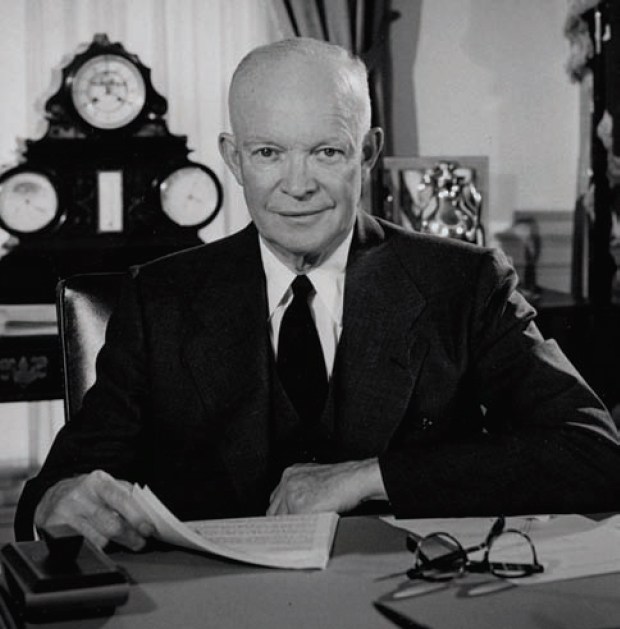
50 years ago today, Dwight D. Eisenhower, whose name is often mentioned among the greatest generals and U.S. presidents, gave a stern warning as part of his farewell address to the nation. I am amazed how astute Eisenhower’s observations were, and how they hold true five decades later.

Here is an excerpt from Eisenhower’s speech, delivered from the Oval Office of the White House:

[…] A vital element in keeping the peace is our military establishment. Our arms must be mighty, ready for instant action, so that no potential aggressor may be tempted to risk his own destruction.

Our military organization today bears little relation to that known by any of my predecessors in peacetime, or indeed by the fighting men of World War II or Korea.

Until the latest of our world conflicts, the United States had no armaments industry. American makers of plowshares could, with time and as required, make swords as well. But now we can no longer risk emergency improvisation of national defense; we have been compelled to create a permanent armaments industry of vast proportions. Added to this, three and a half million men and women are directly engaged in the defense establishment. We annually spend on military security more than the net income of all United States corporations.

This conjunction of an immense military establishment and a large arms industry is new in the American experience. The total influence — economic, political, even spiritual — is felt in every city, every State house, every office of the Federal government. We recognize the imperative need for this development. Yet we must not fail to comprehend its grave implications. Our toil, resources and livelihood are all involved; so is the very structure of our society.

In the councils of government, we must guard against the acquisition of unwarranted influence, whether sought or unsought, by the military-industrial complex. The potential for the disastrous rise of misplaced power exists and will persist.

We must never let the weight of this combination endanger our liberties or democratic processes. We should take nothing for granted. Only an alert and knowledgeable citizenry can compel the proper meshing of the huge industrial and military machinery of defense with our peaceful methods and goals, so that security and liberty may prosper together. […]

From:  Dwight D. Eisenhower’s farewell speech to the nation, January 17, 1961.

The complete transcript and audio file of the address are archived here, another transcript is here.

Related Articles:

TweetReinhard

Last Interview With John Lennon

John Lennon was killed 30 years ago today. Recorded only hours before the murder, this is the very last interview with him and Yoko Ono.

The interview took place at Studio One at the Dakota building in New York, where Lennon and Ono lived and where the deadly shots were fired at the entrance.

Listening to this caused me to pause and remember how quickly and unexpectedly life can end, and how rapidly families and relationships can be shattered.

I have omitted Parts 1 – 3, on which one could hear Yoko Ono chatting with reporters while they are waiting for Lennon, who is running late and enters the room at about 3’40” of Part 4 (below).

Part 5

Part 6

Part 7

Part 8

Part 9

Thanks to Chris Simpson (who goes by the handle NeilFraudstong) for archiving and sharing this material.

Related Articles:

TweetReinhard