Category Archives: English

Facebook Friendships Around The Globe

Image Showing Facebook Relationships Around The World

Click to enlarge! This shows the volume of Facebook relationships around the world, as of December 2010. The image was produced by Paul Butler, an intern on Facebook’s data infrastructure engineering team.

Related Articles:

TweetReinhard

Dear People of China (An Open Letter)

You are one of the oldest civilizations on Earth.

I am filled with deep respect for your many achievements over the course of thousands of years. Your accomplishments in science, language, mythology, philosophy, spirituality, architecture, literature, music, cuisine and so many other cultural and intellectual pursuits are astounding. You have given the world many of the greatest minds.

But out of ten ethnically Chinese Nobel Prize winners so far, only one — journalist and writer Liu Xiaobo — has done his work in his own homeland, where his intellect is wasted in prison.

No less than six (Chen Ning Yang, Tsung-Dao Lee, Samual Chao Chung Ting, Steven Chu, Daniel Chee Tsui, Roger Yonchien Tsien) have left China to do their work in the United States of America.

One (Charles Kuen Kao) has done his research in England and Hong Kong, one (Yuan Tseh Lee) in Taiwan, and one (Gao Xingjian) has done his writings in France. One other (the Dalai Lama) is not ethnically Chinese. Although he is highly respected everywhere he goes in the world, he is loathed in the People’s Republic of China — and only there.

Dear Members of Government of the People’s Republic of China:

Does it not give you reason to ask yourselves why so many of your people’s best thinkers feel the need to leave the land of their ancestors?

Your artists, your philosophers and your scientists have so much to contribute to the entire world. They are your best ambassadors, your best assets. We want to hear from them. We all need them to make the world a better and more civilized place.

Wouldn’t it be time to let them do that? Wouldn’t it be better to give them all your support, so that they may earn even more respect for your culture, for the success of your country and for the countless virtues of the Chinese people?

Respectfully,

Reinhard Kargl :.

Related Articles:

TweetReinhard

Last Interview With John Lennon

John Lennon was killed 30 years ago today. Recorded only hours before the murder, this is the very last interview with him and Yoko Ono.

The interview took place at Studio One at the Dakota building in New York, where Lennon and Ono lived and where the deadly shots were fired at the entrance.

Listening to this caused me to pause and remember how quickly and unexpectedly life can end, and how rapidly families and relationships can be shattered.

I have omitted Parts 1 – 3, on which one could hear Yoko Ono chatting with reporters while they are waiting for Lennon, who is running late and enters the room at about 3’40” of Part 4 (below).

Part 5

Part 6

Part 7

Part 8

Part 9

Thanks to Chris Simpson (who goes by the handle NeilFraudstong) for archiving and sharing this material.

Related Articles:

TweetReinhard

We Need More Krampus!

In the misty forests of the northern Alps, under cover of darkness, mysterious figures are making their rounds through the snow.

As he has been doing for many centuries on December 6, Saint Nicholas appears out of nowhere, to bring blessings and gifts to children. If they were good, that is. Bad children may receive a visit from someone else instead …
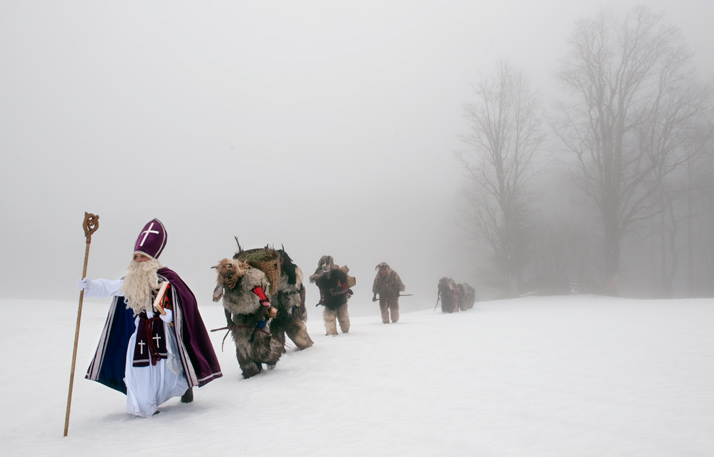
The amazing National Geographic photographer Carsten Peters had the good fortune to encounter Nikolaus (as he is known in German) and Krampus in Bavaria, which resulted in this wonderful image. It was featured in the December 2010 edition of National Geographic Magazine (“Visions of Earth, p. 12). Click to enlarge.

Saint Nicholas (also known as Nikolaos of Myra) was a third century monk and bishop. Many good deeds and miracles are attributed to this worthy man. He was particularly kind to children.

When I was a kid growing up in Europe (and perhaps because I was a rebellious one who usually identified with the underdog), I was always more interested in Saint Nicholas’ sinister companion and servant: the Krampus. While Nicholas represents everything that is kind and good, the Krampus is a bird of different feather. I kid you not — the Krampus is liable to make children (and sometimes adults too) wet their pants.

Perhaps you were not so good last year. The Krampus might administer a thorough lashing. If you are lucky, that is. He might also fling you over his shoulder and into his knapsack, and take you to places where you really don’t want to go.

Like many of us, Saint Nicholas also emigrated to the New World. But he did not fare well in America.

First, “Saint Nick” was stripped of his dark companion. In America, violence is something kids ought to watch on TV every day, but there’s little public acceptance of it in folk tales, fables and ancient stories. Christian holidays are supposed to be nice and sanitized – and mostly secular, so they can be sold to non-Christians as well. As a marketing tool, Christmas must not offend. It cannot be controversial, and it must not be too thought provoking. Next, Hollywood agents called for a name change. “More catchy and easier to pronounce, please! And drop the “Saint”, so that Protestant majority won’t be offended. How about Santa Claus?”

Then, because too much seriousness is bad for publicity, Hollywood producers admonished him to cheer up and smile for the cameras. And the outfit now had to be a brighter, flashier red.

Worst of all, Wall Street hired Santa as the official spokesman and promoter of “Christmas” cheer and consumerism. Increasingly frustrated, Santa gorged himself on American junk food for comfort, until he became grotesquely obese.

What a shame! Today, there are so many misbehaving children in America. And of course, these turn into nasty, ill-behaved adults. I propose that what America really needs is less Santa Claus … and more Krampus! Wouldn’t it be great?

I love old postcards, so here are a couple of images of greeting cards from the the early 20th Century. (Click to enlarge).

And so, should you hear a rap on your door late tonight, you might think twice about opening. Who might your visitor be? Saint Nicholas — or rather the Krampus?

 

Related Articles:

TweetReinhard

U.S. Foreign Relations Would Have Appalled George Washington

I am fascinated by what the recent Wikileaks revelations confirm about U.S. diplomacy and foreign policy. And I often wonder how the American Founding Fathers would judge today’s course. George Washington, I believe, would be rather appalled.

In his Farewell Address of 1796, George Washington had this to say about foreign relations:

A passionate attachment of one nation for another produces a variety of evils. Sympathy for the favorite nation,  facilitating the illusion of an imaginary common interest in cases where no real common interest exists, and infusing into one the enmities of the other, betrays the former into a participation in the quarrels and wars of the latter without adequate inducement or justification. It leads also to concessions to the favorite nation of privileges denied to others which is apt doubly to injure the nation making the concessions; by unnecessarily parting with what ought to have been retained, and by exciting jealousy, ill-will, and a disposition to retaliate, in the parties from whom equal privileges are withheld. And it gives to ambitious, corrupted, or deluded citizens (who devote themselves to the favorite nation), facility to betray or sacrifice the interests of their own country, without odium, sometimes even with popularity; gilding, with the appearances of a virtuous sense of obligation, a commendable deference for public opinion, or a laudable zeal for public good, the base or foolish compliances of ambition, corruption, or infatuation.

Wise words indeed! Would the America face a terrorism problem today if it had heeded Washington’s warnings? Would it have been drawn into the Cold War?

We can’t know for sure. What we do know is that George Washington’s admonitions have been ignored in the last 100 years. Read the full passage of Washington’s speech dealing with foreign relations:

Related Articles:

TweetReinhard

Wikileaks: Why Plato Would Have Loved It

Yesterday and today, the world was awash in news about the latest disclosures on Wikileaks.

The official U.S. reaction was hysterical — and predictable. A cacophony of American politicians is frothing at the mouth and screaming for blood. Wikileaks should be investigated for all sorts of crimes, including treason. Wikileaks should even be branded a “terrorist” organization. (I dare ask: who exactly is being “terrorized”?) And since this morning, the site was down due to hacking attacks so massive that U.S. cyberwar and intelligence agencies must be considered the main suspects.

Unfortunately, the heavy-handed response by U.S. Secretary of State Hilary Clinton and others did even more harm by feeding into the negative perception much of the world already harbors: that the U.S. has gotten out of control; that America has turned from a benevolent guarantor of world peace and stability into one huge, egomaniac, narcissistic, hypocritical, imperialist and gluttonous global bully.

Clinton, her posse and her government colleagues also exposed that they are hopelessly out of touch with the new realities of the 21st Century information age. The whole depth of the paradigm shift brought on by information technology has not even dawned on these people. Digital IT will change the civilized world more fundamentally than Gutenberg’s printing press from around 1440 — and much faster. Attempts to thwart the free flow of information are becoming as counterproductive and futile as book burnings once were.

I was reminded of what Plato would have said about this affair.

Even 2,400 years ago Plato knew: morality comes from full disclosure. It is human nature that without accountability for our actions, we all become compromised as time passes. Moreover, the power to conceal one’s actions leads to temptation and corruption.

To illustrate, Plato told the parable of the Ring of Gyges, which we find in The Republic.

According to legend, the  wearer  of the ring of Gyges can make himself invisible at will. Found in a cave tomb by this simple shepherd tending his flock, Gyges discovered the ring’s secret. Intoxicated with its powers, Gyges infiltrated the palace of the King of Lydia, seduced the queen, then conspired with her to murder the king. He topped off his coup d’état by making himself King of Lydia.

Plato observed that even a habitually just and humble man who possessed such a ring would become a thief, knowing that if he couldn’t be seen, he could not be caught.

Plato (in the voice of his character Glaucon) argues that morality is a social construction, whose source is the desire to maintain one’s reputation for virtue and honesty. Without the threat of sanctions, moral character would begin to evaporate. Those who abuse the power of the Ring of Gyges slowly but surely descend into moral bankruptcy and suffer irreparable failings of character.

Many times over, human history shows how right Plato was.

We are still slow to understand and learn from past mistakes. Ever since World War II, we have allowed the amount of information concealed by the U.S. and other democracies to increase exponentially. All for the sake of “national security”, as we are supposed to believe.

Necessary or not, the ability to keep huge sectors of America out of the view and scrutiny of Americans also handed the Ring of Gyges to the administrators of major portions of the national budget, and to ever growing sectors of government.

Today’s situation is the result. Plato would not have been surprised at all.

Related Articles:

TweetReinhard

Are Screenings at U.S. Airports Still “Reasonable”?

by Oleg Volk

Just before one of the most important American holidays (and peak travel season), the ferocious debate about the new full-body scanners and manual body searches at U.S. airports shows no sign of abating.

What I find most infuriating is the perplexing amount of disinformation and blatant propaganda spewed by the TSA and its supporters, to the degree where it becomes condescending and insulting to rational human beings. Continue reading

Related Articles:

TweetReinhard

The Facebook Diaries

I have been watching in amazement how Facebook, which now has half a billion users, is evolving into a gigantic online diary. Assuming it will be around for our entire lifetime, it has the potential to become a chronicle of our lives.

CG artist Maxime Luère plays on this notion in his amazing video:

Related Articles:

TweetReinhard

Voyagers In Space

It’s been exactly 30 years today since Voyager 1 made its closest approach to Saturn. Its sister ship, Voyager 2, followed closely behind. Curious where they are now?

Voyager 1, which was launched on Sept. 5, 1977, is currently about 17 billion kilometers (11 billion miles) away from the sun. It is the most distant spacecraft launched from Earth. Voyager 2, which was sent on its way on Aug. 20, 1977, is travelling at a distance of 14 billion kilometers (9 billion miles) from the sun.

Both craft have reached the outer regions of the Solar System and are still returning useful scientific data. (Where exactly we should consider the Solar System to end and interstellar space to begin is subject of scientific controversy. Some astronomers take the position that the solar system extends quite a bit further. If the Voyagers continue to radio back measurements, they might contribute to the debate).

The Voyagers were built by the Jet Propulsion Laboratory in California, which continues to operate both spacecraft.

More Voyager information is available at:

http://www.nasa.gov/voyager and http://voyager.jpl.nasa.gov .

Related Articles:

TweetReinhard