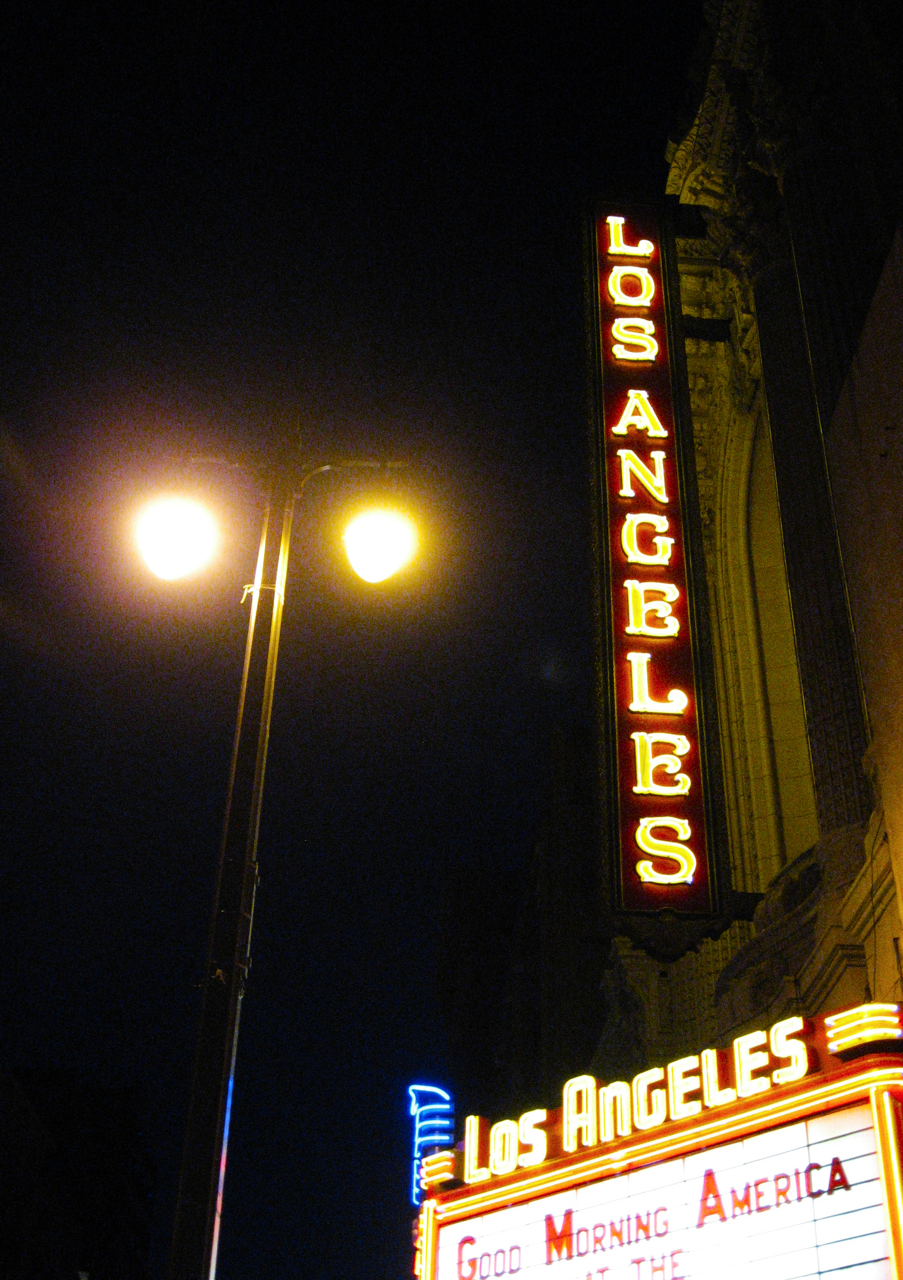
Los Angeles Theater. Photo: Reinhard Kargl, 2010



Journalist and media professional currently based in Los Angeles, California. Focusing on science and technology.

Los Angeles Theater. Photo: Reinhard Kargl, 2010
Journalist and media professional currently based in Los Angeles, California. Focusing on science and technology.

Morris "Dick" Jeppson's only combat mission was aboard the Enola Gay
The story of mankind’s first use of nuclear weapons in war has always fascinated me.
Who were the men who designed and built these weapons? And who were the men who delivered it? How did they personally justify, cope and live with the unspeakable destruction of civilian life, including women and children, caused by their actions?
One by one, the people involved in these events are passing away. With the death of Weapons Specialist Morris “Dick” Jeppson on March 30, at the age of 87, there is only one person from the Enola Gay crew still alive today: Navigator Theodore “Dutch” Van Kirk, who is 89 this year.
On August 6, 1945, it was Jeppson’s job, along with Navy Capt. William “Deak” Parsons, to arm the bomb that ended up destroying Hiroshima, and killing somewhere between 90,000 and 160,000 people within months. (Many others died from wounds and from the effects of radioactive contamination in decades to come).
After the war, Jeppson studied toward a doctorate in physics at UC Berkeley. He working at Berkeley’s radiation laboratory and the Lawrence Livermore laboratory, both here in California.
He also founded a number of companies, including Applied Radiation Corp., which built electron-beam accelerators for nuclear physics research, and Cryodry Corp., a maker of industrial microwave ovens.
Jeppson lived in Carmel, California, and retired to Las Vegas 20 years ago. He did not speak about the bombing in public until 1995, and even then, his comments were laconic: “You had a job to do, you just did it.”
Obituary in the Los Angeles Times
Journalist and media professional currently based in Los Angeles, California. Focusing on science and technology.
Here is a shot I captured during a cocktail hour at Musso & Frank, one of Hollywood’s legendary old joints. In its heyday it was a popular hangout for the Hollywood scene, including movie stars, film directors, producers and writers such as F. Scott Fitzgerald, William Faulkner and Raymond Chandler. Ernest Hemingway sipped cocktails here, and Orson Welles used to hold court.
Legend has it that Charlie Chaplin, Rudolph Valentino, and Douglas Fairbanks raced each other down Hollywood Boulevard on horseback, the loser having to pick up the dinner tab at Musso & Frank.
This shot takes me to L.A. Noir. Perhaps this is Philip Marlowe‘s hat …
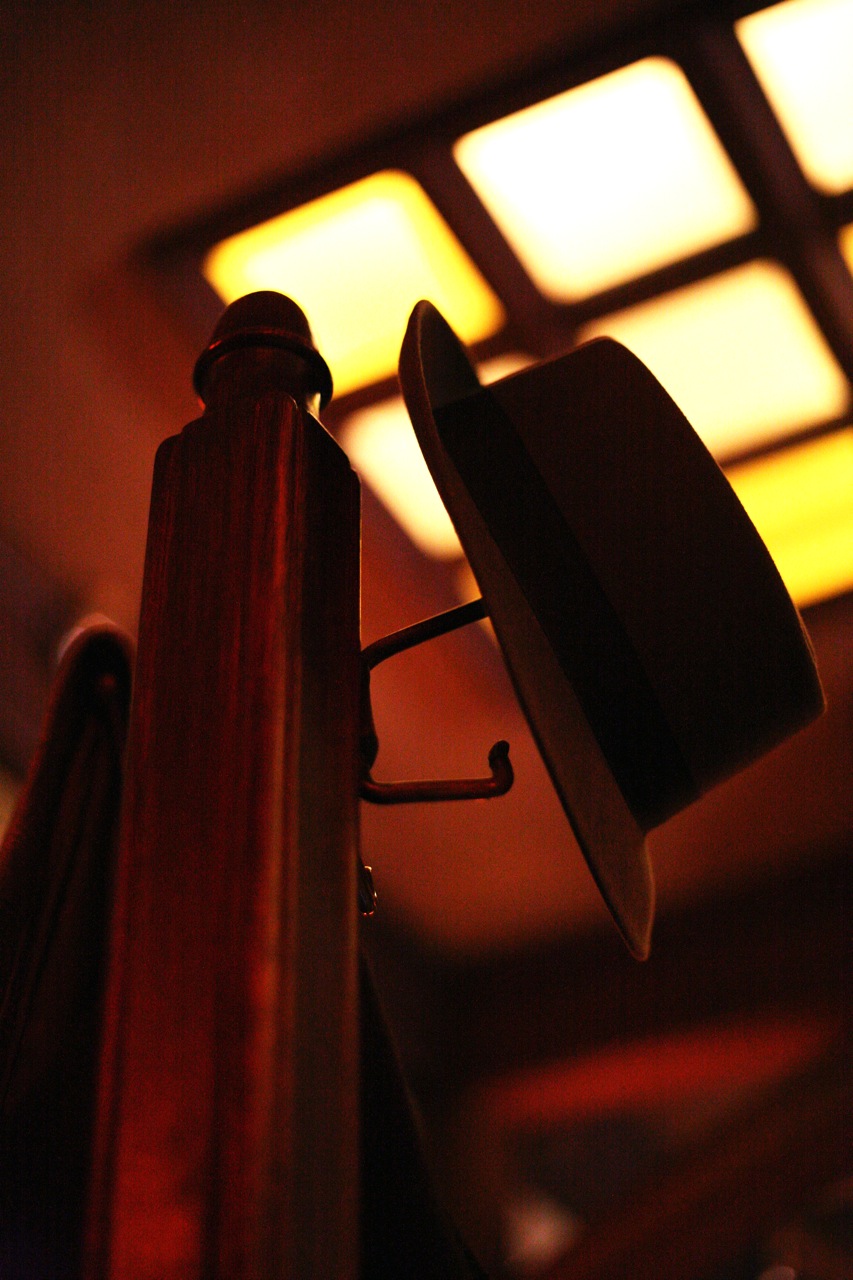
"Marlowe's Hat" • Photo: Reinhard Kargl
Journalist and media professional currently based in Los Angeles, California. Focusing on science and technology.
When I was kid, I often dreamed of attaching a camera to a balloon and flying it as high as it would go. But much to my chagrin at the time, crucial components for such a homemade undertaking were not yet available to the average school boy. At the time, commercial or military guidance systems and suitable cameras were beyond the means of the starry-eyed kid that I was.
Today of course, we have mass produced GPS receivers and cheap digital cameras. And now, Robert Harrison, a British amateur photographer has surprised the world with his stunning images of Earth, taken from the edge of space.
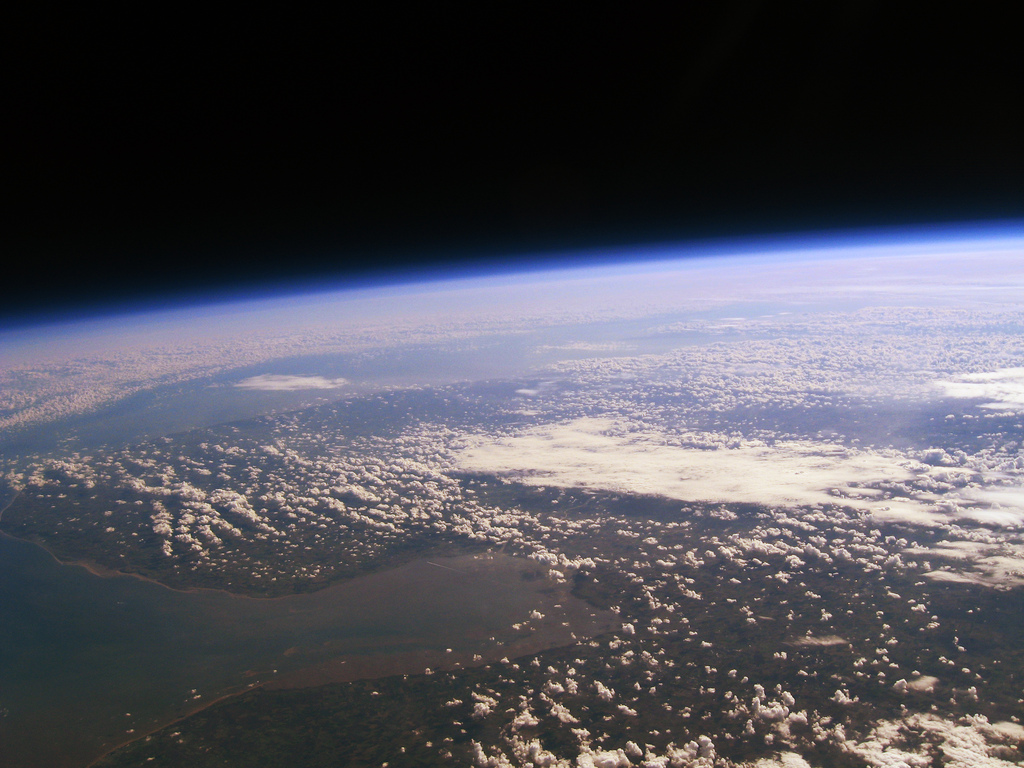
Photo: Robert Harrison
The technology could not be cheaper and simpler: a helium balloon, a simple digital point-and-shoot camera, and a tracking system using a commercial GPS receiver is all Harrison needs to snap amazing pictures. And the marvel of Google Maps allows free flight tracking. All for the combined cost of about $750!
Harrison’s image gallery is here, and his personal web site is at:
Harrison, a computer engineer, lives in Highburton, West Yorkshire — which strikes me as an unlikely place from which to launch space missions. Since 2008, his contraptions have flown about 20 times. The camera used (a Canon A560) is very similar to one I own.
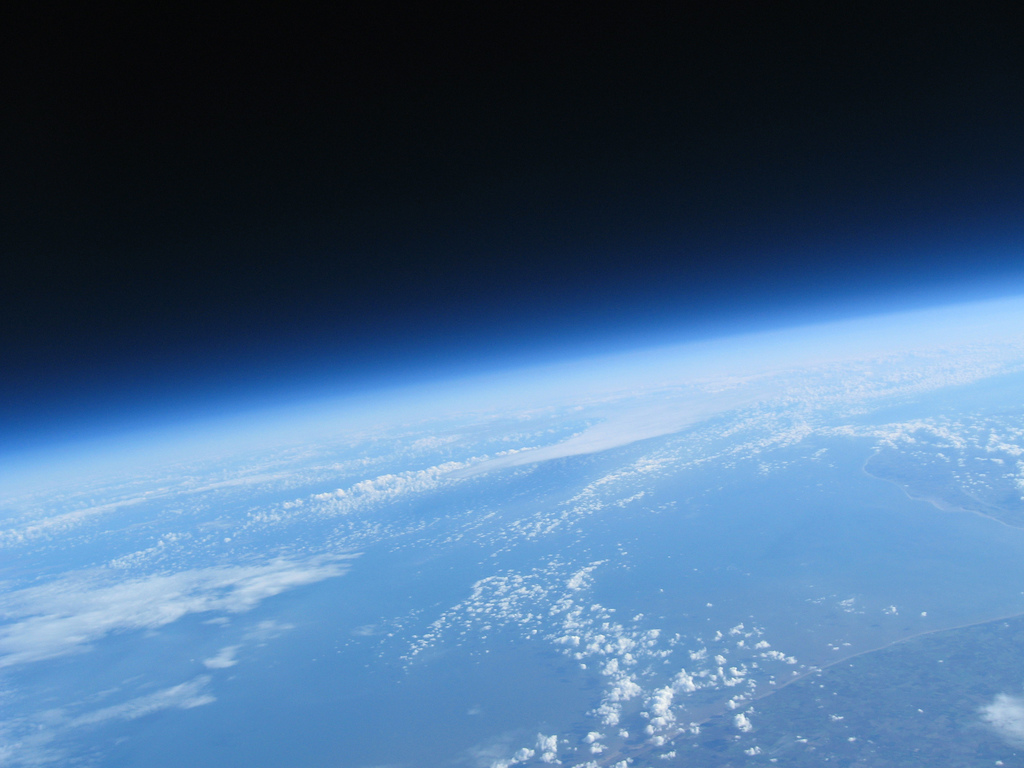
Photo: Robert Harrison
So where does “space” really begin? The question is not so easy to answer, because the Earth’s atmosphere does not simply “end” at a clearly defined elevation. It becomes gradually thinner. The further away one gets from Earth, an increasing number of air molecules escape the Earth’s gravity and magnetic field and drift away from our planet.
By international convention, “space” is presumed to begin at an elevation of 100 km (or 62.1 miles) — the so-called Kármán Line. Even higher, at 75 miles, space vehicles returning to Earth hit aerodynamic drag. But this is more attributable to the enormous speed at which a vehicle must travel when in orbit. The atmosphere’s density at such elevations is so thin that it is practically qualifies as an almost perfect vacuum.
But there are other definitions of “space”. For example, in the U.S., a person is presumed to be an “astronaut” after traveling 50 miles (or about 80 km) above the mean sea level. By that definition, a number of military test pilots have reached space as early as the 1960s while traveling in winged aircraft, and before many NASA astronauts traveling on ballistic rockets.
Journalist and media professional currently based in Los Angeles, California. Focusing on science and technology.

This is a picture I took at the Huntington Library last week. At first I was not sure if I liked it. But when I was told that the image evoked impressions from one of my favorite poems, I was sold on it.
Here is the poem by Robert Frost, first published in 1916 in the collection Mountain Inverval. (More information can be found here.)
•••
The Road Not Taken
Two roads diverged in a yellow wood,
And sorry I could not travel both
And be one traveler, long I stood
And looked down one as far as I could
To where it bent in the undergrowth;
Then took the other, as just as fair,
And having perhaps the better claim,
Because it was grassy and wanted wear;
Though as for that the passing there
Had worn them really about the same,
And both that morning equally lay
In leaves no step had trodden black.
Oh, I kept the first for another day!
Yet knowing how way leads on to way,
I doubted if I should ever come back.
I shall be telling this with a sigh
Somewhere ages and ages hence:
Two roads diverged in a wood, and I—
I took the one less traveled by,
And that has made all the difference.
•••
Journalist and media professional currently based in Los Angeles, California. Focusing on science and technology.
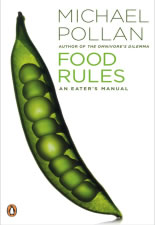
Most of us are trying to become more conscious about what we put into our mouths. In the age of industrially manufactured, synthetic “food”, all-you-can eat buffets and heavily advertised junk available around the clock, it’s not always easy to separate the fad from the food.
Journalism professor and bestselling author Michael Pollan just came out with a concise paperback guide consisting of 64 simple, universal rules. These can be read in less than 20 minutes and are easy to understand and memorize.
At a suggested retail price of $11, Food Rules: An Eater’s Manual is a bargain. (Publisher: Penguin Paperback, 112 pages, ISBN-13: 978-0143116387)
Pollan is also the author of the highly acclaimed The Omnivore’s Dilemma: the Secrets Behind What You Eat and In Defense of Food: An Eater’s Manifesto.
Journalist and media professional currently based in Los Angeles, California. Focusing on science and technology.

Lanters hanging at Hsi Lai Buddhist Temple during the last day of Chinese New Year. Photo: Reinhard Kargl
Journalist and media professional currently based in Los Angeles, California. Focusing on science and technology.
Not even the nuclear industry claims with a straight face that it could ever be cost efficient without massive government subsidies. Last week the White House answered the nuclear lobby’s call in the form of loan guarantees for “a new generation of safe, clean nuclear plants”. For this, Obama has earmarked $36 billion.
But what about nuclear waste storage options? More than half a century has passed since the first nuclear power plants became operational. And yet, we don’t even have any options on where to stick existing nuclear waste in the long term. And we have essentially no plans for waste from the touted next generation of nuclear reactors.
In the U.S., the nuclear industry has been eerily absent from this discussion. Because for reasons that are beyond strange, the industry is not responsible for the permanent storage of the waste it generates. The federal government (read: the taxpayer) is.
Not surprisingly, the government has been handling this problems with the same acumen it handles all other huge undertakings. First, a huge bureaucracy was created. It was then paralyzed by congressional infighting, partisan divisions, various lobbies, rebelling states (neither of which is keen to become the radioactive dumping ground for the entire nation) and political posturing. Add to that campaign contributions in one form or another and one arrives at a predictable political quagmire.
Precise figures are not obtainable, but it has been estimated that $14 billion have been spent on project “studies” since 1983. That’s just for “thinking” about options. The result? We are no closer to a long term storage solution than we were decades ago. The proposed Yucca Mountain repository for high level waste is all but dead. The proposed 2011 budget contains no funding for it. And even if the Yucca Mountain project would be revived over the objection of many geologists who consider the site unsafe, it would not have enough capacity. Not to forget that it would cost the taxpayer more than $100 billion to build and operate!
So we continue to have nuclear waste sitting in interim storage on hundreds of reactor sites across the United States — a huge security risk, but the only option we have had for decades. And the only option available for the foreseeable future.
At a symposium during last week’s annual meeting of the American Association for the Advancement of Science in San Diego, California, geologist Allsion Macfarlane (George Mason University, Virginia) put it this way: The U.S. should consider “moving waste management out” of the federal government’s hands, perhaps into a public-private partnership. (And why not make the nuclear industry entirely responsible for the cost of nuclear waste management? After all, that’s what we demand of other industries).
While given past experiences on this issue would seem to make Macfarlane’s suggestion a logical step, I remain skeptical that consensus on a sound, cost efficient and safe solution will be found before radioactive waste from the proposed new generation of nuclear plants needs disposal.
So let’s not fool ourselves with talk about “options” when there are none in sight.
Journalist and media professional currently based in Los Angeles, California. Focusing on science and technology.
Some inventions fly all over the planet. One such thing is the Frisbee, whose inventor, Walter Fredrick Morrison passed away at the age of 90 last week.
Since the 1950s, hundreds of millions of people (and their dogs) have been enjoying the flying discs. The original mass manufacturer, the American toy company Wham-O Inc., has sold more than 200 million of them. In addition, there must have been hundreds of millions of knockoffs made all over the world.
I grew up in Europe. My personal introduction to the Frisbee arrived with Kirk, an American exchange student from Ohio, who stayed with us at my parents’ house. To me as a boy, Kirk seemed very cool and very mature.

Childhood memories: Kirk in my parents' backyard, demonstrating proper Frisbee technique. It's all in the wrist!
Inventor Fredrick Morrison’s family moved from Utah to California when Fred was 11 years old. In 1937, he and his girlfriend Lucile began tossing a large popcorn lid back and forth. It seemed like a fun thing to do at a Thanksgiving party. The fun soon continued at Santa Monica Beach, where the couple switched to tossing a cake pan.
Californians are always quick to pick up a trend. When another beach-goer offered Morrison a quarter for the cake pan, it dawned on him that he had a business. (A cake pan cost just a nickel, thus allowing a hefty margin). Soon, Morrison and his girlfriend were selling cake pans at the beach.
They married in 1939. Soon afterwards, Morrison was off to the war. He served in the Army Air Force as a P-47 Thunderbolt pilot in Europe, was shot down and spent 48 days as prisoner of war.
Back home in 1946, Morrison used his aviator’s knowledge to sketch a more aerodynamical disc, which he called the Whirlo-Way. With experiments and experience, the discs’ shape was further improved and resulted in the Pluto Platter of 1955. Two years later, Morrison sold the patent to Wham-O Inc., also known for the Hula-Hoop a dozen other wacky toys. It was Wham-O that came up with the name “Frisbee” – which Morrison first resented but then (after receiving more than $2 million in royalties) made peace with.
And that’s the story!
I’m not sure what happened to Kirk after he left. But the Frisbee he gave me, made from indestructible plastic, might still be found in my parents’ basement somewhere.
_______________________________________________________
Journalist and media professional currently based in Los Angeles, California. Focusing on science and technology.
This has been a full weekend.
Friday night, I attended a screening of Buster Keaton’s 1928 silent movie Steamboat Bill, Jr., surrounded by historical instruments at the Nethercutt Collection. The Nethercutt not only has a world renowned collection of classic cars, but also restores and exhibits historic reproducing pianos, Nickelodeons, phonographs, striking watches, Orchestrions, cylinder and disc music boxes. The engineering of these things has always fascinated me. Dean Mora, a top expert for 1920s and 1930s music, performed on the Mighty Wurlitzer Theatre Pipe Organ. (The instrument in the Nethercutt Collection is one of the largest of its kind).

Detail of the Nethercutt's Mighty Wurlitzer Pipe Organ. Photo: Reinhard Kargl
Saturday night, friends and I spend time observing the night sky in the mountains outside of Los Angeles. (The mountains of Southern California still have relatively dark sites in proximity to populated areas).
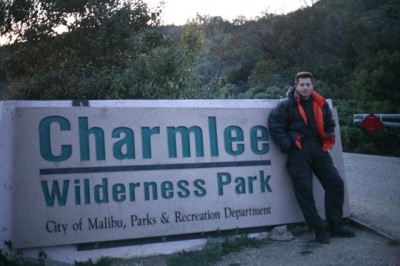
At the entrance to Charmlee Park in the Santa Monica Mountains, California.
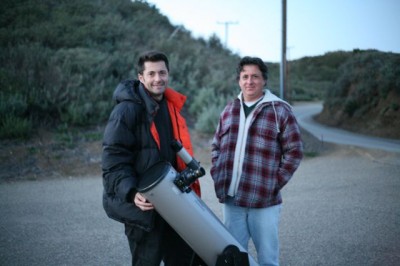
With SMAAC founder Robert Lozano and our Newtonian refractor.
Back in the city after midnight, I accidentally ran over a small shaggy dog! Luckily, the animal was not hurt — just tremendously frightened. I noticed the dog had a collar tag, but each time I tried to approach him, the terrorized animal tried to bite me. With lots of patience and smooth talking, I was able to inch closer and closer until he finally allowed me to inspect his collar tag. Finally, an address! Together with my friend Thor, who happened to have a pet crate in his nearby apartment, I sat out on a mission to find the dog’s owner. (Getting the dog into the crate was another problem to be solved. I was bitten, but my leather gloves prevented an injury).
After some difficulties, we were ultimately successful. I ended up banging on doors in a bleak, gang infested, rough neighborhood where hardly anyone spoke English. This generally is not a bright idea in the middle of the night.
But it was all worth it. Roused residents at the building (who at first probably thought we were immigration agents or police officers) directed us to the right apartment and ultimately, to the dog’s family.
It turned out the dog had been lost two days ago and had since been wandering some of the roughest streets of Los Angeles. Happy ending for one dog and his overjoyed family – including a very cute (and very sleepy) little girl in pajamas.
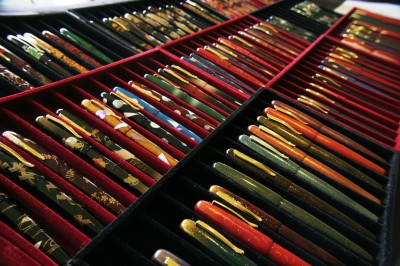
Photo: Dave Gooley
Being a writer, I have a fascination with fine fountain pens. So on Sunday, I attended the annual International Fountain Pen Expo in L.A./Manhattan Beach. Each year, traders, collectors and pen aficionados from all over the world get together to exchange information and trade in vintage and new writing instruments, inks, accessories and ephemera. All of these are prized collectors items.
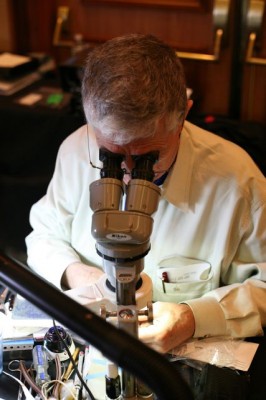
Photo: Reinhard Kargl
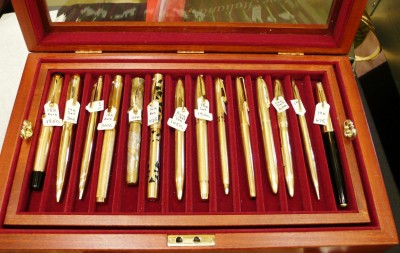
Vintage fountain pens for sale. Photo: Dave Gooley
Journalist and media professional currently based in Los Angeles, California. Focusing on science and technology.