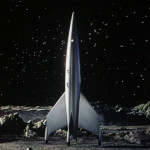
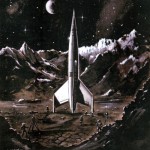
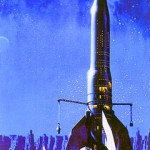
Vertically landing rockets have been a staple in science fiction for a long time:
And in the 1960s, Wernher von Braun’s Saturn team was already intensely thinking about outfitting future versions of the Saturn V with reusable stages. Among the many concepts studied were a winged flyback version and a parachute-assisted return. Unfortunately, these ambitions never went beyond the drawing stages. While closing down the Apollo program, NASA made the fateful (and as we now know, mistaken) decision to pursue the Space Shuttle as NASA’s exclusive launch vehicle. The vehemently protesting Wernher on Braun was sidelined and “kicked up” into a senior administrative position with little real decision making power. (Disappointed and unsatisfied, he left NASA a few years later). Since then, astronauts have been confined to low Earth orbit, going essentially nowhere but in circles.
It took almost five decades for the reusable rocket concept to return and become reality, and it was neither NASA nor any other national space program, but two private companies which accomplished the first proof-of-concept.
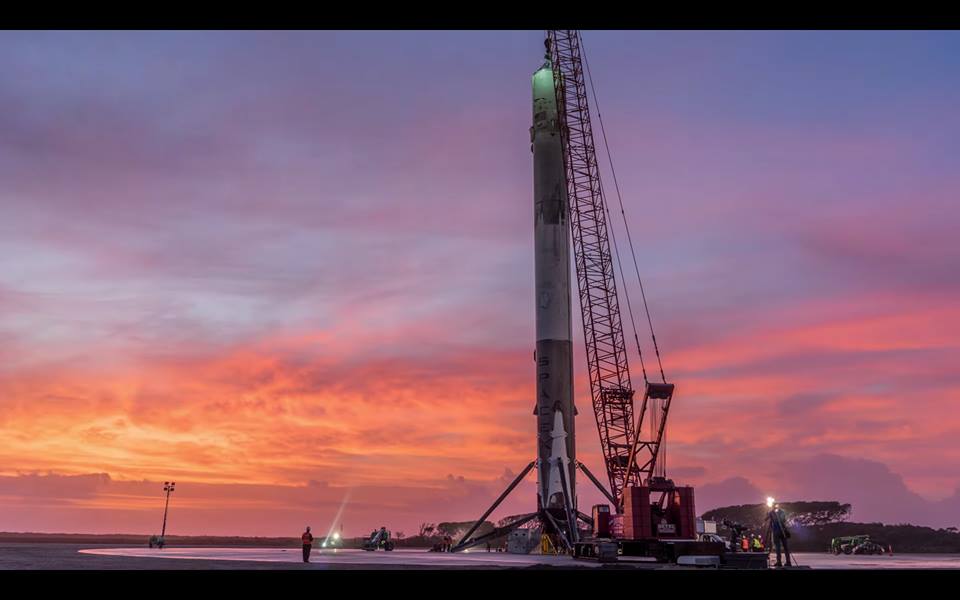
In November 2015, Blue Origin had successfully landed an experimental test rocket at its launch site in West Texas. It plans to use the rocket again. And on December 21, 2015, California based SpaceX successfully launched a Falcon 9 rocket to space while returning and landing the rocket’s 1st stage to the launch site for a powered, vertical landing. For the first time a rocket has been successfully landed during a commercial satellite launch.
The concepts used by the two companies are very different, as illustrated here:
The end result result of the SpaceX flight is certainly stunning and resembles what science fiction described so many decades ago:
It now remains to be seen if recovering and refurbishing an entire rocket stage and its engines is indeed cheaper than building a new one — something that hasn’t been tried on a commercial scale. But if Wernher von Braun was right (and he usually was), this should be the way to go.
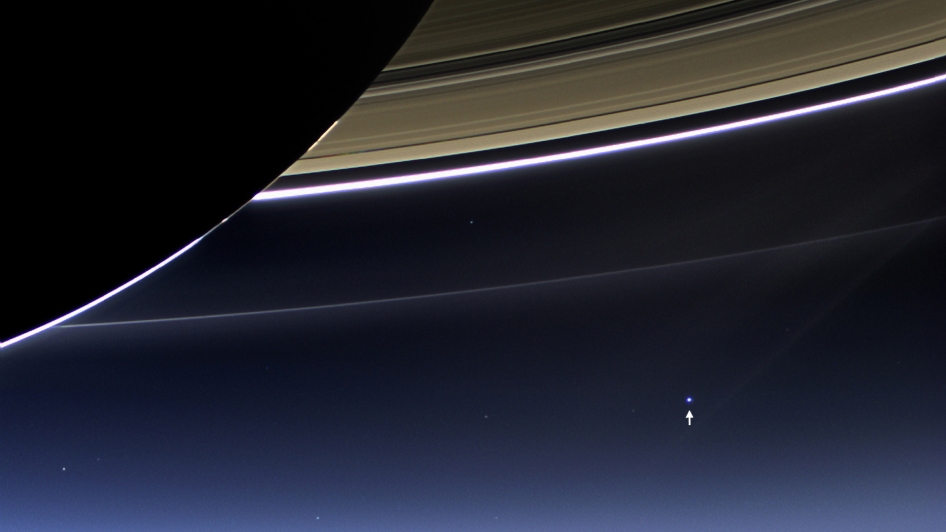
This picture shows us. All of us on planet Earth. All 7 billion human beings contained one tiny dot of light.
(Click to enlarge)
In this rare image taken on July 19, 2013, the wide-angle camera on NASA’s Cassini spacecraft has captured Saturn’s rings and our planet Earth and its moon in the same frame. It is only one footprint in a mosaic of 33 footprints covering the entire Saturn ring system (including Saturn itself). At each footprint, images were taken in different spectral filters for a total of 323 images: some were taken for scientific purposes and some to produce a natural color mosaic. This is the only wide-angle footprint that has the Earth-moon system in it.
The dark side of Saturn, its bright limb, the main rings, the F ring, and the G and E rings are clearly seen; the limb of Saturn and the F ring are overexposed. The “breaks” in the brightness of Saturn’s limb are due to the shadows of the rings on the globe of Saturn, preventing sunlight from shining through the atmosphere in those regions. The E and G rings have been brightened for better visibility.
Earth, which is 898 million miles (1.44 billion kilometers) away in this image, appears as a blue dot at center right; the moon can be seen as a fainter protrusion off its right side. An arrow indicates their location in the annotated version. (The two are clearly seen as separate objects in the accompanying narrow angle frame: PIA14949.) The other bright dots nearby are stars.
This is only the third time ever that Earth has been imaged from the outer solar system. Continue reading →
Congressman Kevin McCarthy has recently introduced a bill (HR 6612) to change the name of the NASA Dryden Flight Research Center in California’s Mojave Desert to “Neil A. Armstrong Flight Research Center”.
Although I greatly admire Neil Armstrong (who doesn’t?), I am opposed to the proposed name change. One reason is tradition, and another: The world does not need one more reminder of the first man on the moon. Every literate person knows who he was. But we should keep a reminder of the very significant and essential contributions of space pioneer Hugh L. Dryden, with whom the general public is less familiar. (Armstrong himself would be the first to point out that getting to the moon was a gigantic team effort and impossible to achieve without the likes of Dryden).
In an article posted on the Smithsonian Air & Space magazine’s web site, Paul Spudis makes a much more informed plea for Dryden than I ever could. Please read it here:
I believe Wernher von Braun was completely right when he suggested, in the 1960s, that a manned Mars landing would require nuclear propulsion. (Incidentally, Sergei Korolev, von Braun’s Soviet counterpart, reached the same conclusion). Had the United States Congress implemented von Braun’s suggestions, we would have astronauts on Mars by now — or at least we would have the technical ability for it. Unmanned Mars landers and spacecraft sent to explore the outer planets would also carry much larger scientific payloads.
Unfortunately, a confluence of several factors ended the nuclear space age before it even began. Although there were projects to develop small nuclear reactors, the main impetus didn’t come from NASA, but from the military. The US Navy wanted scaled down power reactors to drive its latest generation of submarines and aircraft carriers. For a while, the US Air Force also studied nuclear propulsion to power long range bombers. Not surprisingly, this idea was abandoned due to safety concerns and after it was realized that ICBMs, not long range bombers, would be the main thrust of nuclear deterrence.
A strong military involvement, and the secretive culture of the Atomic Energy Commission as well as the US nuclear weapons labs, meant that much of the research into small nuclear reactors was highly compartmentalized and classified. Especially during the Cold War, nearly everything containing the word “nuclear” also had a “national security” tag attached.
The secrecy also meant that many of America’s leading scientists and engineers had no access to the most important research papers in the field. This led to a lack of scientific discourse among space experts, few of whom would be pushing for a technology about which they knew no technical details. It also meant that very few political leaders fully understood the potential and necessity of nuclear propulsion in space. In addition, there was the question of which reactor technology to advance. As it happened, the US Navy prevailed in its pursuit of a reactor type suited for marine applications, but ill suited for space travel, where no external cooling medium is available.
Still, as director of Marshal Space Flight Center, von Braun’s word carried weight. Linking together NASA, the Atomic Energy Commission (AEC) and Los Alamos National Laboratory (LANL), the newly created Space Nuclear Propulsion Office took over the previously launched (and classified) AEC directed Project Rover.
“Project Rover could be divided into three phases: Kiwi, between 1955 and 1964, Phoebus, taking place between 1964 and 1969, and Pewee, taking place between 1969 and the project’s cancellation along with the cancellation of the NERVA rocket at the end of 1972,” writes James Dewar in “To The End Of The Solar System: The Story Of The Nuclear Rocket” (University Press of Kentucky, 2003; Apogee Books, 2008). “Kiwi and Phoebus were large reactors; Pewee 1 and Pewee 2 were much smaller and they conformed to the smaller budget available after 1968. Both Kiwi and Phoebus became part of the NERVA program.”
Many of the papers and background stories relating to all aspects of these programs remain classified and unpublished to this day. At least in part, this could be attributed to self-protective motives of the various entities involved. There is little question that many errors were made in the course of these programs, and that some of them led to serious incidents, mishaps, wasteful spending and questionable decisions.
For instance, in a highly classified test in 1965 at Jackass Flats (an area within the Nevada Test Site), a reactor core was allowed to overheat and explode. The event was recorded by high-speed cameras.
When the reactor blew itself to smithereens, bits and pieces of highly radioactive debris were ejected over 2,600 feet into the sky. Aircraft flew through the debris cloud to take samples. The cloud drifted east at first, then west toward Los Angeles. To this day, the full set of radiation measurement data remains secret.
One minor problem: the test was a violation of the 1963 Limited Test Ban Treaty with the Soviet Union. (But one could of course argue that it was merely an “accident”). What goes up, must come down, and radioactive debris rained back down over a wide area.
Five months later, in June of 1965, a nuclear rocket engine code-named “Phoebus” suddenly overheated and exploded. Large chunks of radioactive fuel were ejected, and what was left of the reactor fused into a highly radioactive, hot pile.
Of course, such incidents provided a welcome opportunity to conduct “decontamination exercises”. From whatever can be learned out of declassified documents, the “cleanup process” took 400 people and two months. Almost 50 years later, the entire area around Jackass Flats is strictly off limits to the public.
Were the radioactive fireworks shows necessary? Perhaps, given the circumstances, the knowledge base and needs of the time. But this certainly did nothing to advance the concept of nuclear propulsion for spacecraft. And it did not exactly alleviate the fears of taxpayers that such programs tend to be out of control, over budget, irresponsible, lacking oversight, and of questionable value to the public. As a result, politicians generally find it difficult to justify and back such programs before the public, which is why they often can only exist in secret. In turn, this creates a hopeless feedback loop.
Despite its problems, NERVA was considered widely successful in achieving its technical objectives. But in the end, it was killed when the funding spigot closed off the flow of cash.
In a first blow, the incoming Nixon administration slashed NASA’s budget dramatically. The remaining Apollo moon landings were canceled, even though the hardware for them had already been built and all personnel and infrastructure were in place. Worse: the new administration and others in NASA’s leadership maneuvered von Braun into a rather innocuous desk job. In plain terms, he was pushed aside by internal power struggles. Overruling his objections, NASA decided to cancel the entire Saturn rocket program — a decision I consider to be the worst blunder in the entire history of human spaceflight.
Now lacking a large launch vehicle to lift large payloads to Earth orbit, there was no more way to the Moon or beyond, and there was no way to launch a nuclear-propelled spacecraft to Mars or elsewhere.
Meanwhile, the Soviet Union (and later, Russia) pursued a more steady course with its TOPAZ and ENISY reactors — although the objectives were different from NERVA. The most important objective behind these Soviet programs was the generation of electricity, not thrust. The US had, and probably still has, similar secret programs to develop small reactors for powering spacecraft.
What is publicly known is that the Soviets flew some of their systems in space on a large scale — with rather mixed results. There is less public information about US reactors flown in space. On April 3, 1965, SNAP-10A was launched from Vandenberg AFB in California into an unusual, retrograde orbit. After 43 days, a voltage regulator aboard the satellite failed, and the reactor was shut down. The satellite was left in a 1300 km high orbit. It is of some concern, because it has shed debris after some event — possibly a collision or meteorite hit — in 1979.
As part of Upravlyaemy Sputnik Aktivnyj (Russian: Управляемый Спутник Активный), or US-A, the Soviets launched 33 reactors aboard Earth-observing radar satellites in low Earth orbit. In addition, the Soviets are known to have launched at least two larger (6 kW) TOPAZ reactors aboard their Kosmos 1818 and Kosmos 1867 satellites.
Russian satellites were generally designed to either eject their radioactive components, or boost the entire satellite, into a “safe” storage orbit further away from Earth. To make a long story short: the reliability record of this technique has been abysmal. In quite a few cases, radioactive debris was either lost in orbit or re-entered the atmosphere. In some instances, radioactive debris fell back to Earth.
This brings me to a question often asked: isn’t it generally extremely dangerous to strap a nuclear reactor on a gigantic, possibly malfunctioning rocket? The answer is a little complex and could fill a book.
In simple terms, here is what I believe: when used for interplanetary travel (as opposed to use in near Earth orbit), the risks are quite manageable. As Wernher von Braun suggested, a reactor for spacecraft propulsion would be sent to orbit “cold”, on a conventional rocket. In this first stage of the trip, the reactor fuel would be tucked away in a strong safety container. Only when the spacecraft is at a safe distance from Earth would the reactor be made operational and start up for the first time. It is only then when the most dangerous, radioactive results of the fission reaction are produced.
After its initiation, the reactor core would remain in space and never return to Earth. However, by sending it on a return orbit around the Sun, it would even be possible to reuse it for multiple missions, for example to “cycle” spacecraft from Mars to Earth and back. (Buzz Aldrin has been fervently advocating one such concept, the “Aldrin Cycler”).
The arithmetics for a manned mission to Mars have not changed since von Braun’s time. As he pointed out, relying on chemical fuel for the interplanetary journey soon becomes a case of diminishing returns. The reason is that it takes a huge amount of rocket fuel to get the payload on course to Mars in the first place. The longer the journey takes, the heavier the load of supplies to be carried for the astronauts. And on the return trip, more fuel is needed, the weight of which has to be figured into the total mass of the outward bound mass.
By means of its very high power-to-weight ratio, a nuclear reactor can reduce the mass to be transported to and from Mars by a significant amount. And it might be possible to speed up the trip, so that fewer supplies and less shielding against cosmic radiation are necessary.
So where do we stand?
Electricity generating, small nuclear reactors like the Russian TOPAZ could be used as part of a propulsion system, possibly employing some type of ion engine. Perhaps these could even be scaled up to a certain degree. But since ion engines provide only low (yet steady) thrust, they are best suited for unmanned spacecraft in which travel time is not as important a factor.
Los Alamos National Laboratory has recently introduced a clever, innovative nuclear power generator for spacecraft:
An interesting idea, but again: even scaled up, this is still a low-power concept.
For serious human travel to Mars and beyond, a much more powerful reactor and propulsion system would be needed — something similar to NERVA. And this is just what von Braun already knew 50 years ago. Trying to make plans to land humans on Mars without an available nuclear propulsion system amounts to putting the cart before the horse.
If you have questions or information about this subject, or if you would like me to write about it for a commercial publication, please e-mail me.
This week has been very exciting for the entire aerospace community. Sleep patterns are being severely disrupted! It all began with the successful launch, after a dramatic abort two days earlier, of the SpaceX Dragon: the first commercially developed space capsule was sent on its way to the ISS, for the first time. You can watch a video of the launch here:
Of course, this is just a test flight, but a very complex undertaking in any case. We should anticipate that some things will not work as planned. The whole purpose of these test flights is to see how the system performs, and to find problems so they can be fixed. It is desirable for problems and weaknesses to be exposed during a test — not later with astronauts on board.
So far, everything is going very well. Dragon is currently flying on a trajectory close to the station. Here is a video from the perspective of the ISS:
In its orbit, Dragon is performing various remotely controlled maneuvers intended to demonstrate that the capsule is fully under control. This is necessary before Dragon will be cleared to fly a close approach to the station, to be captured by the station’s robotic arm. The final decision for the go-ahead rests with Oleg Kononenko, the current commander of the ISS, who is responsible for the safety of the space station and its crew of six.
Here are the milestones for the coming days, from a SpaceX press release:
FRIDAY MORNING – Final Approach, Dragon Grapple
Around 2:00 AM Pacific/5:00 AM Eastern NASA will decide if Dragon is GO to move into the approach ellipsoid 1.4 kilometers around the space station. If Dragon is GO, after approximately one hour Dragon will move to a location 250 meters directly below the station. Dragon will then perform a series of maneuvers to show systems are operating as expected. If NASA is satisfied with the results of these many tests, Dragon will be allowed to perform the final approach to the space station.
Sometime around 6:00 AM Pacific/9:00 AM Eastern, astronauts on the space station will grapple Dragon with the space station’s robotic arm and the spacecraft will attach to the station.
SATURDAY MORNING – Hatch Opening
If all goes well, at approximately 2:00 AM Pacific/5:00 AM Eastern, the crew will start procedures to open Dragon’s hatch. It will take around 2 hours to complete all operations leading to the hatch opening. Once the hatch is opened, astronauts will enter Dragon for the first time in space.
All dates and times are approximate and could easily change.
NASA TV is covering many of these events. NASA and ESA both maintain web sites for the ISS:
This is one of the two existing Shuttle Carrier Aircaft (SCA). This one is aircraft N911NA. The other SCA (N905NA) was spotted by a friend at Washington Dulles Airport the next morning, with Space Shuttle Discovery mounted on top. (Discovery is being delivered to the Smithsonian Air & Space Museum. N911NA is now officially retired at Dryden. It will be used as a “donor” for spare parts for SOFIA).
Mars Science Laboratory (aka “Curiosity”) successfully left Earth this morning. The launch from Cape Canaveral, Florida was perfect:
After a powered flight of almost 12 minutes, the second stage Centaur engine shut down as the vehicle reached a parking orbit at altitudes between 165 and 324 km above Earth. After coasting in orbit for around 21 minutes, the Centaur stage fired again — this time for about 8 minutes. The second burn lifted the vehicle out of Earth orbit and sent it on its way to Mars.
Mars Science Laboratory then separated from the Centaur engine. It has sent back signals indicating that everything on board is exactly as it should be. The eight-month journey to Mars is now underway. Fade in the music! (Incidentally, one of my favorite pieces).
•••
Earlier this year I had a chance to say good-bye to Curiosity a few days before she left the Jet Propulsion Laboratory in California. (Read my account here). These videos show what happened since then.
The Russian Soyuz launch system is now also operating from the European space launch facilities in French Guyana. To the Russians, this location offers a number of advantages.
Located close to the equator, the ESA spaceport can make better use of the Earth’s rotational speed, which is higher at the equator and translates into fuel savings (or performance gains). Secondly, Russia’s main launch sites were built during Soviet times and are now located outside of Russia. (As a result, Russia has been pressured into paying high rent for its continued use of the facilities). And finally, western lawmakers have been lobbied to impose export restrictions on the number of Western satellites shipped for launching from Soviet successor states and China. Although these restrictions and tariffs have been somewhat relaxed lately, commercial launches from the ESA spaceport might avoid the issue altogether.
What ESA and Arianespace stand to gain from the agreement with Russia is not completely clear to me. Certainly, Soyuz will compete against Europe’s Ariane 5 in some aspects. On the other hand, there can be no question that more competition and the removal of artificial trade barriers will be good for spaceflight in general. Perhaps the market will grow so fast that in the end, everyone gets to benefit.
Here is a fascinating time lapse video showing how the Soyuz system works. (It is very different to Western systems).
In a tweet, astronaut Leroy Chiao (@AstroDude) called today’s crash of the Russian cargo transport to the ISS a “big damn deal”. My take: no, it aint. Or at least it shouldn’t be.
Just launch another one. (Better yet: always have at least another one on standby, preferably at a different launch site).
I know I am simplifying, but: the loss of Progress M-12M (44P) is the first loss after 43 successful supply flights to the ISS, and after a total of 134 successful flights of this vehicle. Nobody was hurt in the crash, and the launch complex and gantry remain fully intact. A failure rate of under 1% should be acceptable for unmanned ships. Even with occasional misfirings like this, a disposable launcher is still a lot cheaper than the shuttle.
To me, this demonstrates why unmanned transports remain the way to go. Had this been a manned shuttle, an accident would have meant a disastrous loss of life. And the shuttle fleet would have been grounded once again. Years would have to go by for the accident to be fully investigated, and for design and procedural changes to be worked out and implemented. Employing astronauts as cargo truck drivers was an absurd idea to begin with. (Wernher von Braun knew this before the shuttle was even flight ready — I wish NASA had listened).
By contrast, an unmanned supply ship is basically a throwaway device anyhow. Yes, it’s not nice to have rocket parts falling down somewhere. This can seriously spoil the day if you happen to be at the impact site. But flight routes and launch facilities can be chosen to minimize the risk of someone actually getting hurt. Basically, one can write off the vehicle as a loss and launch another one.
However Chiao is completely right about it being a huge blunder to rely on only one vehicle for ISS cargo. NASA made another mistake here. Delta IV and Atlas V should have been purposed for cargo flights a long time ago, but those vested in the shuttle project always understood how to derail such proposals. (Interestingly, the military made the right decision by abandoning the shuttle a long time ago; the military space program has completely switched to reliable throw-away rockets instead).
Fortunately, ESA’s Automated Transfer Vehicle (launched on European Ariane V) is practically ready to assume full operations. The ATV happens to have three times the cargo capacity of Russia’s Progress.
And let’s not forget SpaceX. Its second test launch of the Dragon capsule is scheduled for November. Things went so well the first time around that the second flight has already been is expected to be cleared to go to the ISS.
This is all great news. We all know what happens when there is competition.
Still, the Progess crash spells potential trouble for the ISS. The reason points to another NASA blunder. For safety reasons, Soyuz capsules must remain docked to the ISS at all times. This is so that astronauts can evacuate in an emergency. But these capsules are only certified to remain reliable for 200 days, after which they must be used or replaced. Because the Soyuz launch vehicle (which also launches Progress supply ships) is now suspended pending the investigation, no new Soyuz ships can be launched at the moment. This means that the ISS may have to be evacuated, because the scheduled Soyuz replacements are disturbed.
Why is this a NASA blunder? Because NASA has failed to come up with an alternate return capsule before the shuttle’s retirement. (Projects have been in the works, but faced delay after delay as NASA was concentrating on keeping the shuttles spaceworthy. There were also proposals for emergency return vehicles, which could have been launched via shuttle or by disposable rockets, but NASA decided not to proceed with these programs).
So we arrive at the current status: No way for people to fly to the ISS or back at this time, except on Russian Soyuz vehicles! And these are grounded at the moment.
Update 2011-09-06: It now appears that should the ISS really have to be evacuated, the SpaceX flight to the ISS might have to be postponed, since docking Dragon with an unmanned station is not an option. Instead, an approach and flyby at the unmanned ISS would be conceivable, but SpaceX considers this to be a waste of time and money.