


Journalist and media professional currently based in Los Angeles, California. Focusing on science and technology.
Journalist and media professional currently based in Los Angeles, California. Focusing on science and technology.
It’s been exactly 30 years today since Voyager 1 made its closest approach to Saturn. Its sister ship, Voyager 2, followed closely behind. Curious where they are now?
Voyager 1, which was launched on Sept. 5, 1977, is currently about 17 billion kilometers (11 billion miles) away from the sun. It is the most distant spacecraft launched from Earth. Voyager 2, which was sent on its way on Aug. 20, 1977, is travelling at a distance of 14 billion kilometers (9 billion miles) from the sun.
Both craft have reached the outer regions of the Solar System and are still returning useful scientific data. (Where exactly we should consider the Solar System to end and interstellar space to begin is subject of scientific controversy. Some astronomers take the position that the solar system extends quite a bit further. If the Voyagers continue to radio back measurements, they might contribute to the debate).
The Voyagers were built by the Jet Propulsion Laboratory in California, which continues to operate both spacecraft.
More Voyager information is available at:
http://www.nasa.gov/voyager and http://voyager.jpl.nasa.gov .
Journalist and media professional currently based in Los Angeles, California. Focusing on science and technology.
It looks even more messy than my place!
Journalist and media professional currently based in Los Angeles, California. Focusing on science and technology.
Last night, a small group from our local astronomy organization attended a lecture at NASA’s Jet Propulsion Laboratory.
In this picture, we are posing in front of the Wide Field and Planetary Camera 2, which will soon be residing at the Smithsonian Air and Space Museum.
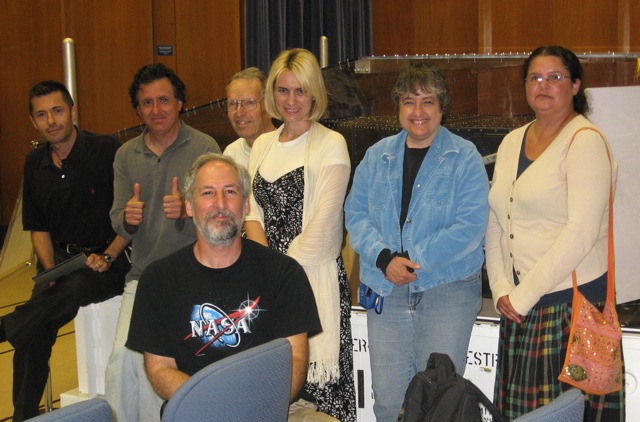
A little bit of history: Soon after its launch in 1990, the orbiting Hubble Space Telescope‘s internal optics proved to be flawed, and the HST seemed doomed. But in 1993, NASA astronauts saved the day by installing the instrument behind us during Space Shuttle mission STS-61. With the addition of this camera, the HST was fully operational. It went on to become one of the most important telescopes in history.
Among the countless, breathtaking images returned by the WFPC2 were the Hubble Deep Field in 1995, the Hourglass Nebula and Egg Nebula in 1996, and the Hubble Deep Field South in 1998.
During Shuttle Mission STS-125, WFPC2 was removed and replaced with the Wide Field Camera 3 as part of the mission’s first spacewalk on May 14, 2009. It was returned to Earth aboard Space Shuttle Atlantis, which landed at Edwards Air Force Base in California on May 24, 2009.
Here are some famous images NASA and ESA made with this camera.
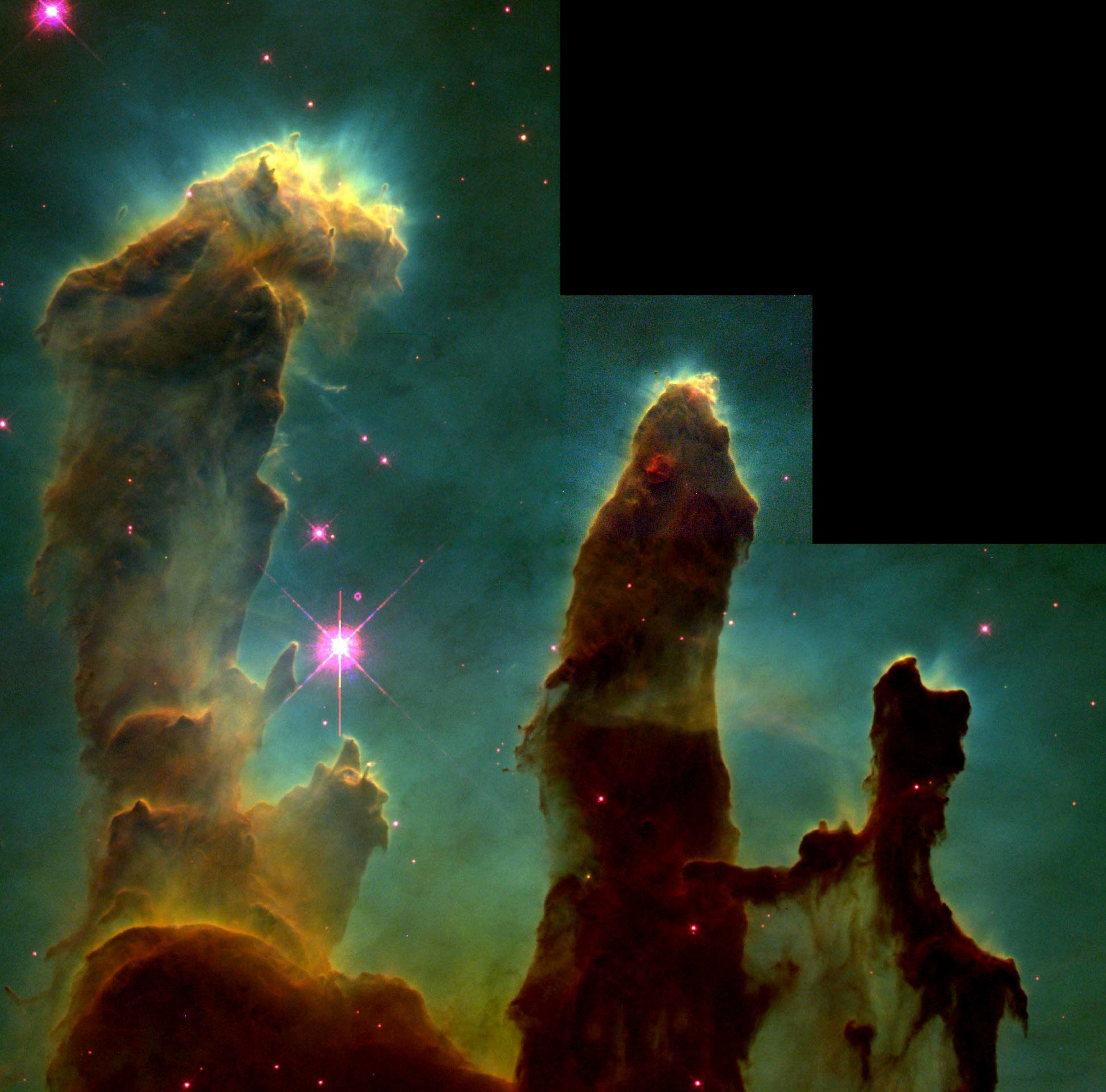
6,500 light years from Earth are the "The "Pillars of Creation" within Eagle Nebula. Columns of gas and dust extend 57 trillion miles (97 trillion km) into space. New stars are forming here! In fact, our own Sun may have come from a structure similar to this. (Click to enlarge).
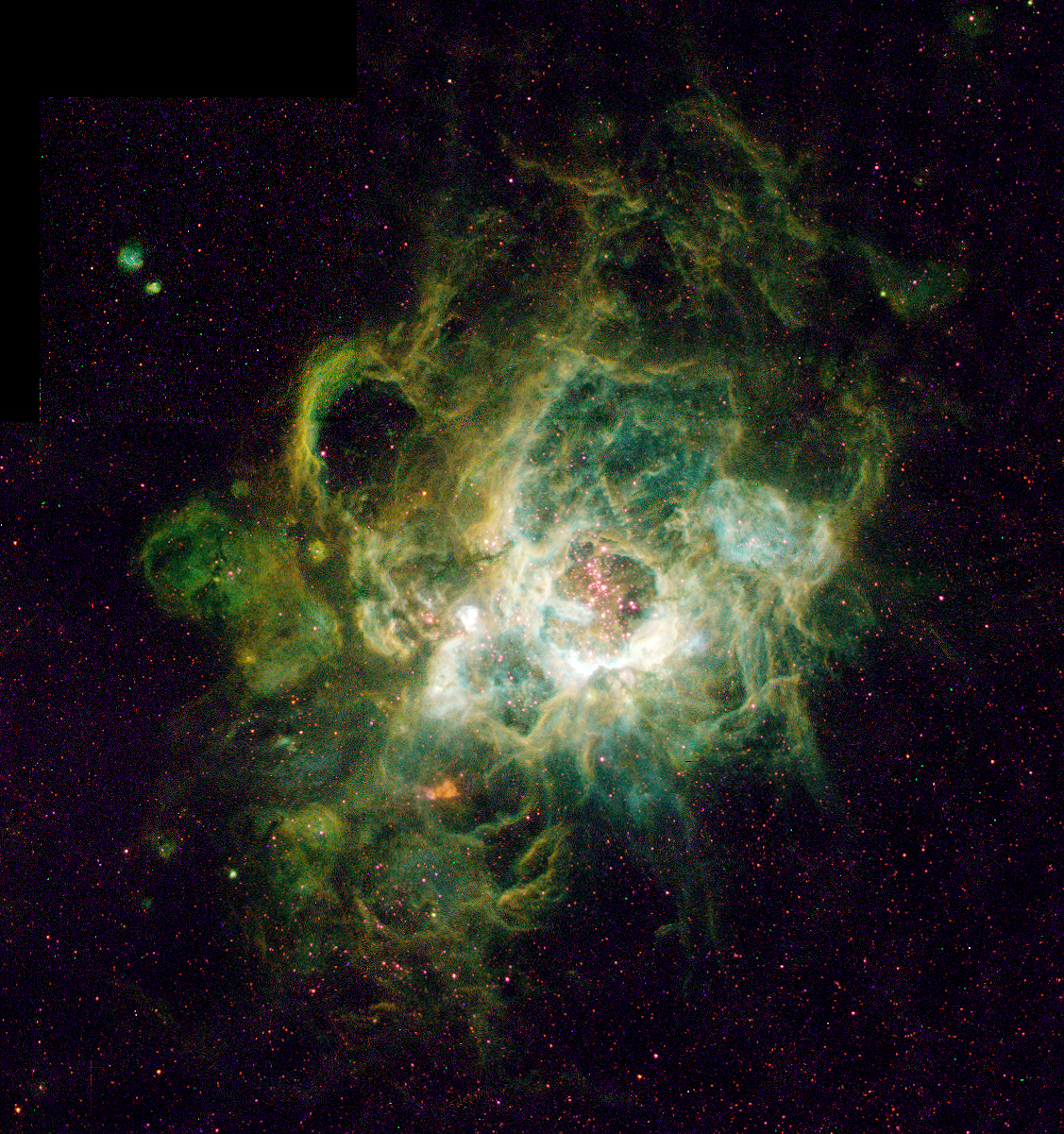
NGC 604, an area in the Triangulum Galaxy about 3 million light years away. In its center are massive stars, which illuminate and ionize gases in this region. New stars appear to be forming here. (Click to enlarge).
Journalist and media professional currently based in Los Angeles, California. Focusing on science and technology.
 The new NASA Administrator, Charles Bolden showed a passionate side in his radio interview with Patt Morrison today.
He gets teary-eyes about the retirement of the Space Shuttle but then turns his eyes toward the future. Bolden, a retired U.S. Marine Corps major general, is a former astronaut who flew on 4 shuttle missions. But despite his feelings, Bolden seems content with the notion that it is time to retire the shuttle and move on by limiting NASA’s role in Earth-orbit launch operations. Which must happen by default anyway, since NASA has no shuttle successor anywhere near the launchpad at this time.
Taking a big step, Bolden conceded that future NASA astronauts will be flying on spacecraft mostly developed and built by private firms.
You can listen to the interview below:
To download the entire audio file, click on Download.
Journalist and media professional currently based in Los Angeles, California. Focusing on science and technology.
Hawthorne / Los Angeles County based SpaceX is celebrating a monumental breakthrough today after a successful first launch of its Falcon 9 rocket.
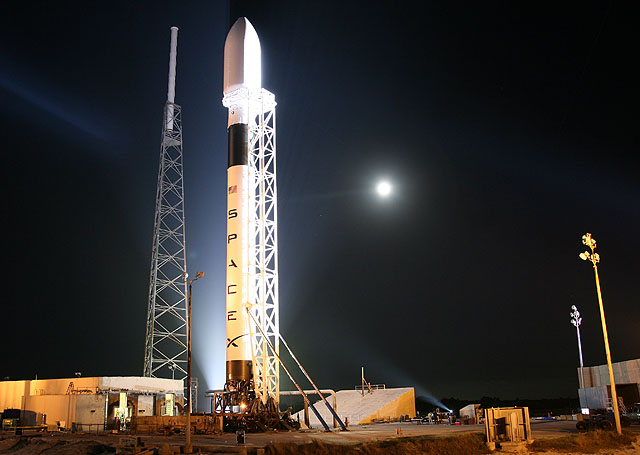
I followed the launch via video feed from Cape Canaveral this morning. At first I was disappointed when the initial launch attempt resulted in a lock-down just at the moment of ignition. I thought for sure it was a scrub. But the launch window was still open. After the countdown clock was reset, everything worked well on the second try. About 10 minutes later, the upper stage with a mock-up of the proposed Dragon crew capsule entered into a low Earth orbit.
This was the inaugural flight of Falcon 9, intended for testing only. What does it mean?
First of all, SpaceX is again proving the doubters wrong. It has shown that a relatively new, relatively small company can successfully design, build and fly a launch vehicle into space. It does so better, faster and cheaper than NASA, which is so stuck in a quagmire of politics, personal maneuvering and a bureaucratic approach to engineering and innovation that it has completely failed to come up with any new launch vehicle in 25 years.
As if it were big news that the remaining three Space Shuttles, with their system history of 25 years of service (and 2 fatal accidents) are more than ready for their final flights to a museum. Nor should it be a big surprise that without the Shuttle and without any alternatives, the U.S. again lacks the capacity for manned flights to space. This means that the U.S. has no autonomous access to the ISS. In 25 years of shuttle operations, NASA could not come up with anything flightworthy?
And the aerospace giants, such as Boeing and Lockheed-Martin? They had no motivation to design anything new and cheaper. For what? To make their existing satellite launch hardware obsolete? Conveniently, they have a captive market for satellite launches. That’s because U.S. law prohibits the launch of many U.S. payloads on foreign launch vehicles. It’s a matter of “national security”, we are told. How come the Europeans are less concerned about that? They all partner with each other and with Russia to launch their payloads.
Manned flights? A crew capsule? Perhaps the aerospace giants could have been given funding to make their satellite launch vehicles (or derivatives) safe enough for human flight. (I suspect NASA and its political backers wanted none of that).
There is an interesting parallel in Formula 1 motor racing. History has shown that small, agile racing teams, with factory sponsorship and with a small, dynamic workforce are overall outperforming teams run by large car manufacturers.
In the crazy world of high-tech motorsports, there is intense competition. Teams must work around the clock to continuously innovate, learn from mistakes, outmaneuver the opponents and adapt to changes. Every race is different, and new challenges (and regulations) appear all the time.
Whoever can adapt the fastest is the most likely to arrive first at the finish line. On the racing circuit, the big car companies are like bulls racing against greyhounds. Not even Fiat-owned Ferrari is an exception. Aware that Ferrari is a national obsession and sacred to Italians, Fiat bosses are smart enough to leave it largely alone. Ferrari’s engineers and technical managers have broad decision making powers and are not micromanaged by the Fiat-Board and bean counters.
Yes, one will often find the name plates of well known automobile manufacturers on engines and other critical components. But this does not mean that Mercedes-Benz or Ford really do the R&D for these highly specialized machines. They often hire contractors — small, agile teams of experts — to solve specific problems and come up with engineering solutions, in the least amount of time. Examples of such specialty engineering firms are Cosworth and Ilmor, both in the UK, and Dallara in Italy.
This kind of structure and engineering management is exactly what is needed if we want to achieve a drop in cost, along with more reliability, in space transportation. NASA, I am afraid, is in its current state incapable of this kind of agile management and risk-taking approach. I speculate that if NASA entered a team in Formula 1, it could be initially competitive by hiring experts from other teams. But it would spend a multiple of other teams to do so and fall behind after a few years. (Oh, how I wish to see everyone on the race track!)
Meanwhile, the future for SpaceX glistens with rocket fuel right now. Of course, one successful launch doth not make a reliable launch vehicle. A lot of further tests will be needed until Falcon 9 could be deemed safe enough to fly humans to the ISS, which is the eventual goal.
If successful, SpaceX will be able to do this in less time and for a lot less money than NASA’s ill conceived Constellation program which, in typical NASA fashion, remains stuck in the mud.
Addendum June 7, 2010: In a press release today, SpaceX claims that it developed the entire Falcon 9 system, the Dragon spacecraft and the launch hardware for what it would cost NASA to build just the Ares 1 launch tower. SpaceX has only about 1,000 employees to date.
Please also see my earlier, related post on NASA’s lingering Constellation program.
Journalist and media professional currently based in Los Angeles, California. Focusing on science and technology.
When I was kid, I often dreamed of attaching a camera to a balloon and flying it as high as it would go. But much to my chagrin at the time, crucial components for such a homemade undertaking were not yet available to the average school boy. At the time, commercial or military guidance systems and suitable cameras were beyond the means of the starry-eyed kid that I was.
Today of course, we have mass produced GPS receivers and cheap digital cameras. And now, Robert Harrison, a British amateur photographer has surprised the world with his stunning images of Earth, taken from the edge of space.
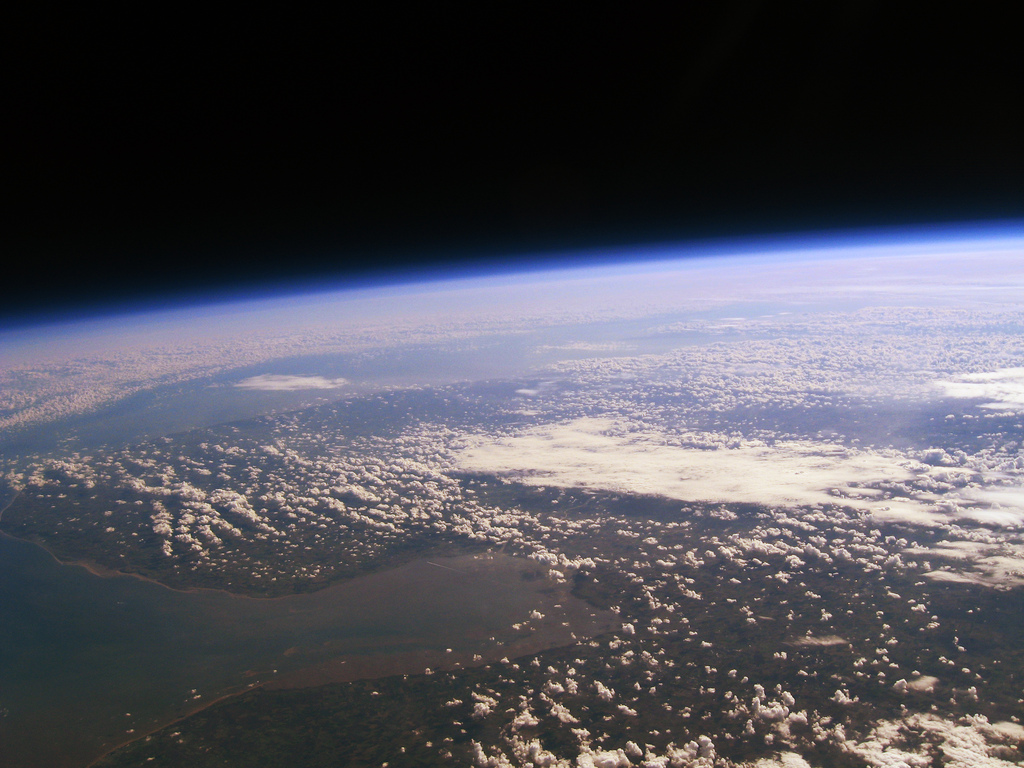
Photo: Robert Harrison
The technology could not be cheaper and simpler: a helium balloon, a simple digital point-and-shoot camera, and a tracking system using a commercial GPS receiver is all Harrison needs to snap amazing pictures. And the marvel of Google Maps allows free flight tracking. All for the combined cost of about $750!
Harrison’s image gallery is here, and his personal web site is at:
Harrison, a computer engineer, lives in Highburton, West Yorkshire — which strikes me as an unlikely place from which to launch space missions. Since 2008, his contraptions have flown about 20 times. The camera used (a Canon A560) is very similar to one I own.
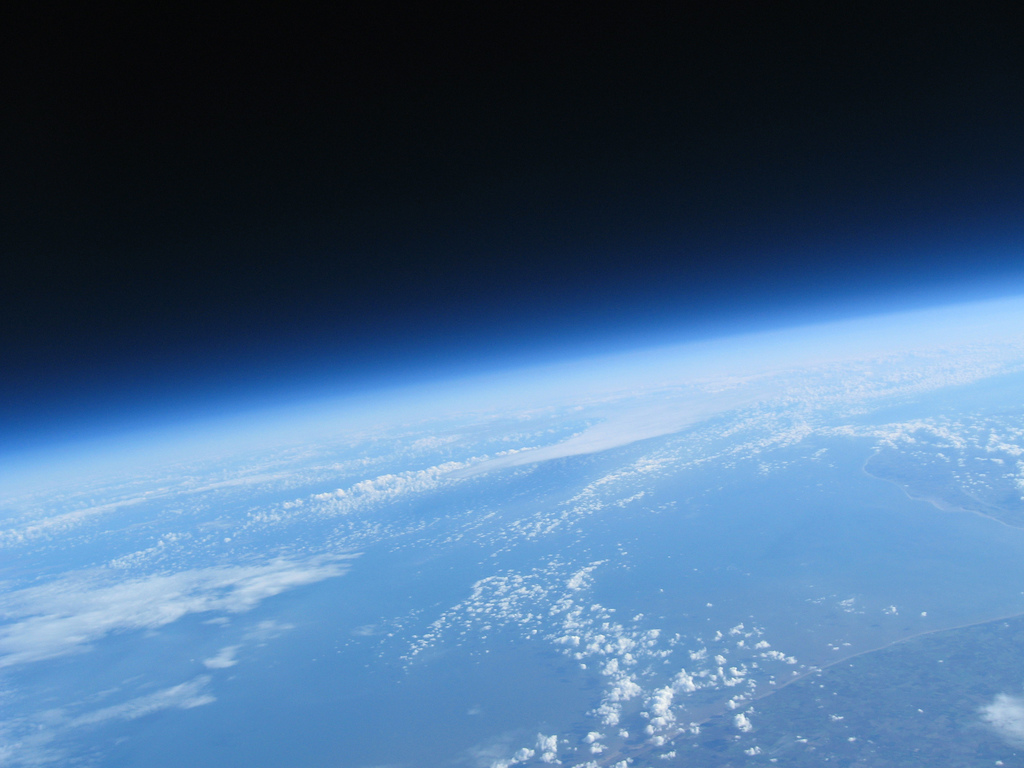
Photo: Robert Harrison
So where does “space” really begin? The question is not so easy to answer, because the Earth’s atmosphere does not simply “end” at a clearly defined elevation. It becomes gradually thinner. The further away one gets from Earth, an increasing number of air molecules escape the Earth’s gravity and magnetic field and drift away from our planet.
By international convention, “space” is presumed to begin at an elevation of 100 km (or 62.1 miles) — the so-called Kármán Line. Even higher, at 75 miles, space vehicles returning to Earth hit aerodynamic drag. But this is more attributable to the enormous speed at which a vehicle must travel when in orbit. The atmosphere’s density at such elevations is so thin that it is practically qualifies as an almost perfect vacuum.
But there are other definitions of “space”. For example, in the U.S., a person is presumed to be an “astronaut” after traveling 50 miles (or about 80 km) above the mean sea level. By that definition, a number of military test pilots have reached space as early as the 1960s while traveling in winged aircraft, and before many NASA astronauts traveling on ballistic rockets.
Journalist and media professional currently based in Los Angeles, California. Focusing on science and technology.
The recent announcements by the White House and the NASA administration were no surprise to insiders. The Ares/Constellation program is dead!

Size comparison between Saturn V, Space Shuttle, Ares I, IV and V
Privately, I’ve been contending this for many months: the solid fuel design based on Space Shuttle booster technology is rife with engineering problems, which is why the program was running late. NASA has been tight lipped about the scale of these problems, which is understandable. But enough has been leaked to call the technical and financial feasibility into question.
The other Ares-problems were weight issues, cost overruns, uncertain long-term funding and perhaps most importantly — given the allocated funds, everything was taking way too long.
So what does the end of Constellation mean?
First, without a man-rated heavy lift launcher (Ares V), NASA’s half-baked plans to return astronauts on the moon are suspended. Secondly, without a man-rated lifter in the arsenal (Ares I), NASA has no way to transport astronauts to the ISS after the Space Shuttle is finally retired. (The Shuttle’s retirement has been projected for this year).
If Congress confirms this course change, we are looking at the end of an era. From the beginnings of the space program, all major U.S. space transport system have been developed by either NASA or by the military. Specific tasks were farmed out to contractors, but everything was managed from the top. On the military side, independent contractors began to take on an increasingly autonomous and commercial role. This development was not mirrored on the civilian side, where the complex Space Shuttle system, which continues to cost half of NASA’s budget just to operate for a few flights per year, prevented any fundamental restructuring. Too many people had vested interests in keeping the Shuttle program going for 30 years.
It looks as though finally, the time has now come to get NASA out of building and managing launch systems. In the future, this may be left entirely to competing commercial contractors. Several players are ready to go, and they can possibly do what NASA’s bureaucracy could not achieve: faster, better, cheaper.
Even the military, which certainly cannot claim to have achieved efficient cost control when it comes to managing such huge and expensive programs, has done a better job encouraging lower launch costs than NASA has. And this point is crucial, because the most important and most expensive part of space missions has never been the actual operating costs in space, but the cost of development and launch.
We may be looking at a new beginning!
Journalist and media professional currently based in Los Angeles, California. Focusing on science and technology.