Category Archives: Technology

Rotary Speed

Here is a picture I took at Mazda’s North American headquarters in Irvine, California. The occasion was the 2010 SevenStock meet, an annual gathering for rotary engine enthusiasts.

Mazda RX-792P race car. Photo: Reinhard Kargl, 2010. (Click to enlarge).

The car pictured is the RX-792P of 1992. This particular car was not very successful on the track, but I think it remains one of the most beautiful race cars ever built. One year earlier, a similar car with the same 4-rotor Wankel engine had been victorious in one of the most grueling auto races the world has ever known: the 24 Hours of LeMans.

I am fascinated with Wankel-type rotary engines. Designed in the 1950s by the German engineer, Felix Wankel, they offer many advantages over conventional piston-engines. And yet, Wankel’s design was never universally adopted among auto makers. Today, its only global, large scale manufacturer is Japan’s Mazda Motor Corporation.

Truth be told, all types of rotary engines also have disadvantages. But it seems to me that many doubts regarding the Wankel engine’s design are based on outdated information. When the engine type was first fielded by Germany’s NSU Motorenwerke AG, its contemporaries and licensees during the 1960s, the technological prerequisites had not evolved yet. The rotary concept was simply ahead of its time.

Today, after decades of experience and with much better materials, a more thorough understanding of thermodynamics, big advances in lubricants and seals, as well as the benefits of turbo or compressor charging, fuel injection, electronic engine control and emission control technologies, things have changed.  Mazda has done quite well with getting the Wankel’s inherent problems under control.

Given more R&D funding and a better supply of skilled and experienced maintenance personnel, Wankel engines could be made ideal for sports cars, motorcycles, aircraft and — due to their high power output at a relatively small size and low weight: as auxiliary engine for hybrid cars. Audi’s A1 e-tron concept study incorporates this configuration!


Related Articles:

TweetReinhard

Just Published: Getting an Earful

Some schools are now using voice amplification systems in their classrooms, and I have been working on an article about their experiences. Here is the (just published) online version:

http://thejournal.com/articles/2010/08/01/giving-them-an-earful.asp

(THE Journal is a specialty publication covering technology in education).

Related Articles:

TweetReinhard

What Do 25,000 Oil Barrels Look Like?

Estimates of the amount of oil spilled from the still gushing BP well in the Gulf of Mexico range 25,000 to 60,000 barrels per day.

It’s hard to imagine how much this is. Here is a video simulation of 25,000 barrels, the lowest estimate. This animation was done with software normally used to produce video games. Impressive!

Related Articles:

TweetReinhard

Send Pictures as Postcards

The Austrian postal service is launching an innovative smart phone app.

First, take a picture on your smart phone and upload it. Then, add a recipient mailing address and a personal message. The postal service in Austria will generate a postcard, print it on paper and send it (via domestic or international mail) to the recipient.

The cost (1.99 euro for postage and postcard) can be paid via credit card or other payment options).

Now you can send your aunt Mimi a postcard from Austria, with a picture of you in Las Vegas. Just for the heck of it.

No smart phone? You can also upload pictures from a computer with Internet access. No special software is required.

http://app.post.at/e-postkarte/site/karte

Related Articles:

TweetReinhard

12 Events That Would Change Everything

Someone at Scientific American had a magnificent idea: come up with a list of 12 plausible events with the biggest potential to shake up our world.

It is not difficult to identify such monumental events in the past, but harder than it seems when we try to gauge the relative importance (and likelihood) of things to come.

Here is what Scientific American came up with for an interactive web-only special:

1. Polar meltdown
2. The proof for additional dimensions
3. Proof for extraterrestrial life
4. An exchange of nuclear strikes
5. The creation of fully synthetic life
6. Superconducitvity at room temperature
7.  Machines demonstrating self-awareness
8. Cloning of a human
9. A really large earthquake along the Pacific Rim
10. Usable fusion reactors
11. A collision with a large asteroid
12. A deadly pandemic

A great list! Except, I don’t think human cloning is a big deal. We already have nature’s way of producing genetically identical humans (identical twins). So perhaps I would replace No. 8 with any of the following:

• Ability to switch off the biological aging mechanism
• Construction of a bionic uterus; extra-corporal gestation
• A working theory uniting Relativity & Quantum Mechanics
• Drugs which significantly decrease the need for sleep
• Fully reversible vasectomies and tubal ligations
• Ability to grow organs and tissues from stem cells
• Solid evidence for / against the life of Jesus Christ
• Technical applications for Quantum Entanglement

Now that I think about it, I’d like to expand the entire list! Food for thought? What would you add or remove?

For more in-depth information on the items on Scientific American’s list, please follow the link below. I seriously doubt that it will run equally well on all systems and browsers, but it is well worth the try.

http://www.scientificamerican.com/article.cfm?id=interactive-12-events

Related Articles:

TweetReinhard

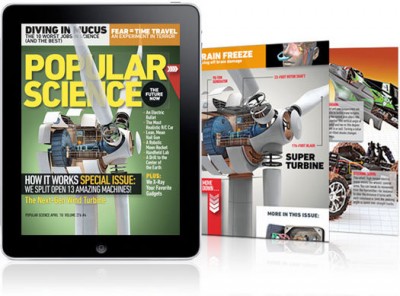
New: Popular Science For iPad

The first magazines are now rolling out digital editions for the iPad. Among the pioneers is a magazine for which I have been a contributing author: Popular Science.

Founded in 1872, the print edition currently has about 1.4 million subscribers. It has been translated into 30 languages and is sold in at least 45 countries.

I am excited! With an estimated 1.8 million iPads sold since April 3, it looks like Apple has another champion in its stable. The iPad could change magazine and newspaper publishing the way the iPod has changed music retailing.

Unlike previous digital readers such the Amazon KindleBarnes & Noble’s Nook, and the Sony Reader, Apple’s iPad has a color screen and a much more user friendly, intuitive interface. Turning pages is reminiscent of flipping real paper. This is the first device really suitable for displaying magazine pages.

Although I will always prefer paper, I could not possibly ever have enough storage space for all the magazines I own or would like to keep. Being able to carry a whole, searchable library in my briefcase would be heaven-sent.

But what I am deeply unhappy about is the price Bonnier Group is charging for the downloads. (Bonnier purchased the magazine in 2007 from Time Inc.).

$4.99 an issue? Are you kidding? That’s the same as a paper copy at the newsstand! And there is currently no discounted annual subscription. Come on! You are not marketing print magazines that way! (Introductory 1-year subscription offers for the print edition can get as cheap as $12! One meager buck a month! You could probably pay for it by looking for lost change on the sidewalk.

Not good. I hope that if sales for the iPad edition are not impressive, those in charge at Bonnier will realize that the culprit is not the lack of demand, but their unrealistic pricing policy!

Related Articles:

TweetReinhard

Artificial Intelligence and an Ode to Spot

I often wonder what produces our self-awareness — the sentient part of our being. Is it just a matter of computational capacity? Would a computer, if large enough, become sentient? Is consciousness a product of our mind, and creativity a produce of consciousness?

There are some who have argued that if this notion was correct, even the Internet may become sentient one day.

“The internet behaves a fair bit like a mind,” says Ben Goertzel, chair of the Artificial General Intelligence Research Institute, an organisation inevitably based in cyberspace. “It might already have a degree of consciousness”. Not that it will necessarily have the same kind of consciousness as humans: it is unlikely to be wondering who it is, for instance.

To Francis Heylighen, who studies consciousness and artificial intelligence at the Free University of Brussels (VUB) in Belgium, consciousness is merely a system of mechanisms for making information processing more efficient by adding a level of control over which of the brain’s processes get the most resources. [New Scientist, April 30, 2009].

Information processing? What about creativity? Will machines ever be able to create true art, not coming from a rational, but rather from an emotional expression?

Star Trek: The Next Generation explored this question in several episodes and with the character of Commander Data. “He” is an android who tries “his” best to learn and experience what it means to be human, but fails over an over again. He dances, paints, plays musical instruments — and although technically more accomplished than any human, Data never seems to get the point.

As a cat lover, I took great delight in Data’s attempt at poetry. In the episode Schisms, Data recites a poem he wrote (“in the iambic heptameter mode”) for his pet cat, Spot:

♦ ODE TO SPOT ♦

Felis catus is your taxonomic nomenclature,
An endothermic quadruped, carnivorous by nature;
Your visual, olfactory, and auditory senses
Contribute to your hunting skills and natural defenses.

I find myself intrigued by your subvocal oscillations,
A singular development of cat communications
That obviates your basic hedonistic predilection
For a rhythmic stroking of your fur to demonstrate affection.

A tail is quite essential for your acrobatic talents;
You would not be so agile if you lacked its counterbalance.
And when not being utilized to aid in locomotion,
It often serves to illustrate the state of your emotion.

O Spot, the complex levels of behavior you display
Connote a fairly well-developed cognitive array.
And though you are not sentient, Spot, and do not comprehend,
I nonetheless consider you a true and valued friend.

Regarding Data’s poem, the writer in me has one objection. The word “obviate” is used in the sense many people believe to be its proper usage from the way it sounds (“to make obvious”), although the word is actually defined as “to make unnecessary.” Data would presumably not make this mistake — so here is a giveaway that the poem was written by a human after all. (Errare humanum est).

[For Trekkies: The poem is referenced again in 2369 (A Fistful of Datas), when Data uploads some of his personal files to the main computer of the USS Enterprise-D during an experimental interface with his neural net. Data’s memories end up overwriting a play witten by the ship’s chief medical officer.]

Related Articles:

TweetReinhard

What “Nuclear Option”?

Not even the nuclear industry claims with a straight face that it could ever be cost efficient without massive government subsidies. Last week the White House answered the nuclear lobby’s call in the form of loan guarantees for “a new generation of safe, clean nuclear plants”. For this, Obama has earmarked $36 billion.

But what about nuclear waste storage options? More than half a century has passed since the first nuclear power plants became operational. And yet, we don’t even have any options on where to stick existing nuclear waste in the long term. And we have essentially no plans for waste from the touted next generation of nuclear reactors.

In the U.S., the nuclear industry has been eerily absent from this discussion. Because for reasons that are beyond strange, the industry is not responsible for the permanent storage of the waste it generates. The federal government (read: the taxpayer) is.

Not surprisingly, the government has been handling this problems with the same acumen it handles all other huge undertakings. First, a huge bureaucracy was created. It was then paralyzed by congressional infighting, partisan divisions, various lobbies, rebelling states (neither of which is keen to become the radioactive dumping ground for the entire nation) and political posturing. Add to that campaign contributions in one form or another and one arrives at a predictable political quagmire.

Precise figures are not obtainable, but it has been estimated that $14 billion have been spent on project “studies” since 1983. That’s just for “thinking” about options. The result? We are no closer to a long term storage solution than we were decades ago. The proposed Yucca Mountain repository for high level waste is all but dead. The proposed 2011 budget contains no funding for it. And even if the Yucca Mountain project would be revived over the objection of many geologists who consider the site unsafe, it would not have enough capacity. Not to forget that it would cost the taxpayer more than $100 billion to build and operate!

So we continue to have nuclear waste sitting in interim storage on hundreds of reactor sites across the United States — a huge security risk, but the only option we have had for decades. And the only option available for the foreseeable future.

At a symposium during last week’s annual meeting of the American Association for the Advancement of Science in San Diego, California, geologist Allsion Macfarlane (George Mason University, Virginia) put it this way: The U.S. should consider “moving waste management out” of the federal government’s hands, perhaps into a public-private partnership. (And why not make the nuclear industry entirely responsible for the cost of nuclear waste management? After all, that’s what we demand of other industries).

While given past experiences on this issue would seem to make Macfarlane’s suggestion a logical step, I remain skeptical that consensus on a sound, cost efficient and safe solution will be found before radioactive waste from the proposed new generation of nuclear plants needs disposal.

So let’s not fool ourselves with talk about “options” when there are none in sight.

Related Articles:

TweetReinhard

London Retires Iconic Routemaster Bus

An era just ended in London, when the city pulled the world famous, old red double decker buses out of regular service. “Routemaster” buses were built from 1959 to 1968 and have been in service ever since. Although they were initially received with skepticism, Londoners and tourists alike soon began to love them with passion.

These buses have several features missing on modern counterparts: There is a conductor who takes tickets, gives directions and helps passengers. (On modern buses, the driver also processes tickets, which wastes time at bus stops). Secondly, the Routemaster has no doors. Passengers can board or exit the bus at any time, which is very convenient when there is a traffic jam and the bus just inches forward.

The decision to retire the buses had to be a financial one. There is the cost of maintaining the old vehicles, the cost for two operators and the danger of liability lawsuits brought by passengers falling off the bus. All this was probably too tough to swallow for a cash strapped public transportation system.

On the other hand, what often is overlooked is the impact this will make on tourism and the city’s spirit. London’s classic taxis, buses and phone booths are quintessential icons which distinguish the British capital from all other cities around the world. I find it sad that the city’s leaders did not come up with a solution to preserve the London’s heritage.

My feeling is that this decision is completely at odds with the public’s wishes. On bulletin boards and blogs, it is hard to find any messages not expressing anger and outrage over this move.

The good news is that about 20 “show” buses will remain for certain runs — mostly as tourist attractions. The rest will probably be bought by private parties. Word has it that they can be had for 5,000 to 10,000 pounds.

There is an organization dedicated to the Routemaster:

http://www.routemaster.org.uk/

Related Articles:

TweetReinhard

Macintosh Becomes Serious Threat to Windows

Wall Street research firm Needham & Co. announced yesterday that in 2005, over 1 million Windows users have switched over to Mac, which completely beat the most optimistic expectations. The trend is expected to become even stronger in 2006, for which the Needham forecasts 1.3 million to abandon Windows in favor of Mac.

Related Articles:

TweetReinhard