Dated at 1924, this appears to be one of the earliest known aerial photographs of the La Monica Ballroom on the Santa Monica Pier in California. The picture must have been taken shortly before or at the opening of the La Monica Ballroom on July 23, 1924, seen here at the end of the pier. (Dunning Air, Ernest Marquez Collection, The Huntington Digital Library)
Over time, the city of Santa Monica was home to several wharfs and piers, but only the Santa Monica Pier still exists today as a famous historic landmark.
Technically, what we see in the pictures consists of two separate piers. The long, narrow portion constitutes the “Municipal Pier”, which opened on September 9, 1909 and was originally constructed for the rather inglorious purpose of carrying sewage water beyond the breaking waves.
The wide “Pleasure Pier” to the south (on the right side in the pictures) was privately owned and also known as the “Newcomb Pier”. This portion was added by amusement park pioneers Charles I. D. Looff and his son Arthur.
Charles I. D. Looff (born Carl Jürgen Detlef Looff) was a Danish master carver and builder of hand-carved carousels and amusement rides, who immigrated to the United States of America in 1870. Looff built the first carousel at Coney Island in 1876. During his lifetime, he built over 40 carousels, several amusements parks, numerous roller coasters and Ferris wheels, including California’s famous Santa Monica Pier. He became famous for creating the unique Coney Island style of carousel carving.Photo: Long Beach Public Library.
On June 12, 1916, Santa Monica’s “Looff Hippodrome”, containing a carousel opened to the public. Eventually, other attractions included the Blue Streak Racer wooden roller coaster (which was purchased from the defunct Wonderland amusement park in San Diego), the Whip, merry-go-rounds, Wurlitzer organs, and a “funhouse”.
The La Monica Ballroom at the end of the pier and seen in the front of the photograph was designed by T. S. Eslick and featured a Spanish façade, and a French Renaissance inspired interior. It was advertised as “the largest dance hall on the west coast”.
La Monica’s 15,000-square-foot (1,400 m2) hard maple floor offered space for 5,000 dancers and competed with the the Bon Ton Ballroom (later renamed Aragon Ballroom) on what was then known as the “Lick Pier”, located a few miles down the coast in Venice.
Autos crowd the pier during the grand opening of the La Monica Ballroom on July 23, 1924.The event was reported to have attracted 50,000 people producing the first traffic jam in Santa Monica.
In the days before air conditioning, Santa Monica’s Pleasure Pier and its attractions thrived during the 1920s, but faded during the Great Depression.
Ca. 1926. Adelbert Bartlett Papers. Department of Special Collections, Charles E. Young Research Library, UCLA.
Ca. 1930: The Santa Monica Deauville Club in the foreground, with the La Monica Ballroom rising in the distance above the pier.
People on the Santa Monica Pier looking out over Santa Monica Beach below, ca. 1930. The Santa Monica Athletic Club and part of the Deauville Club are in view at upper right.
Subsequently, during the 1930s most of the amusement park attractions were closed down, sold off, or falling into disrepair. Then in 1934, a breakwater was built. This provided protected docking for up to 100 fishing and pleasure boats near the pier, and helped attract new income.
Ca. 1934: A crowd amid beach umbrellas watching two pugilists boxing in an outdoor boxing ring on the beach in front of the Santa Monica Athletic Club. The Santa Monica Pleasure Pier with the La Monica Ballroom and Municipal Pier are in the background.
1936: Crowds of people standing in line at the Catalina Steamer Landing on Santa Monica Pier across from the La Monica Ballroom.
A 1936 postcard view of Santa Monica Beach showing the La Monica Ballroom on the pier. A portion of the Deauville Club (opened in 1927) can be seen in lower right. Photo by Burton Frasher Sr. (1888-1955), Pomona Public Library, Frasher Foto Postcard Collection).
The “Swinging Years” of Big Band Jazz from 1935 to 1945 also brought new crowds to the ballroom. And country music and “western swing” star Spade Cooley began broadcasting his weekly television show from the the La Monica Ballroom in 1948, where the program remained until 1954.
After that, in the summer of 1955, the Hollywood Autocade opened at the La Monica, featuring roughly one hundred famous and unusual cars, including Jack Benny’s Maxwell and a Rumpler Drop Car. Between 1955 to 1962, the ballroom served as a roller skating rink, first as “Skater’s Ballroom”, and later as the “Santa Monica Roller Rink”. A local speed skating club is said to have won many state and regional championships. Speed skater Ronnie Rains became a Roller Derby star. The rink’s operator was a former vaudeville and silent film star, Jack Goodrich, whose daughter, Michelle Goodrich, later became a showgirl in Ice Capades.
The owners of the pier and the ballroom, the Newcomb family didn’t invest enough in upkeep and upgrades to keep the venue from decaying.
And so, the La Monica Ballroom was closed to the public 1962, and demolished in 1963.
Only very few of the original space pioneers are still with us, and we keep losing the last remaining few.
Fellow pilot, war hero and astronaut Buzz Aldrin, who keeps very engaged online, posted this:
Grieving the loss of one of my best friends, Jim Lovell. His extraordinary legacy is cemented by many space missions: Gemini VII, Gemini XII, Apollo 8 and Apollo 13.
Our mutual respect had no limits. The Gemini XII mission we flew together paved the way for the Apollo missions. Heartfelt condolences to Jim’s family. Farewell Jim. You will be missed, my friend. Godspeed!
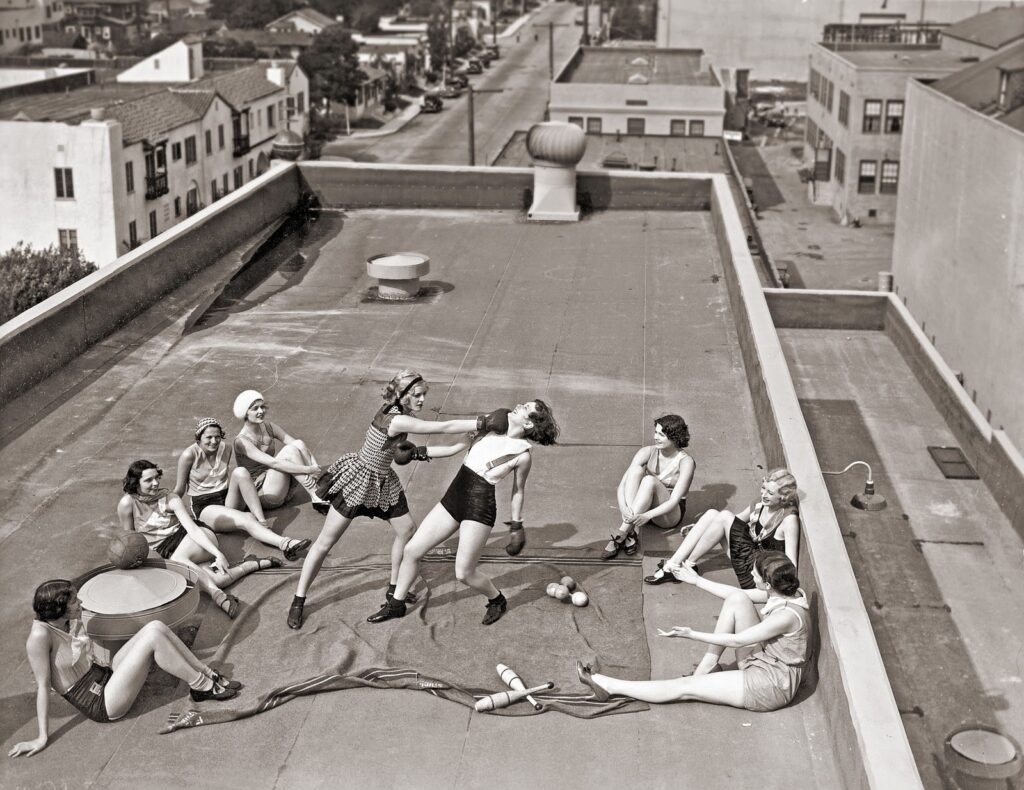
Few details about this photograph can be substantiated. The original caption was supposedly “Radio Pictures Chorus Girls“. This might have been a reference to RKO Radio Pictures Inc., which operated from 1929 to 1959.
The girls were almost certainly entertainers who were photographed while having fun exercising on a Hollywood rooftop — possibly in 1938. The automobiles in the background were likely built in the 1920s and 1930s, and the boxing scene was obviously posed for the photographer. (If you can identify the street address or know any of the girls in the image, I’d love to hear from you!)
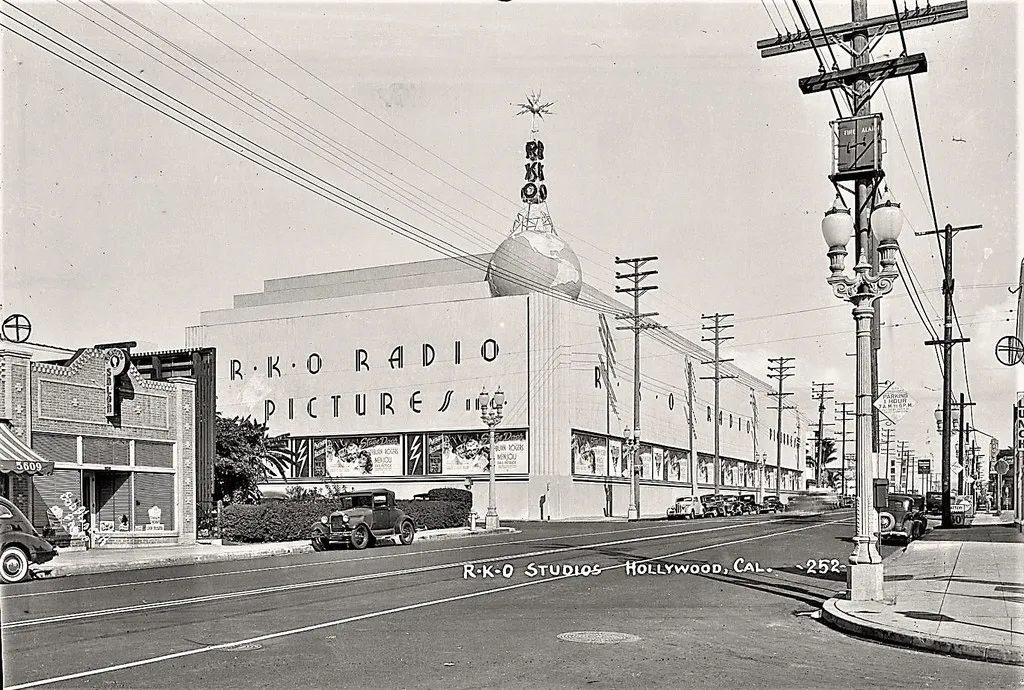
RKO Studios at Melrose Avenue and Gower Street, Hollywood, circa 1937.
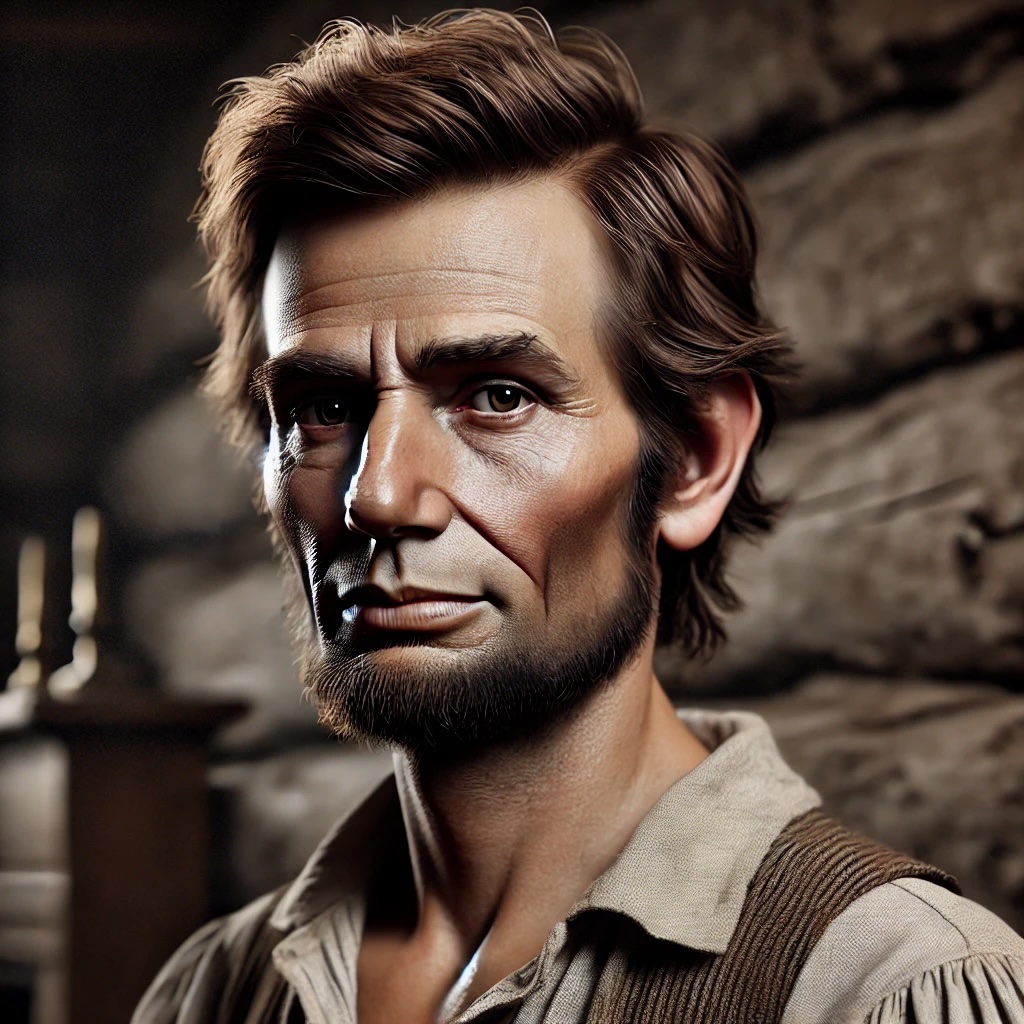
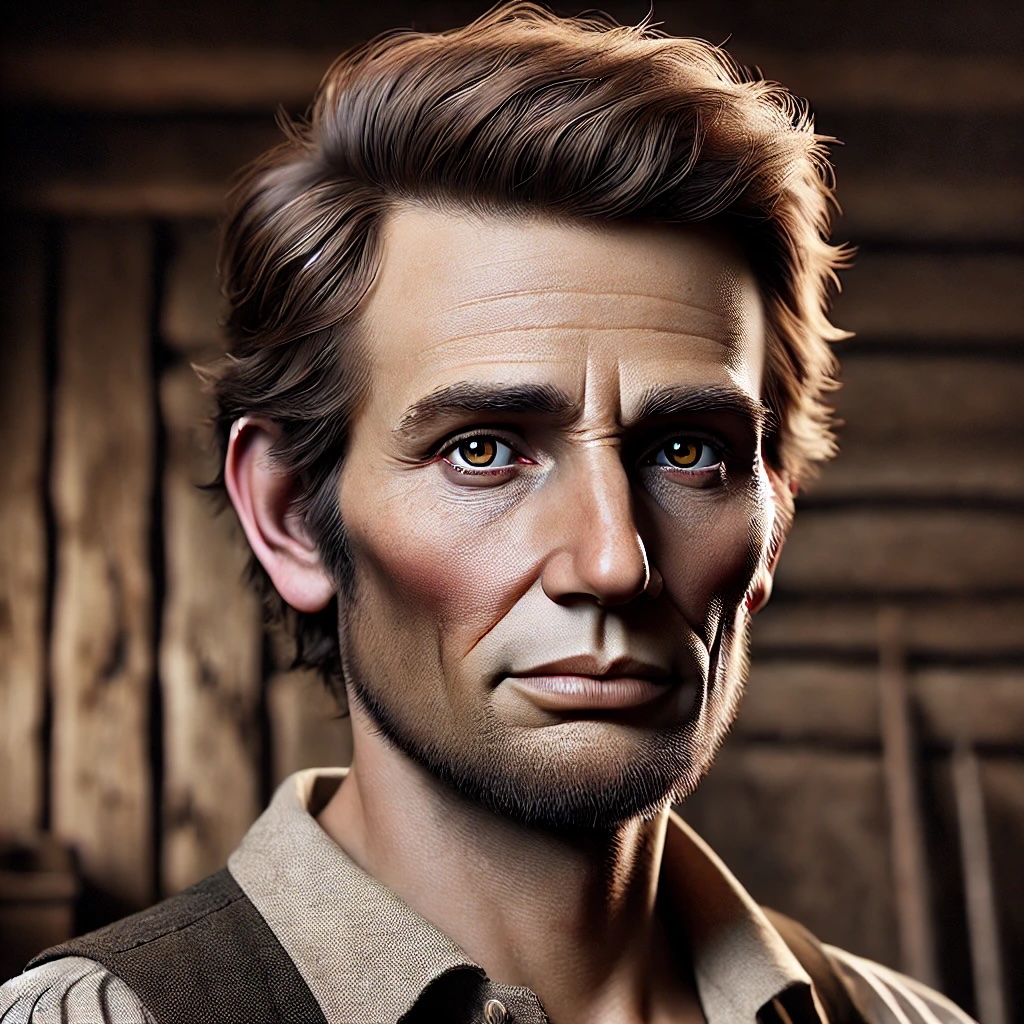
On this day in 1863, Abraham Lincoln was born into poverty. His birthplace was a log cabin on Sinking Spring Farm near Hodgenville, Kentucky. Raised on the frontier (mainly in Indiana) he was well-read and self-educated, and became a lawyer who opened a law practice in Springfield, Illinois.
I asked DALL-E to simulate what Lincoln might have looked like as a young man during this period of his life, using historical images as reference. Here are the results:
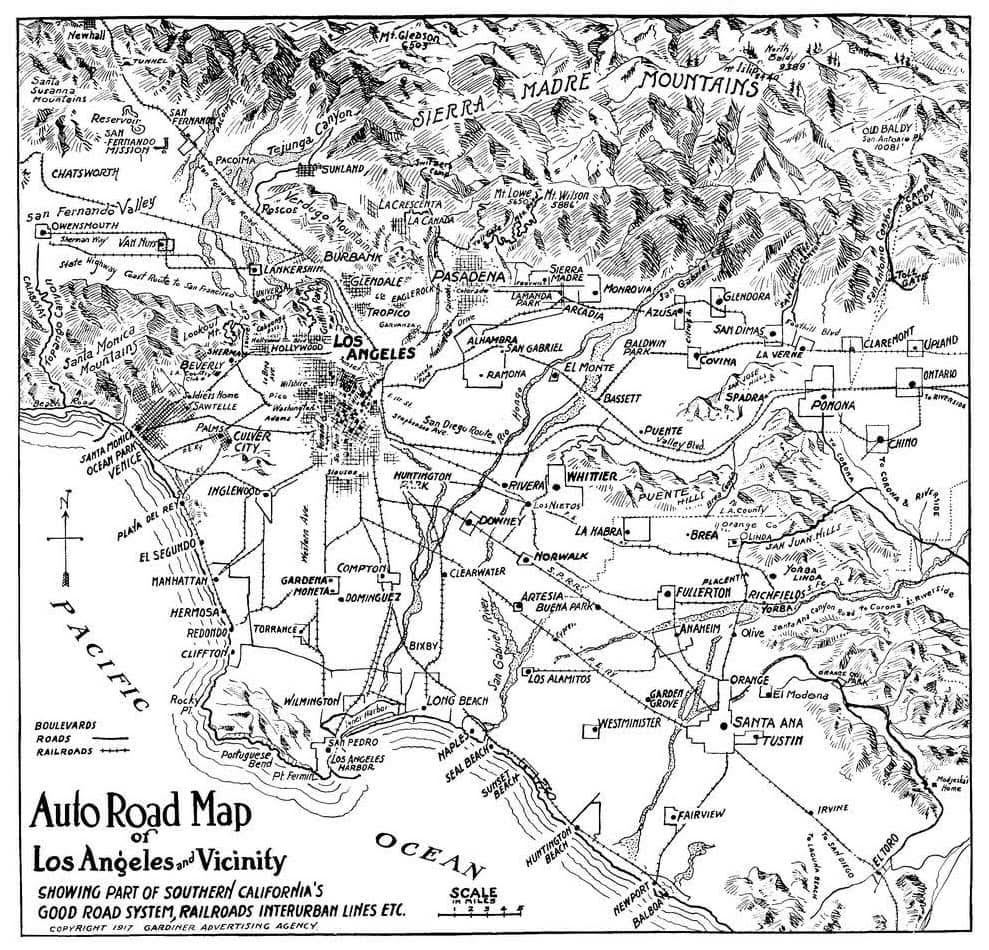
At the time this map was printed, Los Angeles County was booming with droves of new arrivals pouring in mostly from the East Coast. According to the U.S. Census, the county’s population had grown by 196% during the decade following 1900. By 1910, it had reached 504,131.
At the following census in 1920, the county’s population had swelled to 936,455, which translates to another 85.8% increase over 10 years . Within 20 years of 1900, the population had increased by 5 1/2 times, and 13 times by 1930, ending the decade with a total population of 2,208,492.
Most of the new settlers arrived by railroad. But when the above map was printed, the first automobile affordable to middle-class Americans, the Ford Model T was already in its 9th year of production. While there was a frenzy to build electric tram lines and a bus infrastructure connecting the Los Angeles area, people’s preferences, and the future of personal transportation, were clear. Then as now, people preferred private automobiles over communally shared vehicles the same way as they prefer private bathrooms over public toilets. For much the same reasons, they always will.
By the end of production in 1927, Ford had sold 14,689,525 Model Ts, with the least expensive model selling for just $260. (At the time of this writing, this would amount to an inflation-adjusted price of roughly $5,000 in 2025).
Motoring at the time would have been both fun as well as challenging. Many Los Angeles area roads at the time were still unpaved and rural. The various towns, settlements and cities were scattered about the vast county, and surrounded by farm or ranch land. Cars frequently broke down miles from populated areas. Flat tires were common. The quality of gasoline was unsteady and questionable, and filling stations were a novelty.
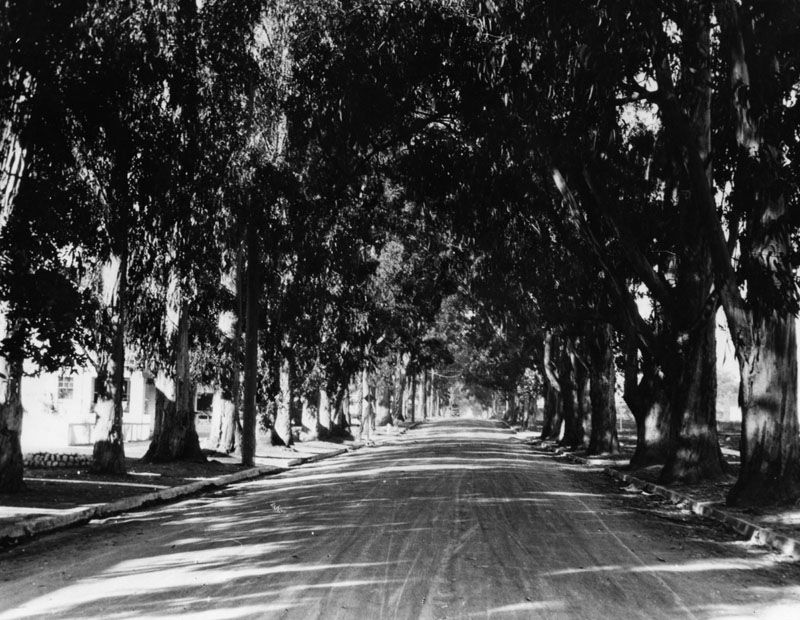
Melrose Avenue, 1910
Most gasoline pumps were installed in front of hardware stores, feed companies, livery stables, and a variety of other retailers. Service Town, the earliest known gas station in a modern sense, was built in 1914, three miles from downtown Los Angeles. Before that time, motorists went one place for gas and oil, and other places for lubrication and cleaning, for repairs, or for tires and other accessories.
As automobile sales increased, the demand for fuel led to a more systematic and standardized way of delivering it. In 1914, Standard Oil of California opened a chain of 34 homogeneous stations along the West Coast, and other oil companies quickly followed suit to secure an outlet for their now increasingly branded and advertised products.
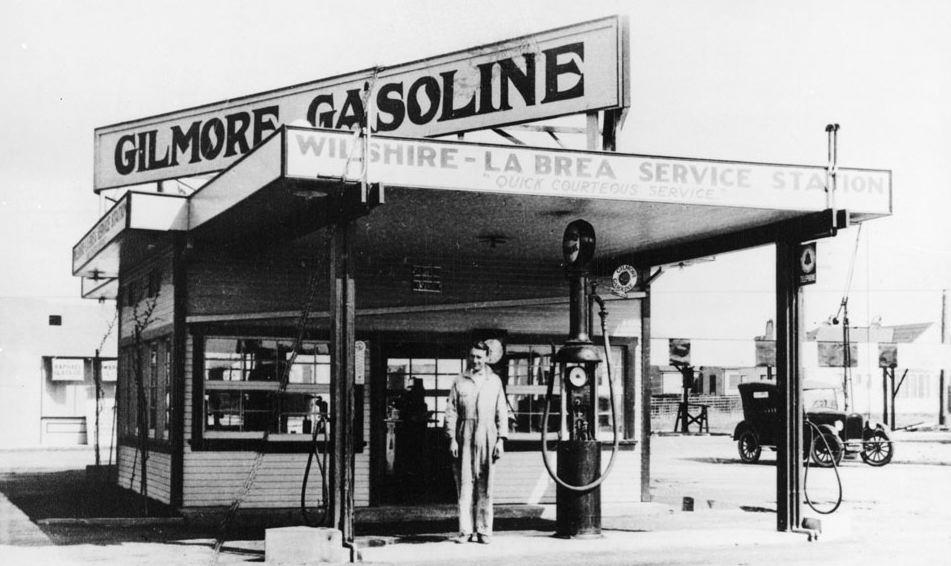
The Gilmore Gas Station was one of the first gas stations in Los Angeles. It was located on the northeast corner of La Brea and Wilshire Boulevards. Photo from ca. 1920. (Los Angeles Department of Water and Power).
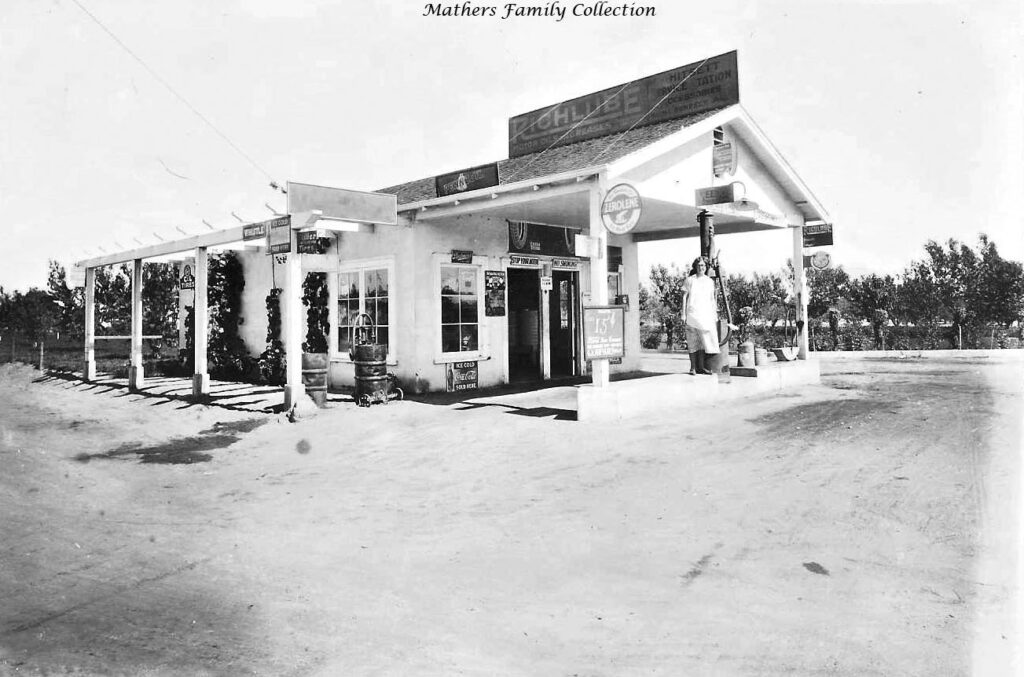
View showing Mabel Demspey standing on the gas pump island at the Whitsett Service Station located at 2912 Whitsett Avenue in North Hollywood. Photo from 1923.(Los Angeles Department of Water and Power).
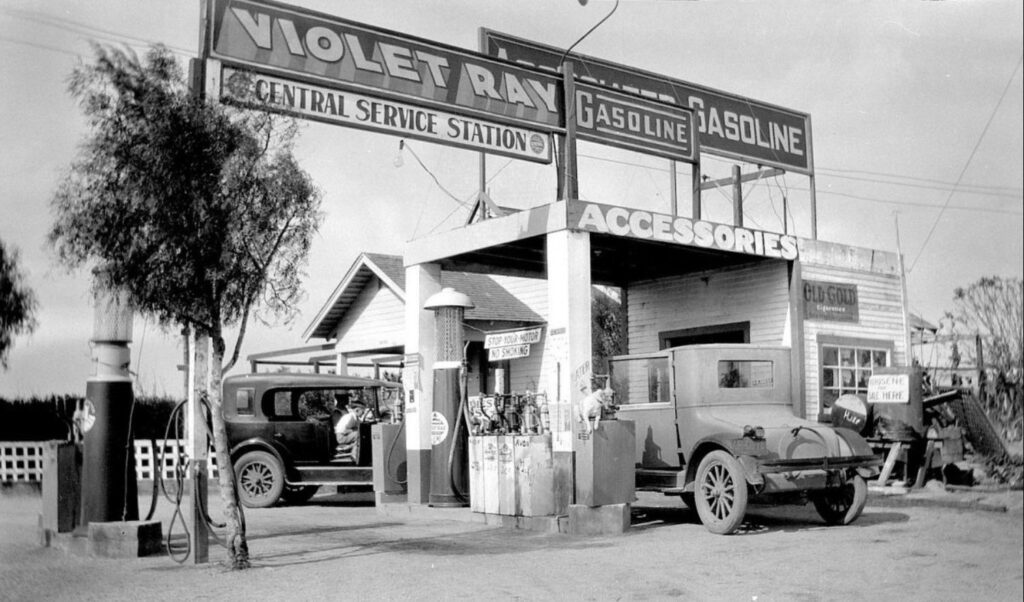
A man and boy sit in a car at the Central Service Station which is selling both Violet Ray Gasoline and Associated Gasoline. Note the dog sitting on top of what appears to be an oil dispenser. Photo ca. 1928.(Los Angeles Department of Water and Power).
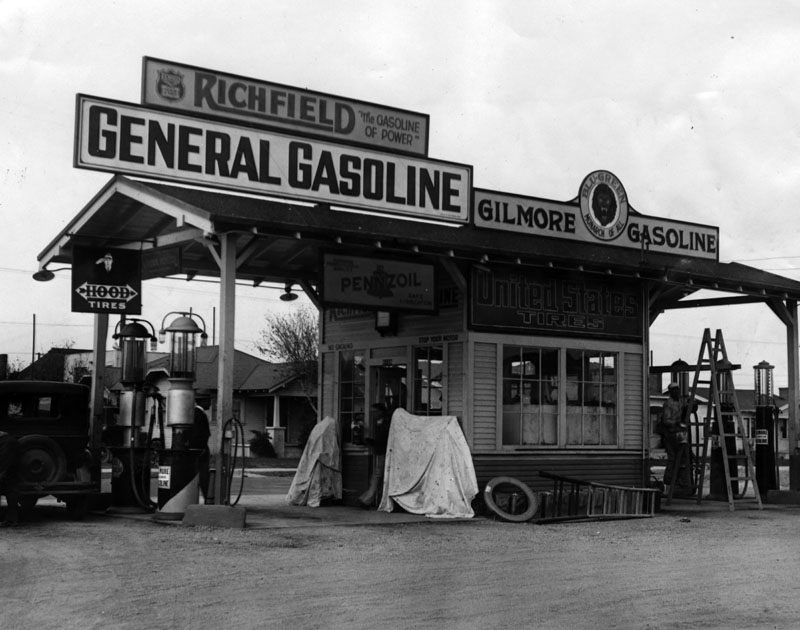
View of service station with gas pumps on either side located at 1800 1/2 Long Beach Boulevard, South Gate. The signs advertise General Gasoline, Richfield Gasoline, Gilmore Gasoline, Hood Tires, United States Tires and Pennzoil. On the right, an attendant is climbing a ladder. Photo ca. 1928. (Los Angeles Department of Water and Power).
Some of the cities on the road map shown above no longer exist, but were absorbed by Los Angeles or other cities. Examples (on the Westside) are the historic City of Sawtelle and the town of Venice, which were annexed by the City of Los Angeles, and the City of Ocean Park, which opted to join the City of Santa Monica
In 1910, the semi-rural town of Hollywood had voted to merge with Los Angeles in order to secure an adequate water supply and to gain access to the L.A. sewer system. This was very common development at the time, and one which many cities later bitterly regretted.
The community of Pacific Palisades, which was consumed by the horrendous fire of 2025, didn’t exist yet. Neither did the City of Malibu, nor the Roosevelt Highway (later renamed to “Pacific Coast Highway”). But there was a “Beach Road” along the coast, as well as a steam rail line from Downtown Los Angeles to Santa Monica. The latter was how most beach goers arrived to take a few days of respite from the summer heat further inland.
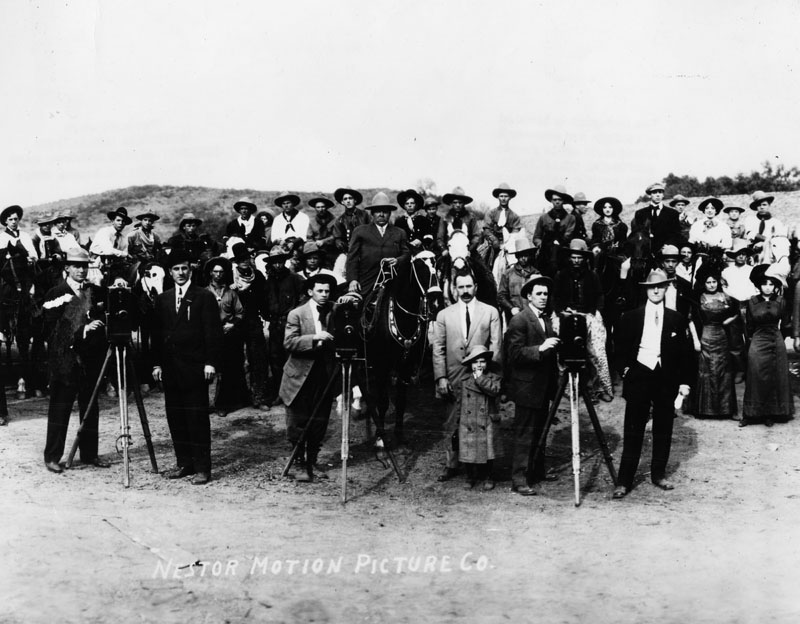
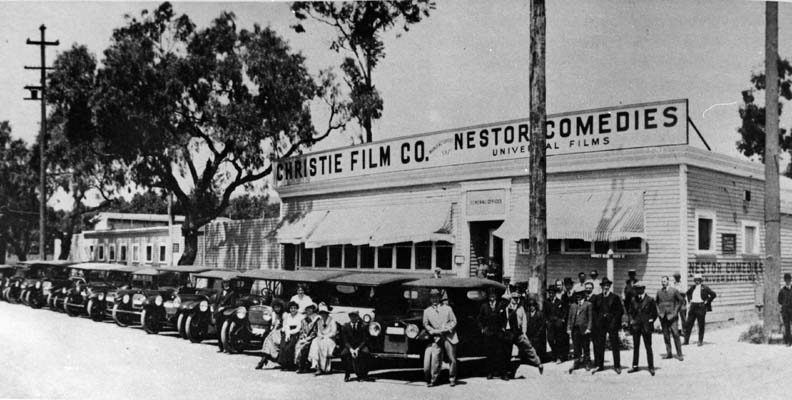
By 1912, some motion-picture companies had moved out West to set up production facilities near or in Los Angeles, one of the first one being short lived Nestor Studios. (Originally known as Nestor Motion Picture Company, then Nestor Film Company, it merged with the Universal Film Manufacturing Company, headed by Carl Laemmle, in 1912).
At the time, the pioneering movie studios were still a newfangled and rather suspect industry, viewed with skepticism by investors, polite society, and cultural guardians alike. They certainly weren’t the main reason why people from all over North America (and Europe) wanted to move to Los Angeles. More important factors were the discovery of vast oilfields and seemingly endless opportunities to make money and fortunes. There was affordable and available vacant land on which one could build quickly, cheaply, and year-round. And all this came with a pleasant climate, and a plentiful supply of fresh meat, fruit and vegetables throughout the year. (This would have been a major draw at a time when heating consisted of building a fire in an oven or fireplace, and electric refrigerators were a rare novelty).
But I would argue that of all industries, it was the motion picture industry which drove America’s rapid motorization in the first part of the 20th Century. Cinemas would soon reach every corner of the country. And there, on big silver screens, huge crowds of people saw all segments of society happily motoring around Southern California. Often in open cars no less, far from snow and ice, and enjoying the joys of personal, individual transportation. To audiences back then, all this looked like magic. And of course, the car industry back east could not have invented a better publicity campaign.
This week, while watching an episode of the classic American TV sitcom “Leave It To Beaver”, I stumbled upon what one might call an “Easter Egg”.
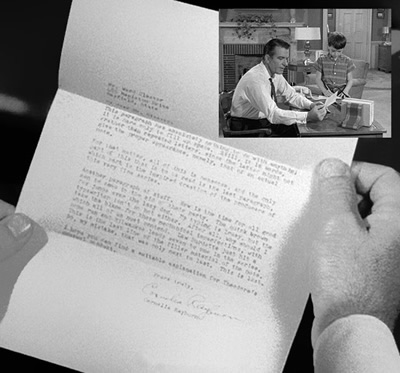
In the episode “Her Idol”, first aired on November 6, 1958, the principal of Grant Avenue Grammar School, Mrs. Rayburn (played by Doris Packer) sends a typewritten complaint letter to Mr. Ward Cleaver (played by Hugh Beaumont). The letter appears on screen for only a brief moment, and Beaumont reads only the last line aloud. When the episode was aired, television resolution was so low that the audience could not have deciphered the letter. But with today’s high definition scans, it is possible (albeit with some difficulty).
And as it turns out, one of the show’s writers (or maybe the props department) had a bit of fun here. The letter reads:
Mr. Ward Cleaver 485 Mapleton Drive Mayfield, State
My Dear Mr. Cleaver:
This paragraph has absolutely nothing to do with anything. It is here merely to fill up space. Still, it is words, rather than repeated letters, since the latter might not give the proper appearance, namely, that of an actual note.
For that matter, all of this is nonsense, and the only part of this that is to be read is the last paragraph, which part is the inspired creation of the producers of this very fine series.
Another paragraph of stuff. Now is the time for all good men to come to the aid of their party. The quick brown fox jumps over the lazy dog. My typing is lousy, but the typewriter isn’t so hot either. After all, why should I take the blame for these mechanical imperfections, with which all of us must contend. Lew Burdette just hit a home run and Milwaukee leads seven to one in the series. This is the last line of the filler material of the note. No, my mistake, that was only the next to last. This is last.
I hope you can find a suitable explanation for Theodore’s unusual conduct.
Yours truly,
Cornelia Rayburn
Two things of note:
“Mayfield” is a fictional American small town, and the show never disclosed the state it was located in. Hence there is no such reference in the letter’s address section.
Lew Burdette (November 22, 1926 – February 6, 2007) was of course a very real person – a very famous Major League Baseball pitcher who played primarily for the Boston / Milwaukee Braves. He was considered the most valuable player of the 1957 World Series, leading the franchise to its first championship in 43 years, and the only title in Milwaukee history. So as it happens, the reference to Burdette and the second game of the World Series allows us to date the letter: it appears to have been typed in the early afternoon of Thursday, October 2, 1958.
On that day, beginning at 1:00 PM Central Time, the Milwaukee Braves played the New York Yankees at County Stadium in Milwaukee, Wisconsin. It was the 2nd game of the World Series. There, during the first inning, with the Braves already leading 4-1, Burdette scored a three-run homer, bringing the tally to 7-1. The Milwaukee Braves ended up winning Game 2, but in a reversal from 1957, the Yankees defeated the Braves in seven games to win their 18th title, and their seventh in 10 years.