In the 1950s, the ambitions of America’s fledgling space program caused great fascination among both young and old.
Above is a poster, with the only identifying information I could find given as “Copyright 1959 Educational Posters # 117 “Space Age”. Only one of the vehicles depicted in the artwork was actually built, and really flew. (Can you tell which one? The answer is at the bottom).
Anyone who knows where and how to obtain a high-resolution image of this artwork: please let me know!
In 1963, the same chart was included in a magazine article. (Dickenson, Fred. “U.S. Space Hardware – Today and Tomorrow”. New York Mirror Magazine, April 28, 1963 pp 9-10). Unfortunately, I have no further information.
Answer to the question above: The North American X-15, shown left and center. It was an experimental hypersonic rocket-powered aircraft, which first flew on June 8, 1959 after being dropped from a B-52 bomber at Edwards Air Force Base in California. During the program, the X-15 reached altitudes over 100 kilometers (62 miles), meeting the definition of “space” as acknowledged by the Fédération Aéronautique Internationale. In terms of speed, the X-15 eventually achieved Mach 6.7 (or 6.7 times the speed of sound). Even today, this is the world record for self-powered, manned aircraft. Unless, of course, we include NASA’s Space Shuttle in this class. (But that would be a stretch. The initial stage of the Space Shuttle’s ascent relied on external boosters, the second phase on an external tank that weighted a lot more than the orbiter. And the shuttle’s descent was unpowered during atmospheric flight – at which point it was just a passive glider. By contrast, once the X-15 was released by the carrier aircraft, it accelerated and flew under its own power and (at least on most flights) used internal fuel. This self-propelled flight phase was when the X-15 reached its record-making altitudes and speeds. On the return trip, the X-15 was also a passive, unpowered glider like its predecessor, the X-1, as well as the much later Space Shuttle.
Today is the 100th anniversary of the first launch of a liquid fueled rocket. In a snowy field near Auburn, Massachusetts, the feat was accomplished by American rocket pioneer Robert Hutchings Goddard (October 5, 1882 – August 10, 1945).
According to Goddard’s field notes, the contraption nicknamed “Nell” reached an altitude of 41 feet (12.5), during a total flight time of 2.5 seconds. There were only a few witnesses: Goddard’s 25-year old wife Esther (serving as photographer), Goddard’s crew chief Henry Sachs, and Clark University assistant physics professor Percy Roope. Some boys who were out sledding happened to pass by and were mesmerized by the surreal display of an object being launched into the air.
Before the launch of “Nell” on March 16, 1926. Photo (most likely) by Esther Goddard.
Unfortunately, it doesn’t appear that anything but fragments of the historical rocket are still around. Goddard and his compatriots took the parts to their workshop, and most parts were reused.
Goddard was a staunch American patriot. At a time when the military was still very skeptical of any military potential for rockets (or plainly ridiculed the idea), Goddard tirelessly advocated for research and development of rockets for military use. Long before commercial uses for rockets, military funding must have seemed vastly more rational than asking for money to pursue another grandiose idea: that of using rockets to leave the Earth and fly to space. The latter concept had captured Goddard’s imagination since childhood. But aside from a few visionaries, most serious engineers and scientists at the time thought of such ideas as just plain silly, unviable, and ridiculous. (Meanwhile in Europe, Hermann Oberth mirrored Goddard’s ambitions for leaving the Earth’s atmosphere and sending rockets to space).
Robert Goddard lecturing at Clark University
Much of the work Goddard did for the military was rather secretive. And this wasn’t just because of the need to keep weapons development secret, but also because funding rocket research from military budgets would have been controversial, to say the least, even within the military.
It appears to me that Goddard was discretely involved in military research very early on in his career. Re-reading some of Goddard’s biography, I came across an interesting tidbit in the notice announcing his death, published by the New York Times of August 11, 1945.
In the very last paragraph, it casually notes:
During the first World War he was research director for the United States Signal Corps, both at Worcester and at Mount Wilson Observatory in California.
“Worcester” might refer to Worcester Polytechnic Institute, where Goddard enrolled in physics classes in 1904, and eventually became a laboratory assistant and tutor. Goddard remained at WPI until 1908, then began his graduate studies at Clark University in Worcester in the fall of 1909.
While studying at Clark, Goddard continued working in Salisbury Labs at WPI and anecdotally caused a damaging explosion, whereupon his work was moved to the Magnetic Lab. In 1912, Goddard accepted a research fellowship at Princeton University’s Palmer Physical Laboratory.
But this was all before WW-1. Therefore, the reference in the New York Times would either be incorrect, or Goddard had already started working on secret “side projects” on behalf of the military as early as during his graduate studies at Clark, beginning in 1909, or possibly even earlier, at WPI.
So what was he secretly working on?
The project was a man-portable recoilless anti-tank rocket launcher weapon, nicknamed the “stovepipe” or “bazooka”. The development of the bazooka involved the development of two specific lines of technology: the rocket-powered weapon and a “shaped charge” warhead. Goddard was probably commissioned to work on the solid fuel rocket and its launch tube. In other words, the delivery system for the warhead.
Reportedly, Goddard and his co-worker Clarence N. Hickman successfully demonstrated the weapon to the U.S. Army Signal Corps at Aberdeen Proving Ground, Maryland, on November 6, 1918. But as the Compiègne Armistice was signed only five days later, the project was halted. (It reemerged for the WW-2 effort, at which point Hickman had taken the lead, and Goddard may no longer have been involved at all).
What about the New York Times’ reference to Mount Wilson Observatory? This one is rather intriguing. Obviously, a secluded astronomical observatory on a California mountaintop would seem like a rather unlikely place for rocket research.
Although notes linking Goddard to Mount Wilson can be found in several sources, none of them are original, and I found no definitive evidence. All I was able to locate is a photograph.
In its archive, Clark University has a picture of Robert Goddard “loading 1918 forerunner of “bazooka” of World War II, Mount Wilson, California”, according to Esther Goddard’s annotation. However, since Goddard and Esther weren’t a couple at the time, this image (if it is indeed from 1918) could not have been taken by Esther. Besides, since a woman’s presence at the all-male Mount Wilson Observatory would have created quite a stir in 1918, we can all but rule out Esther as a first hand witness. Most likely, her annotation was made much later, possibly long after her husband’s death in 1945. Therefore, her annotation does nothing to establish a location. The widow merely recorded something she recalled being told about her late husband’s work.
I take the view, pending evidence to the contrary, that this picture wasn’t taken on Mount Wilson, and that Robert Goddard was never really present there. His supposed work at the observatory was probably just a convenient cover story concocted by someone at the U.S. Army Signal Corps.
It is however possible that the cover story was deemed necessary because Goddard may have had some contacts, interviewed for a job, or done some work at Caltech around that time. Caltech is just down the mountain, so there is at least a geographic proximity. Perhaps the Signal Corps wanted to shield Goddard and the bazooka project. Or perhaps Goddard himself wanted to keep a possible visit and connection to Caltech concealed from Worcester Polytechnic Institute, Clark University, and Princeton University?
Dated at 1924, this appears to be one of the earliest known aerial photographs of the La Monica Ballroom on the Santa Monica Pier in California. The picture must have been taken shortly before or at the opening of the La Monica Ballroom on July 23, 1924, seen here at the end of the pier. (Dunning Air, Ernest Marquez Collection, The Huntington Digital Library)
Over time, the city of Santa Monica was home to several wharfs and piers, but only the Santa Monica Pier still exists today as a famous historic landmark.
Technically, what we see in the pictures consists of two separate piers. The long, narrow portion constitutes the “Municipal Pier”, which opened on September 9, 1909 and was originally constructed for the rather inglorious purpose of carrying sewage water beyond the breaking waves.
The wide “Pleasure Pier” to the south (on the right side in the pictures) was privately owned and also known as the “Newcomb Pier”. This portion was added by amusement park pioneers Charles I. D. Looff and his son Arthur.
Charles I. D. Looff (born Carl Jürgen Detlef Looff) was a Danish master carver and builder of hand-carved carousels and amusement rides, who immigrated to the United States of America in 1870. Looff built the first carousel at Coney Island in 1876. During his lifetime, he built over 40 carousels, several amusements parks, numerous roller coasters and Ferris wheels, including California’s famous Santa Monica Pier. He became famous for creating the unique Coney Island style of carousel carving.Photo: Long Beach Public Library.
On June 12, 1916, Santa Monica’s “Looff Hippodrome”, containing a carousel opened to the public. Eventually, other attractions included the Blue Streak Racer wooden roller coaster (which was purchased from the defunct Wonderland amusement park in San Diego), the Whip, merry-go-rounds, Wurlitzer organs, and a “funhouse”.
The La Monica Ballroom at the end of the pier and seen in the front of the photograph was designed by T. S. Eslick and featured a Spanish façade, and a French Renaissance inspired interior. It was advertised as “the largest dance hall on the west coast”.
La Monica’s 15,000-square-foot (1,400 m2) hard maple floor offered space for 5,000 dancers and competed with the the Bon Ton Ballroom (later renamed Aragon Ballroom) on what was then known as the “Lick Pier”, located a few miles down the coast in Venice.
Autos crowd the pier during the grand opening of the La Monica Ballroom on July 23, 1924.The event was reported to have attracted 50,000 people producing the first traffic jam in Santa Monica.
In the days before air conditioning, Santa Monica’s Pleasure Pier and its attractions thrived during the 1920s, but faded during the Great Depression.
Ca. 1926. Adelbert Bartlett Papers. Department of Special Collections, Charles E. Young Research Library, UCLA.
Ca. 1930: The Santa Monica Deauville Club in the foreground, with the La Monica Ballroom rising in the distance above the pier.
People on the Santa Monica Pier looking out over Santa Monica Beach below, ca. 1930. The Santa Monica Athletic Club and part of the Deauville Club are in view at upper right.
Subsequently, during the 1930s most of the amusement park attractions were closed down, sold off, or falling into disrepair. Then in 1934, a breakwater was built. This provided protected docking for up to 100 fishing and pleasure boats near the pier, and helped attract new income.
Ca. 1934: A crowd amid beach umbrellas watching two pugilists boxing in an outdoor boxing ring on the beach in front of the Santa Monica Athletic Club. The Santa Monica Pleasure Pier with the La Monica Ballroom and Municipal Pier are in the background.
1936: Crowds of people standing in line at the Catalina Steamer Landing on Santa Monica Pier across from the La Monica Ballroom.
A 1936 postcard view of Santa Monica Beach showing the La Monica Ballroom on the pier. A portion of the Deauville Club (opened in 1927) can be seen in lower right. Photo by Burton Frasher Sr. (1888-1955), Pomona Public Library, Frasher Foto Postcard Collection).
The “Swinging Years” of Big Band Jazz from 1935 to 1945 also brought new crowds to the ballroom. And country music and “western swing” star Spade Cooley began broadcasting his weekly television show from the the La Monica Ballroom in 1948, where the program remained until 1954.
After that, in the summer of 1955, the Hollywood Autocade opened at the La Monica, featuring roughly one hundred famous and unusual cars, including Jack Benny’s Maxwell and a Rumpler Drop Car. Between 1955 to 1962, the ballroom served as a roller skating rink, first as “Skater’s Ballroom”, and later as the “Santa Monica Roller Rink”. A local speed skating club is said to have won many state and regional championships. Speed skater Ronnie Rains became a Roller Derby star. The rink’s operator was a former vaudeville and silent film star, Jack Goodrich, whose daughter, Michelle Goodrich, later became a showgirl in Ice Capades.
The owners of the pier and the ballroom, the Newcomb family didn’t invest enough in upkeep and upgrades to keep the venue from decaying.
And so, the La Monica Ballroom was closed to the public 1962, and demolished in 1963.
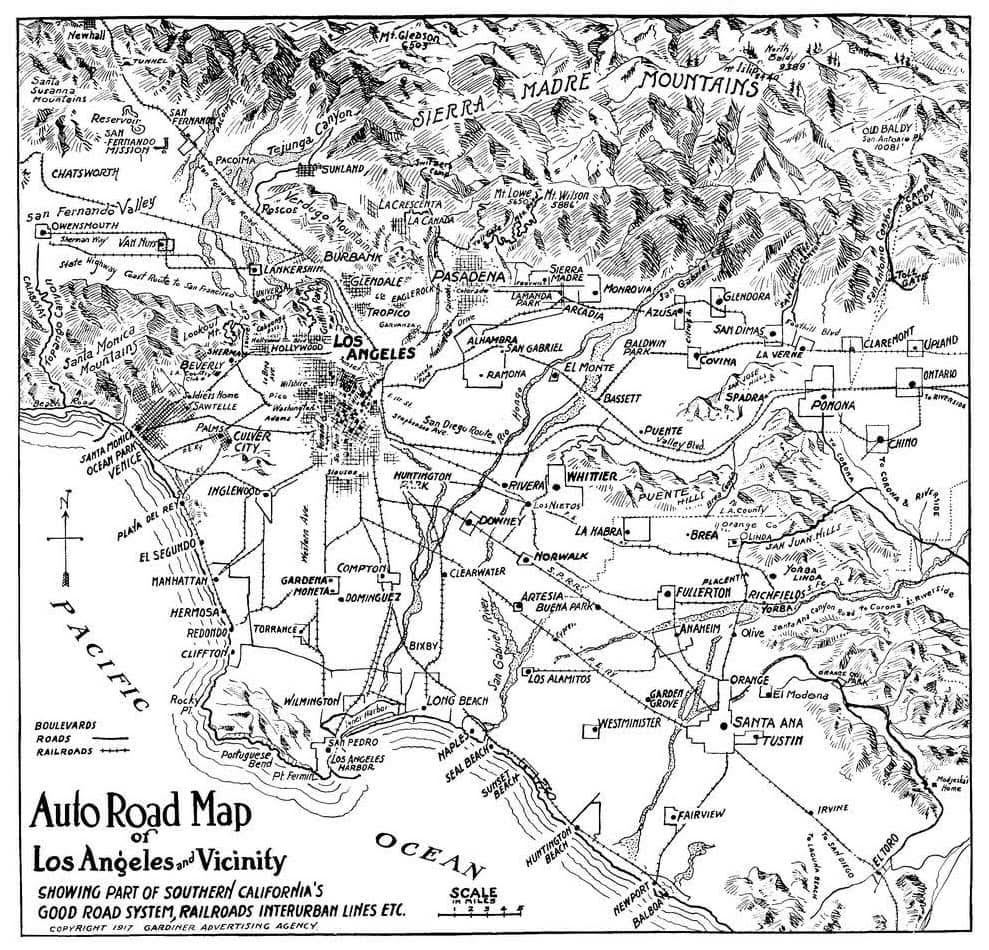
At the time this map was printed, Los Angeles County was booming with droves of new arrivals pouring in mostly from the East Coast. According to the U.S. Census, the county’s population had grown by 196% during the decade following 1900. By 1910, it had reached 504,131.
At the following census in 1920, the county’s population had swelled to 936,455, which translates to another 85.8% increase over 10 years . Within 20 years of 1900, the population had increased by 5 1/2 times, and 13 times by 1930, ending the decade with a total population of 2,208,492.
Most of the new settlers arrived by railroad. But when the above map was printed, the first automobile affordable to middle-class Americans, the Ford Model T was already in its 9th year of production. While there was a frenzy to build electric tram lines and a bus infrastructure connecting the Los Angeles area, people’s preferences, and the future of personal transportation, were clear. Then as now, people preferred private automobiles over communally shared vehicles the same way as they prefer private bathrooms over public toilets. For much the same reasons, they always will.
By the end of production in 1927, Ford had sold 14,689,525 Model Ts, with the least expensive model selling for just $260. (At the time of this writing, this would amount to an inflation-adjusted price of roughly $5,000 in 2025).
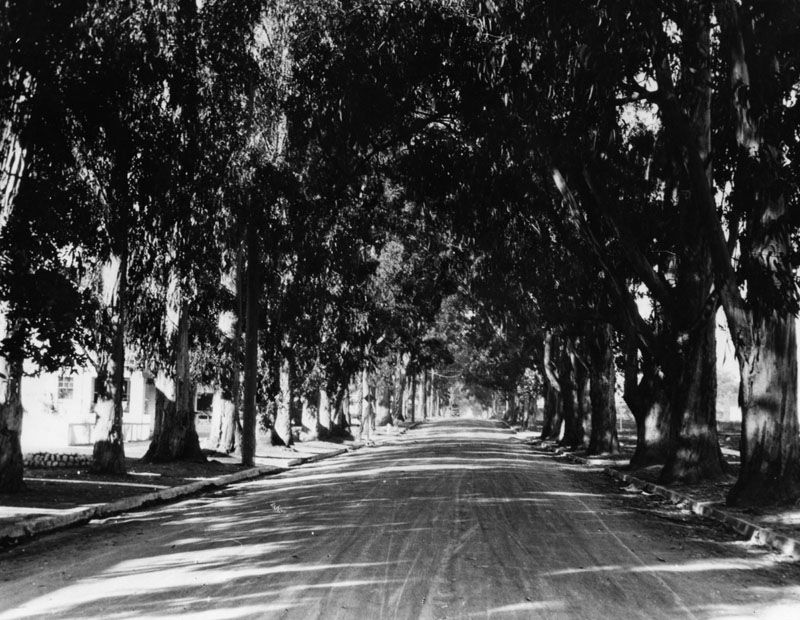
Motoring at the time would have been both fun as well as challenging. Many Los Angeles area roads at the time were still unpaved and rural. The various towns, settlements and cities were scattered about the vast county, and surrounded by farm or ranch land. Cars frequently broke down miles from populated areas. Flat tires were common. The quality of gasoline was unsteady and questionable, and filling stations were a novelty.
Melrose Avenue, 1910
Most gasoline pumps were installed in front of hardware stores, feed companies, livery stables, and a variety of other retailers. Service Town, the earliest known gas station in a modern sense, was built in 1914, three miles from downtown Los Angeles. Before that time, motorists went one place for gas and oil, and other places for lubrication and cleaning, for repairs, or for tires and other accessories.
As automobile sales increased, the demand for fuel led to a more systematic and standardized way of delivering it. In 1914, Standard Oil of California opened a chain of 34 homogeneous stations along the West Coast, and other oil companies quickly followed suit to secure an outlet for their now increasingly branded and advertised products.
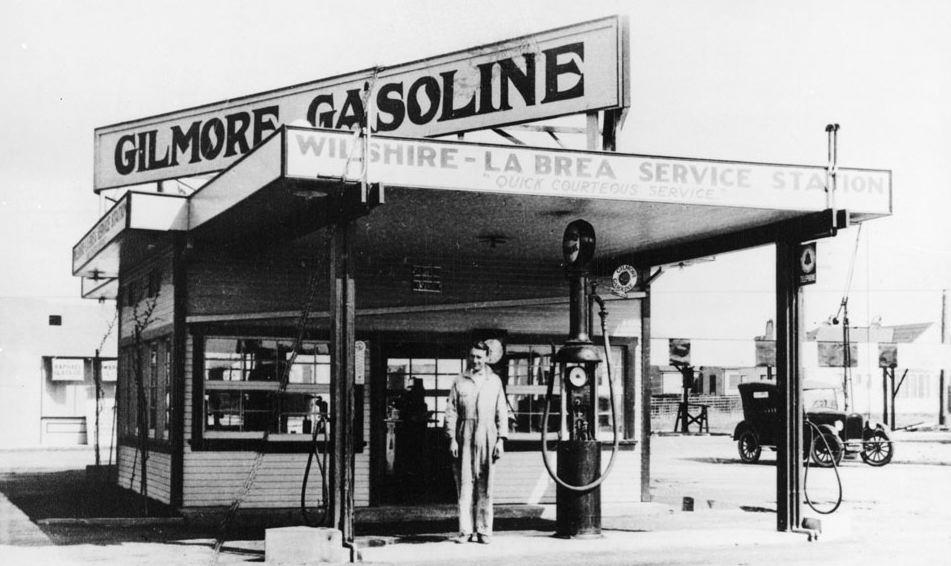
The Gilmore Gas Station was one of the first gas stations in Los Angeles. It was located on the northeast corner of La Brea and Wilshire Boulevards. Photo from ca. 1920. (Los Angeles Department of Water and Power).
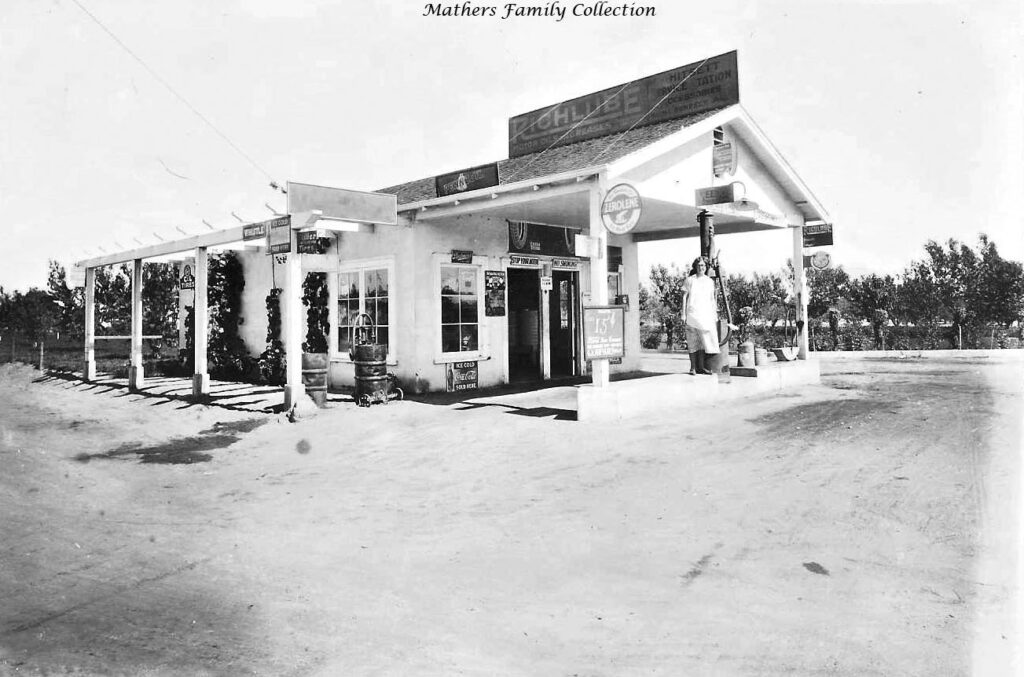
View showing Mabel Demspey standing on the gas pump island at the Whitsett Service Station located at 2912 Whitsett Avenue in North Hollywood. Photo from 1923.(Los Angeles Department of Water and Power).
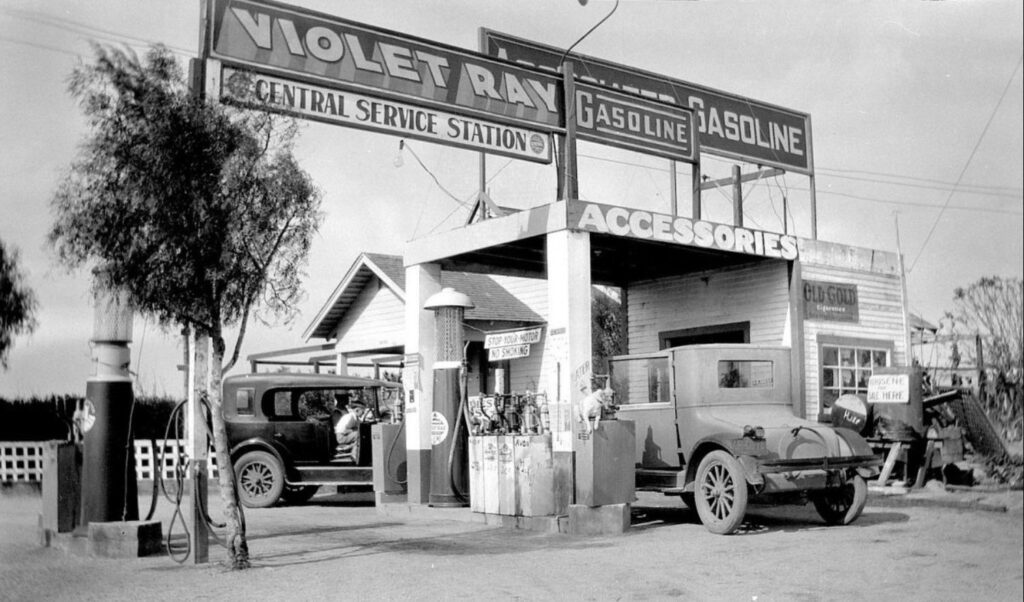
A man and boy sit in a car at the Central Service Station which is selling both Violet Ray Gasoline and Associated Gasoline. Note the dog sitting on top of what appears to be an oil dispenser. Photo ca. 1928.(Los Angeles Department of Water and Power).
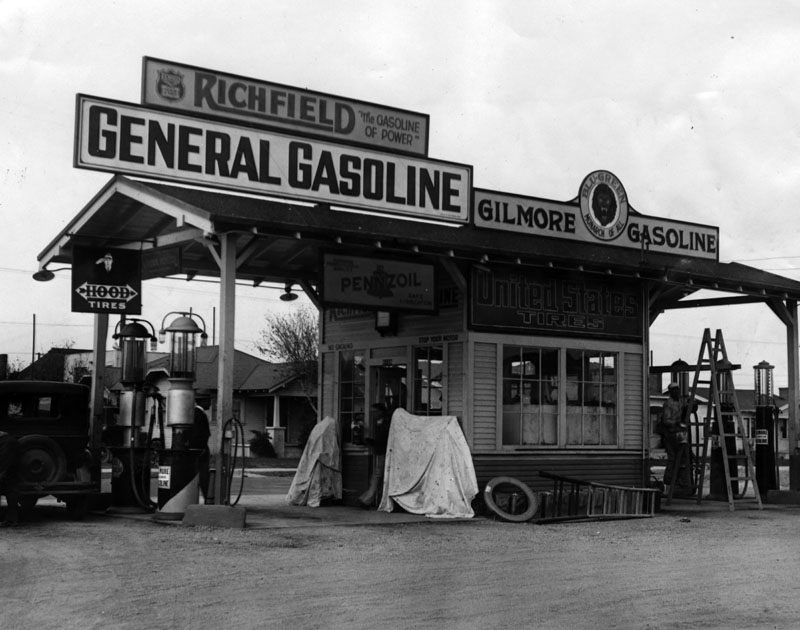
View of service station with gas pumps on either side located at 1800 1/2 Long Beach Boulevard, South Gate. The signs advertise General Gasoline, Richfield Gasoline, Gilmore Gasoline, Hood Tires, United States Tires and Pennzoil. On the right, an attendant is climbing a ladder. Photo ca. 1928. (Los Angeles Department of Water and Power).
Some of the cities on the road map shown above no longer exist, but were absorbed by Los Angeles or other cities. Examples (on the Westside) are the historic City of Sawtelle and the town of Venice, which were annexed by the City of Los Angeles, and the City of Ocean Park, which opted to join the City of Santa Monica
In 1910, the semi-rural town of Hollywood had voted to merge with Los Angeles in order to secure an adequate water supply and to gain access to the L.A. sewer system. This was very common development at the time, and one which many cities later bitterly regretted.
The community of Pacific Palisades, which was consumed by the horrendous fire of 2025, didn’t exist yet. Neither did the City of Malibu, nor the Roosevelt Highway (later renamed to “Pacific Coast Highway”). But there was a “Beach Road” along the coast, as well as a steam rail line from Downtown Los Angeles to Santa Monica. The latter was how most beach goers arrived to take a few days of respite from the summer heat further inland.
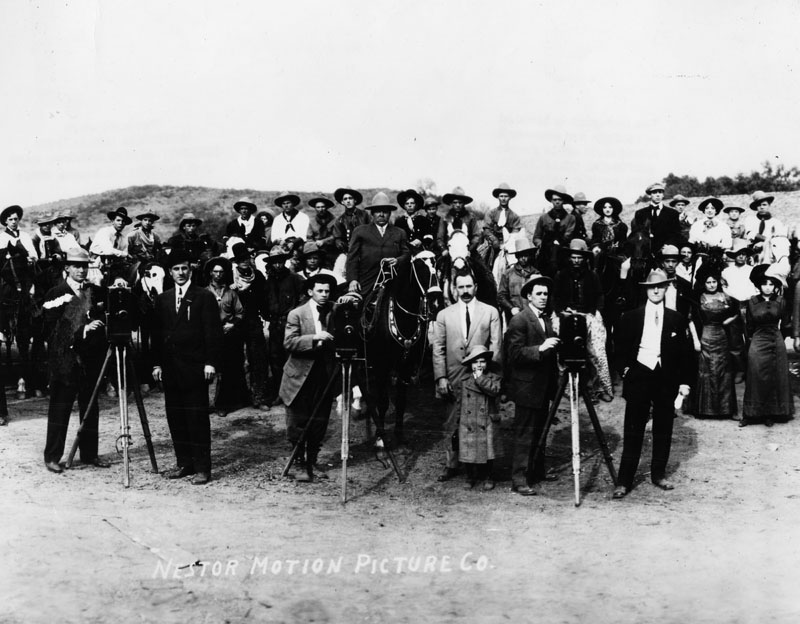
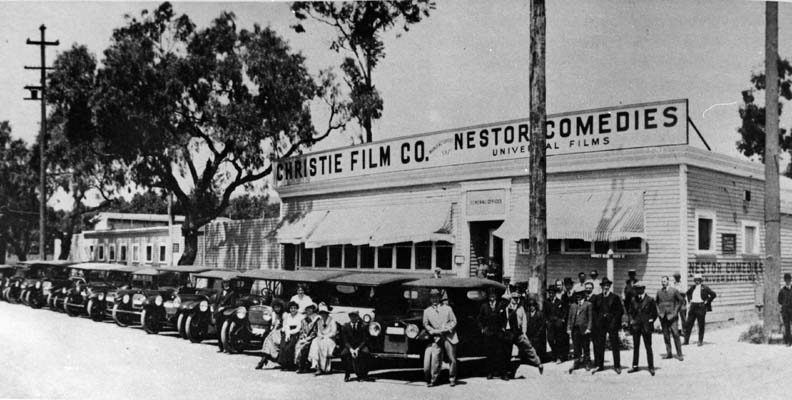
By 1912, some motion-picture companies had moved out West to set up production facilities near or in Los Angeles, one of the first one being short lived Nestor Studios. (Originally known as Nestor Motion Picture Company, then Nestor Film Company, it merged with the Universal Film Manufacturing Company, headed by Carl Laemmle, in 1912).
At the time, the pioneering movie studios were still a newfangled and rather suspect industry, viewed with skepticism by investors, polite society, and cultural guardians alike. They certainly weren’t the main reason why people from all over North America (and Europe) wanted to move to Los Angeles. More important factors were the discovery of vast oilfields and seemingly endless opportunities to make money and fortunes. There was affordable and available vacant land on which one could build quickly, cheaply, and year-round. And all this came with a pleasant climate, and a plentiful supply of fresh meat, fruit and vegetables throughout the year. (This would have been a major draw at a time when heating consisted of building a fire in an oven or fireplace, and electric refrigerators were a rare novelty).
But I would argue that of all industries, it was the motion picture industry which drove America’s rapid motorization in the first part of the 20th Century. Cinemas would soon reach every corner of the country. And there, on big silver screens, huge crowds of people saw all segments of society happily motoring around Southern California. Often in open cars no less, far from snow and ice, and enjoying the joys of personal, individual transportation. To audiences back then, all this looked like magic. And of course, the car industry back east could not have invented a better publicity campaign.
(according to Richard W. Fisher, former President and CEO of the Federal Reserve Bank of Dallas)
California
The Governor of California is jogging with his dog along a nature trail. A coyote jumps out and attacks the Governor’s dog, then bites the Governor.
The Governor starts to intervene, but reflects upon the movie “Bambi” and then realizes he should stop because the coyote is only doing what is natural.
He calls animal control. Animal Control captures the coyote and bills the state $200 testing it for diseases and $500 for relocating it.
He calls a veterinarian. The vet collects the dead dog and bills the State $200 testing it for diseases.
The Governor goes to hospital and spends $3,500 getting checked for diseases from the coyote and on getting his bite wound bandaged.
The running trail gets shut down for 6 months while Fish & Game conducts a $100,000 survey to make sure the area is now free of dangerous animals.
The Governor spends $50,000 in state funds implementing a “coyote awareness program” for residents of the area.
The State Legislature spends $2 million to study how to better treat rabies and how to permanently eradicate the disease throughout the world.
The Governor’s security agent is fired for not stopping the attack. The state spends $150,000 to hire and train a new agent with additional special training regarding the nature of coyotes.
PETA protests the coyote’s relocation and files a $5 million suit against the state.
Texas
The Governor of Texas is jogging with his dog along a nature trail. A coyote jumps out and attacks his dog.
The Governor shoots the coyote with his state-issued pistol and keeps jogging. The Governor has spent $.75 on a .45 ACP hollow point cartridge.
The buzzards eat the dead coyote.
And that, my friends, is why California is broke and Texas is not.
For many years, California and New York City have been competing about who can pass the craziest feelgood nanny-state laws and regulations in America. To qualify, such laws must keep bureaucrats and politicians ostensibly busy, so it appears as though they are actually performing a valuable public service. Bold and fearless, our superhero politicians are fighting to save us from one urgent social ill or another! Bonus points are awarded for laws that are unenforceable and inconsequential. Double bonus points if the law’s effects cannot be measured, rationally examined or fiscally accounted for in any way.
New York City was clearly in the lead with the NY SAFE Act of 2013, which among other things prohibits the possession of gun magazines with a capacity of more than 10 rounds. (No official word yet on how many of New York’s criminals have turned in their now illegal gun magazines). The law also required that only 7 rounds could be loaded in each 10-round magazine. (New York gets one point deducted because this provision was struck down by a federal judge in 2013. According to rumors, the court’s concern was that many of New York’s criminals would not be able to count to 7 even if they tried).
This week, I am pleased to report that California is in the lead once again!
We first pulled equal with New York by creating a law requiring porn actors to wear condoms while acting their acts. No word on how this should be enforced, but perhaps “Motion Picture Genital Inspector” will soon be an actual job title. Or maybe law enforcement agencies will need special condom enforcement squads. The future will tell.
But it gets even better! This week, California took the lead by adding a new statewide ban on glasses (or cups) of drinking water being served in restaurants – unless the customer specifically requests it. (You must say: “Waiter, may I please have a glass of tap water?” Waiter: “Certainly Sir, I’ll bring it right away” or “Sorry dude, we’re out of tap water today. How ‘bout some bottled water?”)
Yes, you read that right. Of course, we have a drought here in California. Big draught, big trouble. (But not big enough to induce the state to reexamine its crazy stance on immigration, and its equally crazy industrial agribusiness). You see, California’s industrial, export-oriented agriculture consumes 80% of the state’s water. And, the state has been adding about 1 million new residents per year without actually creating more water resources.
California is North America’s biggest producer of almonds, avocados, broccoli, carrots, cauliflower, grapes, lettuce, milk, onions, peppers, spinach, tomatoes, walnuts, and dozens of other commodities. (Source: 2012 Department of Agriculture report (PDF). Only a tiny portion of this stuff could grow naturally in California’s ecosystem – and most of it is exported to other states. This means that drought stricken California is actually exporting huge amounts of water to the rest of North American, and even to Asia.
Someone calculated that for the amount of water used for the irrigation of California’s almond trees alone (they produce a cash crop mostly for export), someone like me could take a 10-minute shower each day. For 86 million years.
Relative to the overall water consumption, water imbibing in restaurants is a microscopically tiny portion. Even if totally prohibited, even if we all stopped drinking water altogether and only drank imported beer – it would make no difference whatsoever.
As a matter of fact, eating out in restaurants is a much bigger culprit, because the restaurant industry is extremely wasteful with water (and food) when compared to home kitchens. And in fact, the law might even have the opposite of the intended effect. If it induces people to order bottled water instead, then there’d be a net increase in drinking water consumption. That’s because filtering and bottling water actually wastes a lot of it. For instance, reverse osmosis, a commonly used process to produce bottled table water, wastes up to 86% of the feed water – only 14% ends up in the bottle.
Well played, California. How can you trump that, New York? Your move!
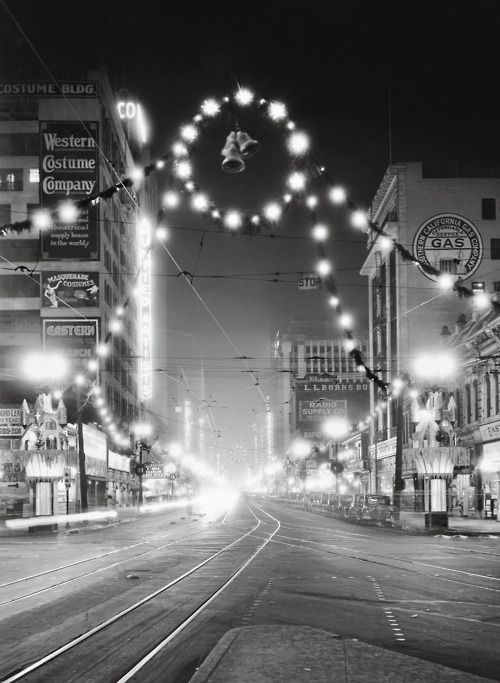
Christmas on Broadway, Downtown Los Angeles, 1940s
Nov. 28, 1952: Police officer watches traffic on Hollywood Blvd. after holiday lights were turned on. Photo looking east from McCadden Place. (Los Angeles Times Archives)