I wish restaurants still had places to hang jackets and hats – like here at Musso & Frank in Hollywood.




Journalist and media professional currently based in Los Angeles, California. Focusing on science and technology.

I wish restaurants still had places to hang jackets and hats – like here at Musso & Frank in Hollywood.
Journalist and media professional currently based in Los Angeles, California. Focusing on science and technology.
Annual subscription: $4.50. Single issue: 10c.

Photo possibly taken at Zuma Beach, looking south, with Pointe Dume in the background?
Journalist and media professional currently based in Los Angeles, California. Focusing on science and technology.

As seen in this street scene around Christmas in the early 1950s, the Broadway Hollywood Building (sometimes Broadway Building or Broadway Department Store Building) is situated in the Hollywood Walk of Fame monument area on the southwest corner of the intersection of Hollywood Boulevard and Vine Street.
It was originally built as the B. H. Dyas Building in 1927. The Broadway Hollywood Building is referred to by both its main address of 6300 Hollywood Boulevard and its side address of 1645 Vine Street.
The building housed the Broadway Department Store until 1982, after which building was reconfigured for office use. In 2005, after having been vacant for many years, a renovation began to convert the 10-story building into 96 loft condominiums, while adding two floors to the annex.
(Photographer unknown).
Journalist and media professional currently based in Los Angeles, California. Focusing on science and technology.
by Reinhard Kargl

Dated at 1924, this appears to be one of the earliest known aerial photographs of the La Monica Ballroom on the Santa Monica Pier in California. The picture must have been taken shortly before or at the opening of the La Monica Ballroom on July 23, 1924, seen here at the end of the pier. (Dunning Air, Ernest Marquez Collection, The Huntington Digital Library)
Over time, the city of Santa Monica was home to several wharfs and piers, but only the Santa Monica Pier still exists today as a famous historic landmark.

Technically, what we see in the pictures consists of two separate piers. The long, narrow portion constitutes the “Municipal Pier”, which opened on September 9, 1909 and was originally constructed for the rather inglorious purpose of carrying sewage water beyond the breaking waves.
The wide “Pleasure Pier” to the south (on the right side in the pictures) was privately owned and also known as the “Newcomb Pier”. This portion was added by amusement park pioneers Charles I. D. Looff and his son Arthur.

Charles I. D. Looff (born Carl Jürgen Detlef Looff) was a Danish master carver and builder of hand-carved carousels and amusement rides, who immigrated to the United States of America in 1870. Looff built the first carousel at Coney Island in 1876. During his lifetime, he built over 40 carousels, several amusements parks, numerous roller coasters and Ferris wheels, including California’s famous Santa Monica Pier. He became famous for creating the unique Coney Island style of carousel carving. Photo: Long Beach Public Library.
On June 12, 1916, Santa Monica’s “Looff Hippodrome”, containing a carousel opened to the public. Eventually, other attractions included the Blue Streak Racer wooden roller coaster (which was purchased from the defunct Wonderland amusement park in San Diego), the Whip, merry-go-rounds, Wurlitzer organs, and a “funhouse”.

The La Monica Ballroom at the end of the pier and seen in the front of the photograph was designed by T. S. Eslick and featured a Spanish façade, and a French Renaissance inspired interior. It was advertised as “the largest dance hall on the west coast”.
La Monica’s 15,000-square-foot (1,400 m2) hard maple floor offered space for 5,000 dancers and competed with the the Bon Ton Ballroom (later renamed Aragon Ballroom) on what was then known as the “Lick Pier”, located a few miles down the coast in Venice.

Autos crowd the pier during the grand opening of the La Monica Ballroom on July 23, 1924. The event was reported to have attracted 50,000 people producing the first traffic jam in Santa Monica.
In the days before air conditioning, Santa Monica’s Pleasure Pier and its attractions thrived during the 1920s, but faded during the Great Depression.


Ca. 1926. Adelbert Bartlett Papers. Department of Special Collections, Charles E. Young Research Library, UCLA.

Ca. 1930: The Santa Monica Deauville Club in the foreground, with the La Monica Ballroom rising in the distance above the pier.

People on the Santa Monica Pier looking out over Santa Monica Beach below, ca. 1930. The Santa Monica Athletic Club and part of the Deauville Club are in view at upper right.
Subsequently, during the 1930s most of the amusement park attractions were closed down, sold off, or falling into disrepair. Then in 1934, a breakwater was built. This provided protected docking for up to 100 fishing and pleasure boats near the pier, and helped attract new income.

Ca. 1934: A crowd amid beach umbrellas watching two pugilists boxing in an outdoor boxing ring on the beach in front of the Santa Monica Athletic Club. The Santa Monica Pleasure Pier with the La Monica Ballroom and Municipal Pier are in the background.


1936: Crowds of people standing in line at the Catalina Steamer Landing on Santa Monica Pier across from the La Monica Ballroom.

A 1936 postcard view of Santa Monica Beach showing the La Monica Ballroom on the pier. A portion of the Deauville Club (opened in 1927) can be seen in lower right. Photo by Burton Frasher Sr. (1888-1955), Pomona Public Library, Frasher Foto Postcard Collection).
The “Swinging Years” of Big Band Jazz from 1935 to 1945 also brought new crowds to the ballroom. And country music and “western swing” star Spade Cooley began broadcasting his weekly television show from the the La Monica Ballroom in 1948, where the program remained until 1954.
After that, in the summer of 1955, the Hollywood Autocade opened at the La Monica, featuring roughly one hundred famous and unusual cars, including Jack Benny’s Maxwell and a Rumpler Drop Car. Between 1955 to 1962, the ballroom served as a roller skating rink, first as “Skater’s Ballroom”, and later as the “Santa Monica Roller Rink”. A local speed skating club is said to have won many state and regional championships. Speed skater Ronnie Rains became a Roller Derby star. The rink’s operator was a former vaudeville and silent film star, Jack Goodrich, whose daughter, Michelle Goodrich, later became a showgirl in Ice Capades.
The owners of the pier and the ballroom, the Newcomb family didn’t invest enough in upkeep and upgrades to keep the venue from decaying.
And so, the La Monica Ballroom was closed to the public 1962, and demolished in 1963.
Journalist and media professional currently based in Los Angeles, California. Focusing on science and technology.
by Reinhard Kargl
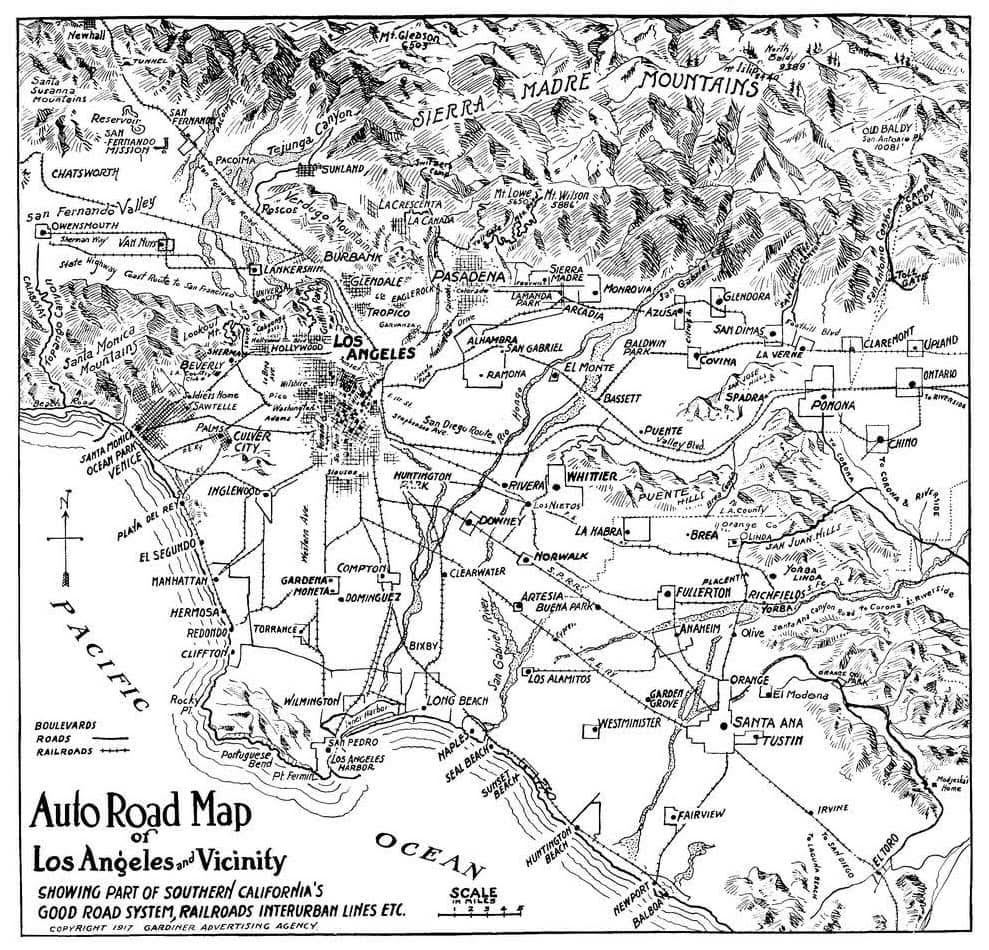
At the time this map was printed, Los Angeles County was booming with droves of new arrivals pouring in mostly from the East Coast. According to the U.S. Census, the county’s population had grown by 196% during the decade following 1900. By 1910, it had reached 504,131.
At the following census in 1920, the county’s population had swelled to 936,455, which translates to another 85.8% increase over 10 years . Within 20 years of 1900, the population had increased by 5 1/2 times, and 13 times by 1930, ending the decade with a total population of 2,208,492.
Most of the new settlers arrived by railroad. But when the above map was printed, the first automobile affordable to middle-class Americans, the Ford Model T was already in its 9th year of production. While there was a frenzy to build electric tram lines and a bus infrastructure connecting the Los Angeles area, people’s preferences, and the future of personal transportation, were clear. Then as now, people preferred private automobiles over communally shared vehicles the same way as they prefer private bathrooms over public toilets. For much the same reasons, they always will.
By the end of production in 1927, Ford had sold 14,689,525 Model Ts, with the least expensive model selling for just $260. (At the time of this writing, this would amount to an inflation-adjusted price of roughly $5,000 in 2025).
Motoring at the time would have been both fun as well as challenging. Many Los Angeles area roads at the time were still unpaved and rural. The various towns, settlements and cities were scattered about the vast county, and surrounded by farm or ranch land. Cars frequently broke down miles from populated areas. Flat tires were common. The quality of gasoline was unsteady and questionable, and filling stations were a novelty.
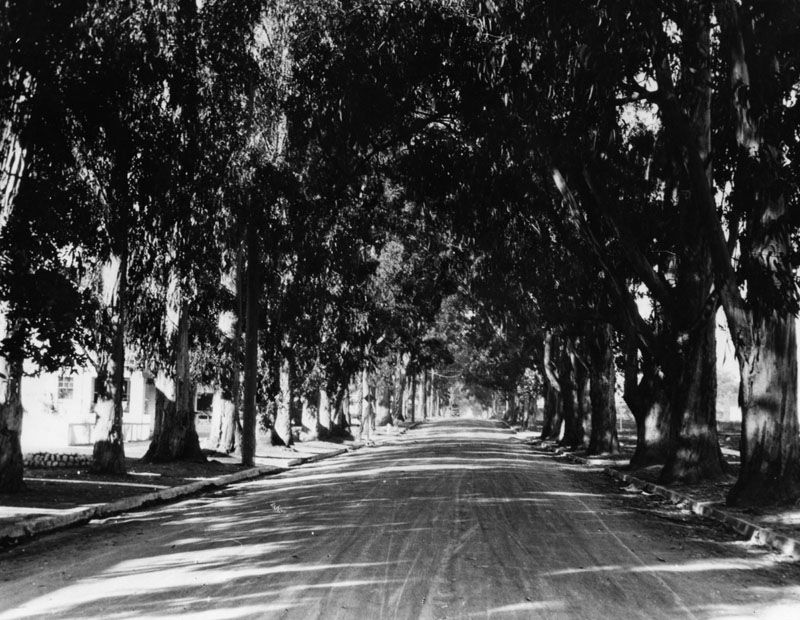
Melrose Avenue, 1910
Most gasoline pumps were installed in front of hardware stores, feed companies, livery stables, and a variety of other retailers. Service Town, the earliest known gas station in a modern sense, was built in 1914, three miles from downtown Los Angeles. Before that time, motorists went one place for gas and oil, and other places for lubrication and cleaning, for repairs, or for tires and other accessories.
As automobile sales increased, the demand for fuel led to a more systematic and standardized way of delivering it. In 1914, Standard Oil of California opened a chain of 34 homogeneous stations along the West Coast, and other oil companies quickly followed suit to secure an outlet for their now increasingly branded and advertised products.
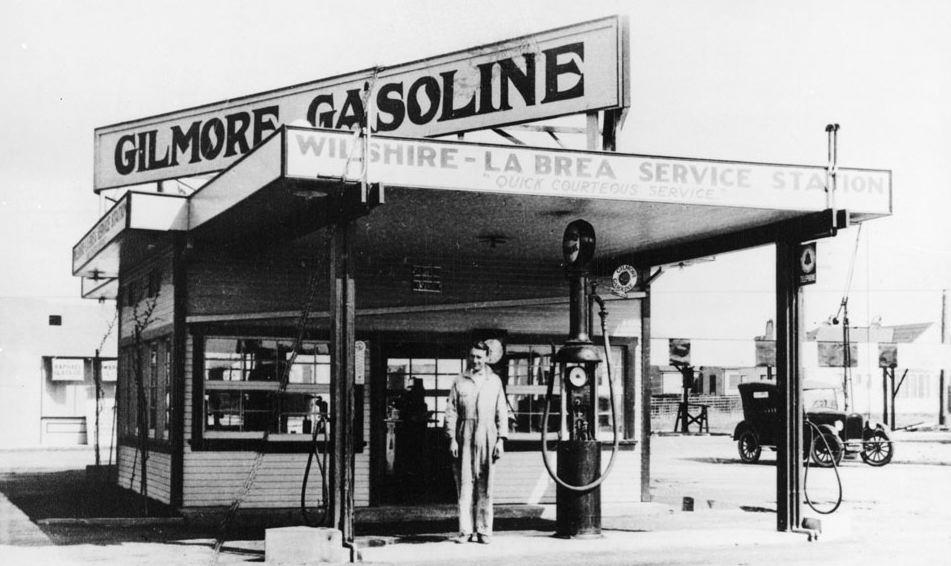
The Gilmore Gas Station was one of the first gas stations in Los Angeles. It was located on the northeast corner of La Brea and Wilshire Boulevards. Photo from ca. 1920. (Los Angeles Department of Water and Power).
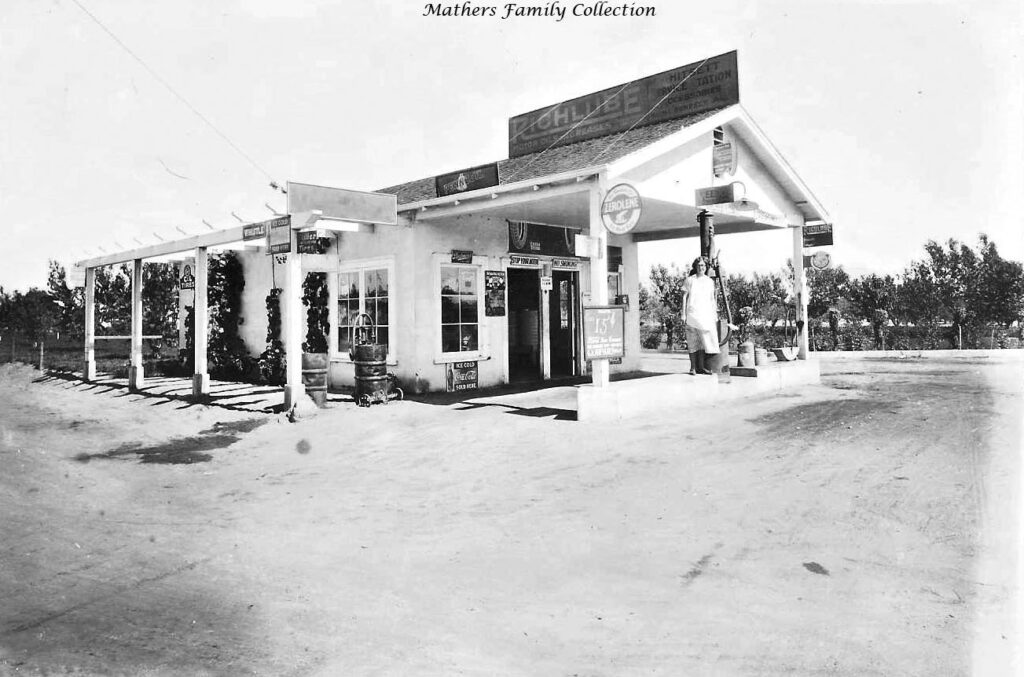
View showing Mabel Demspey standing on the gas pump island at the Whitsett Service Station located at 2912 Whitsett Avenue in North Hollywood. Photo from 1923. (Los Angeles Department of Water and Power).
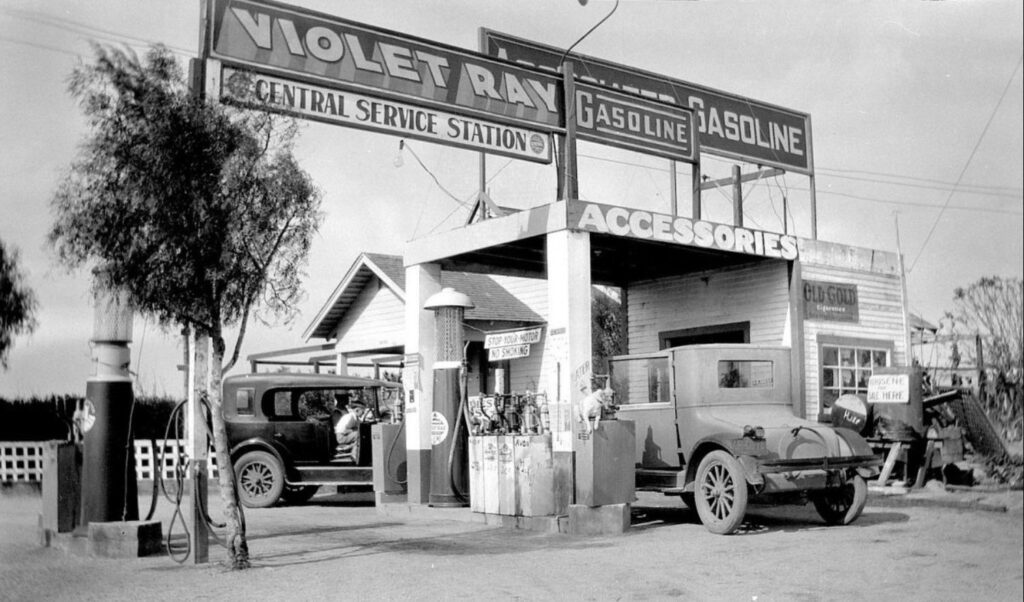
A man and boy sit in a car at the Central Service Station which is selling both Violet Ray Gasoline and Associated Gasoline. Note the dog sitting on top of what appears to be an oil dispenser. Photo ca. 1928. (Los Angeles Department of Water and Power).
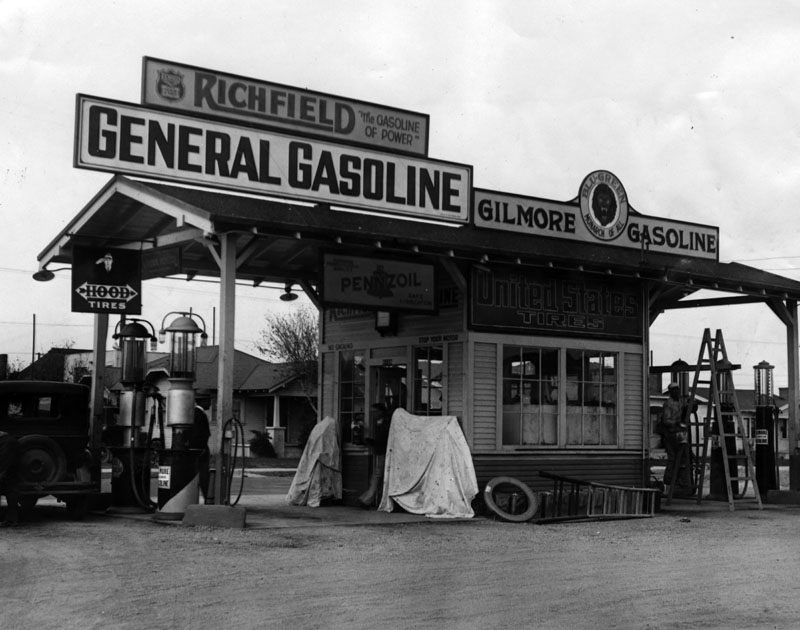
View of service station with gas pumps on either side located at 1800 1/2 Long Beach Boulevard, South Gate. The signs advertise General Gasoline, Richfield Gasoline, Gilmore Gasoline, Hood Tires, United States Tires and Pennzoil. On the right, an attendant is climbing a ladder. Photo ca. 1928. (Los Angeles Department of Water and Power).
Some of the cities on the road map shown above no longer exist, but were absorbed by Los Angeles or other cities. Examples (on the Westside) are the historic City of Sawtelle and the town of Venice, which were annexed by the City of Los Angeles, and the City of Ocean Park, which opted to join the City of Santa Monica
In 1910, the semi-rural town of Hollywood had voted to merge with Los Angeles in order to secure an adequate water supply and to gain access to the L.A. sewer system. This was very common development at the time, and one which many cities later bitterly regretted.
The community of Pacific Palisades, which was consumed by the horrendous fire of 2025, didn’t exist yet. Neither did the City of Malibu, nor the Roosevelt Highway (later renamed to “Pacific Coast Highway”). But there was a “Beach Road” along the coast, as well as a steam rail line from Downtown Los Angeles to Santa Monica. The latter was how most beach goers arrived to take a few days of respite from the summer heat further inland.
By 1912, some motion-picture companies had moved out West to set up production facilities near or in Los Angeles, one of the first one being short lived Nestor Studios. (Originally known as Nestor Motion Picture Company, then Nestor Film Company, it merged with the Universal Film Manufacturing Company, headed by Carl Laemmle, in 1912).
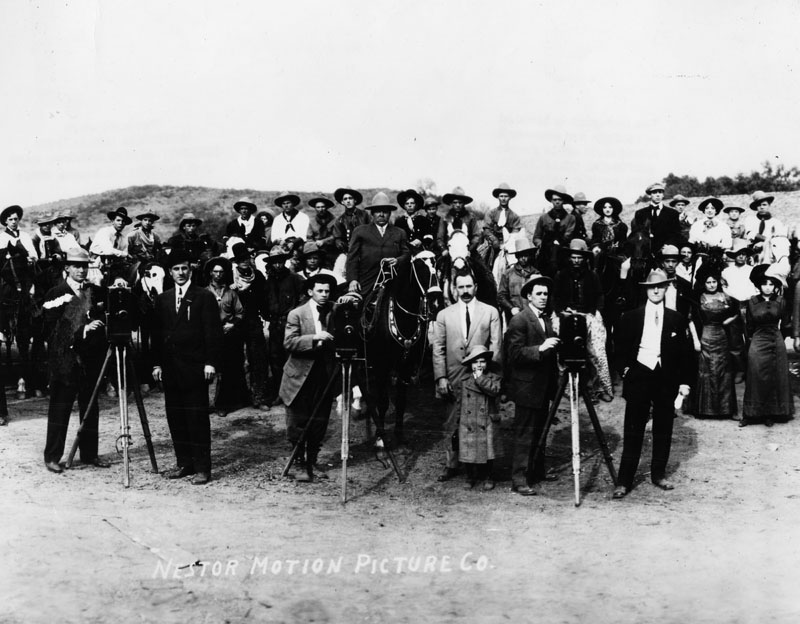
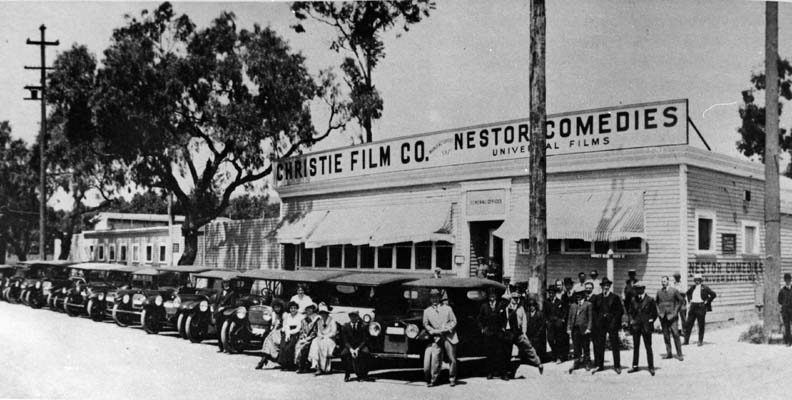
At the time, the pioneering movie studios were still a newfangled and rather suspect industry, viewed with skepticism by investors, polite society, and cultural guardians alike. They certainly weren’t the main reason why people from all over North America (and Europe) wanted to move to Los Angeles. More important factors were the discovery of vast oilfields and seemingly endless opportunities to make money and fortunes. There was affordable and available vacant land on which one could build quickly, cheaply, and year-round. And all this came with a pleasant climate, and a plentiful supply of fresh meat, fruit and vegetables throughout the year. (This would have been a major draw at a time when heating consisted of building a fire in an oven or fireplace, and electric refrigerators were a rare novelty).
But I would argue that of all industries, it was the motion picture industry which drove America’s rapid motorization in the first part of the 20th Century. Cinemas would soon reach every corner of the country. And there, on big silver screens, huge crowds of people saw all segments of society happily motoring around Southern California. Often in open cars no less, far from snow and ice, and enjoying the joys of personal, individual transportation. To audiences back then, all this looked like magic. And of course, the car industry back east could not have invented a better publicity campaign.
Journalist and media professional currently based in Los Angeles, California. Focusing on science and technology.
by Reinhard Kargl
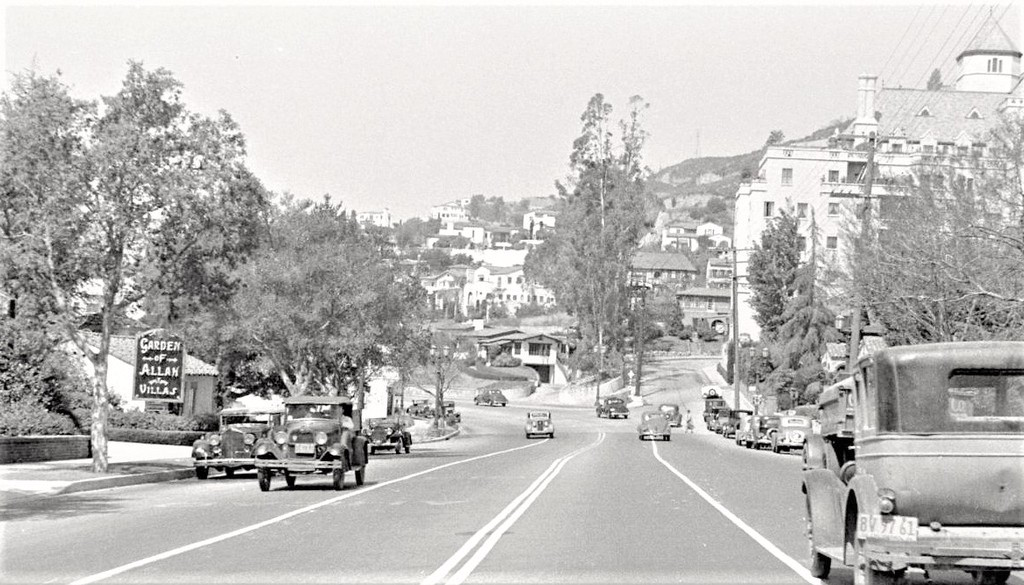
On the left in this rare image of Sunset Boulevard just west of Crescent Heights, taken during the early 1930s, we see the entrance to the Garden of Allah at 8152 Sunset Boulevard. On the right is the Chateau Marmont, which still stands. A house behind the trees in the center would eventually become the Preston Sturges’ Players Club, then the Imperial Gardens, Miyagi’s, and the Roxbury.
About three decades preceding this photograph, the hills to the north were still lined with orange groves. What became Sunset Boulevard was just a dirt road. By 1905, real estate mogul William Hamilton Hay (1865-1946) began dividing and developing 160-acres of land bounded by today’s Sunset Boulevard to the north, Santa Monica Boulevard to the south, Crescent Avenue (today’s Fairfax Avenue) to the east and Sweetzer Avenue, in what is now the City of West Hollywood.
At the originally assigned street address of 8080 Sunset Boulevard, the “Hayvenhurst Estate” occupied a 2.5 acres site fronting Sunset. It was bounded by Crescent Heights Boulevard on the east, and Hayvenhurst Drive (today spelled Havenhurst) on the west. The property’s southern edge formed the city limits between the Hollywood district of the City of Los Angeles, and what later became the incorporated City of West Hollywood. Eventually, the property’s address was changed to 8152 Sunset Boulevard.
The estate had twelve rooms and four bathrooms. The interior finishes were fashioned from Circassian walnut wood which Mr. Hay and his wife Katherine had collected on a trip to the Philippines in 1912. (It is said that the couple personally managed the project). The interior walls were covered in hand-painted canvas and hand-painted. Perhaps unusual for the time, the property included a two-car garage (with upstairs rooms servants).
Completed in 1918, the property stood vacant for several years, as Mr. and Mrs. Hays had moved on to other building projects.
Around that time, the property was recommended to silent film actress Alla Nazimova, who first leased and then bought the estate from the Hays.
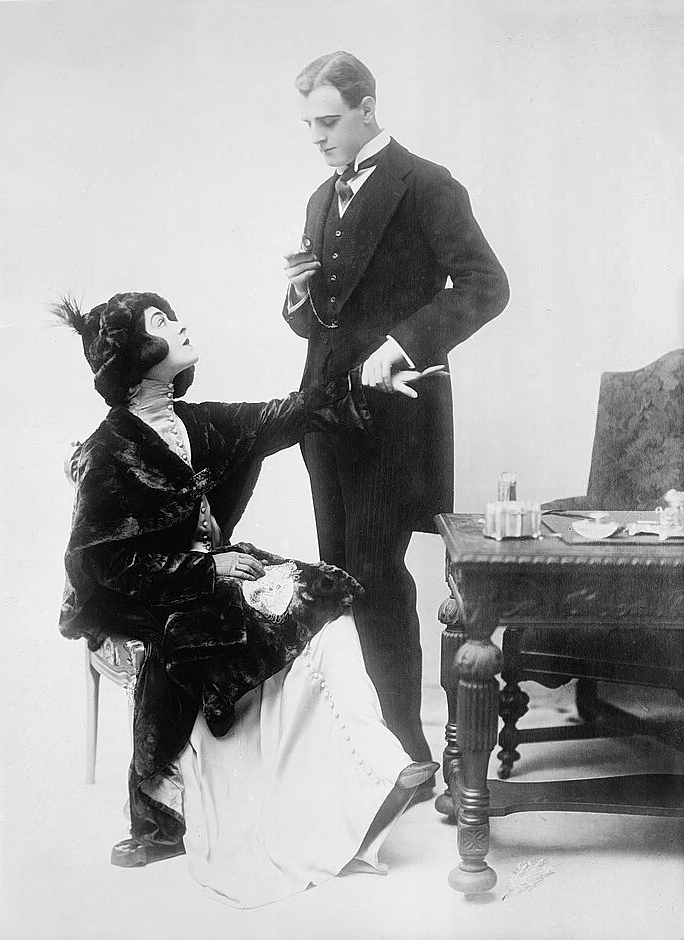
Alla Nazimova and Charles Bryant (actor) in a photo dated Dec. 6, 1912. George Grantham Bain Collection, Library of Congress.
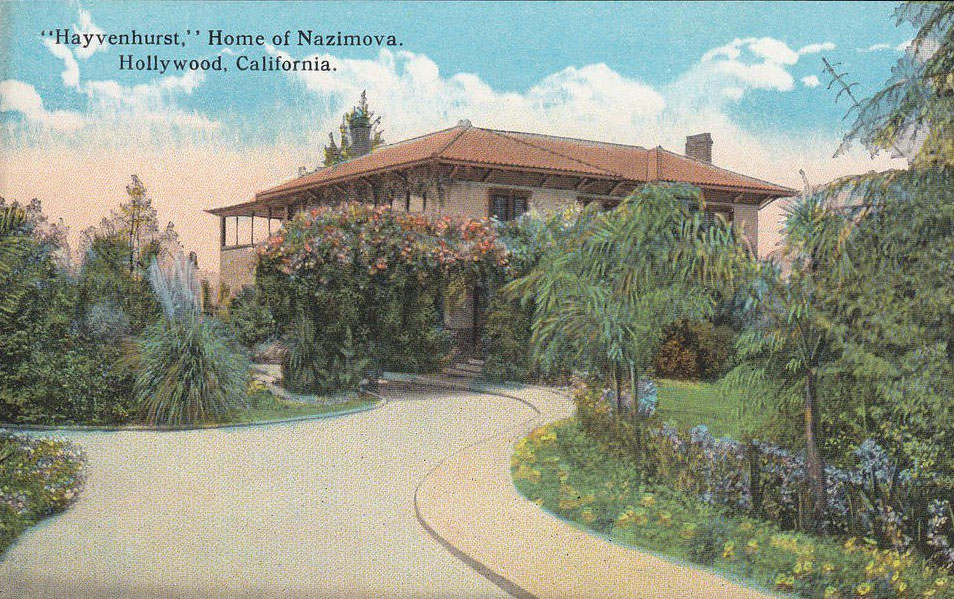
Facing bankruptcy, Ms. Nazimova apparently found investors, and had the property converted to a hotel by commissioning 25 villas on the site. In 1927, this became known as “the Garden of Alla”.
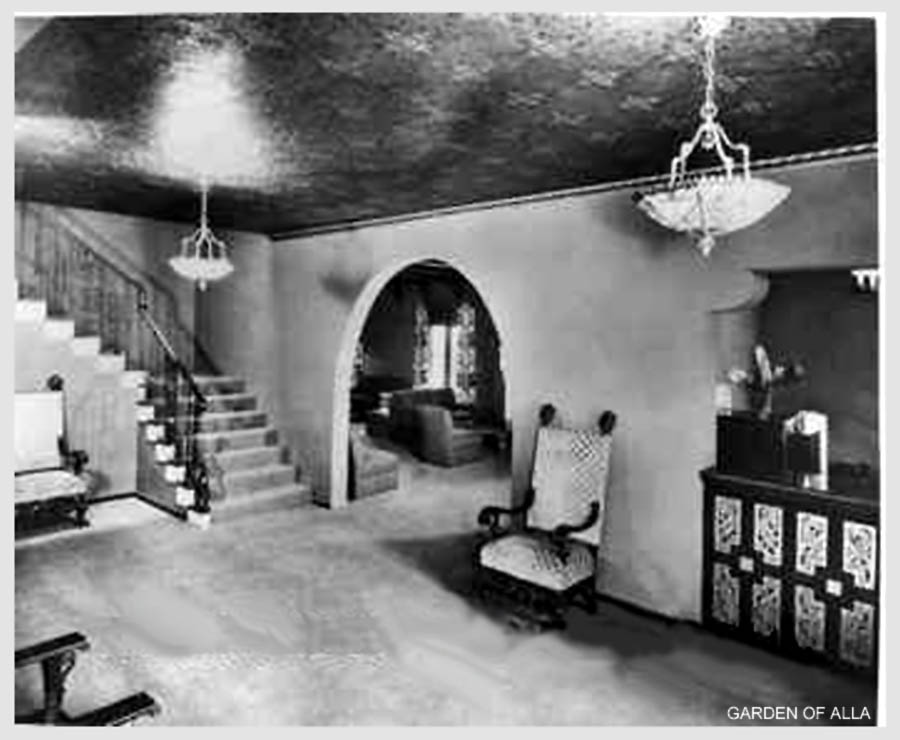
Main house interior, date unknown
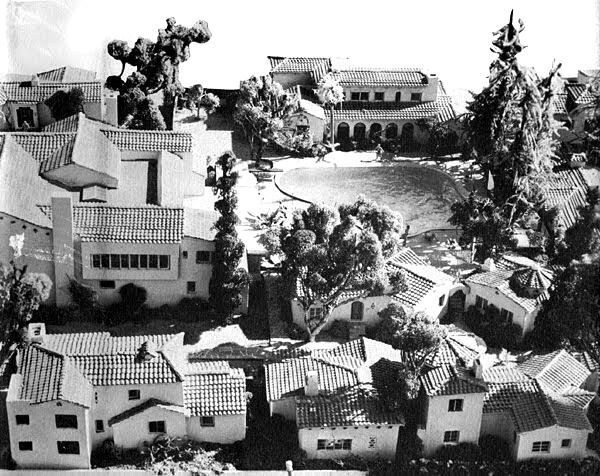
Not skilled in running a hotel, Ms. Nazimova was forced to sell the money-losing property to a holding corporation, which renamed it to “Garden of Allah”. It was, in its heyday, a bohemian hangout for young creative types flocking to Hollywood’s film industry from all corners of the world. Given the list of guests (see below) and the many stories of rambunctious parties, dubious events and salacious happenings, it was quite the place to be.
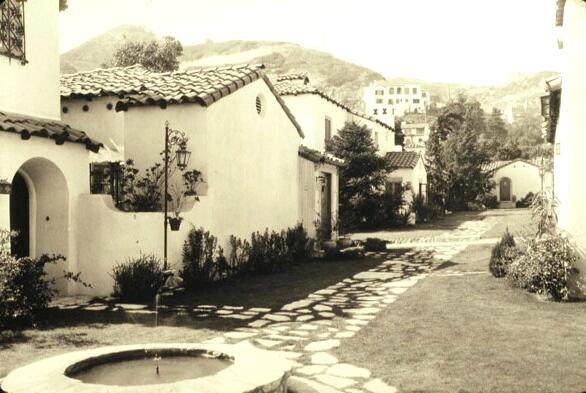
Date unknown
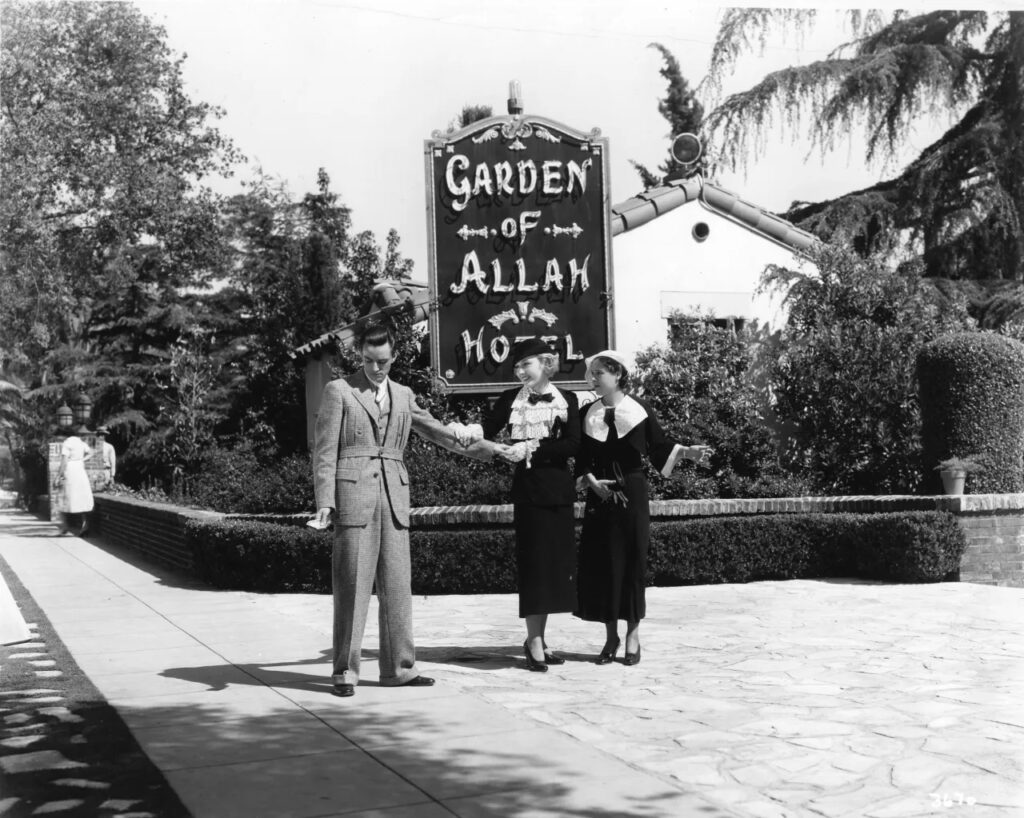
1932

1934
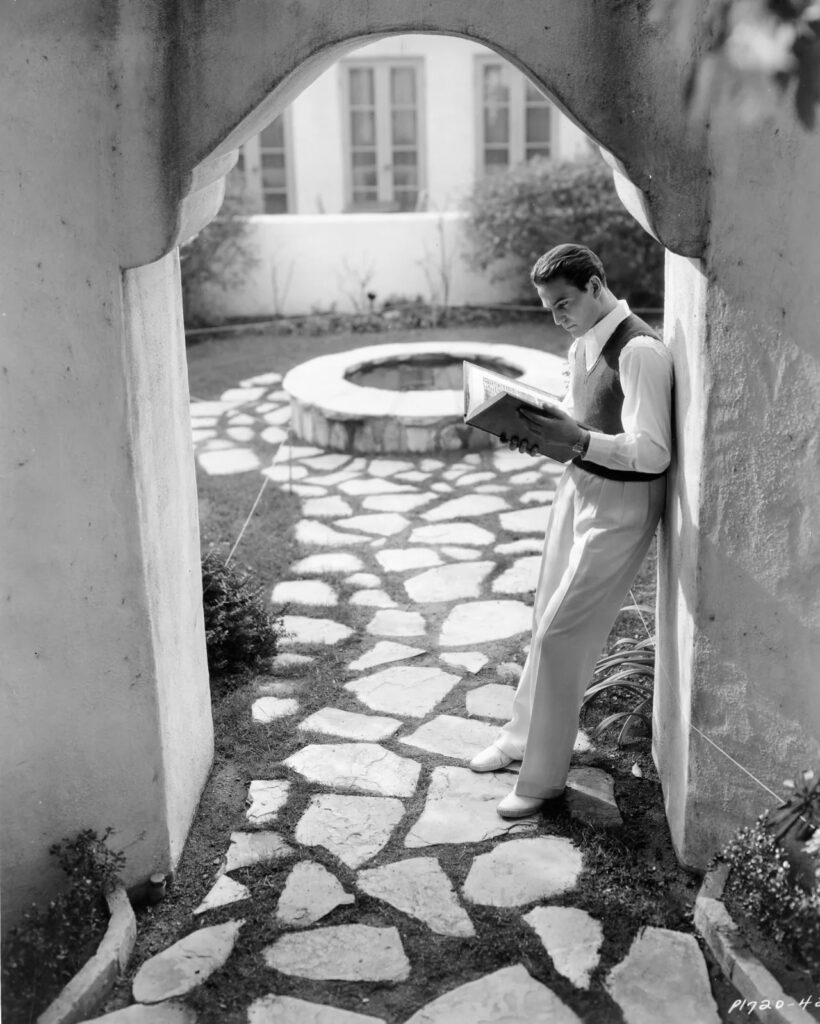
A striking photo of Henry Wilcoxon at the Garden of Allah, 1934. Known as an actor in many of director Cecil B. DeMille’s films, he later served as DeMille’s associate producer.
When Alla Nazimova returned to California in 1938 after a stay on Broadway, she rented Villa 24 at the hotel, and continued to live there until her death in 1945.
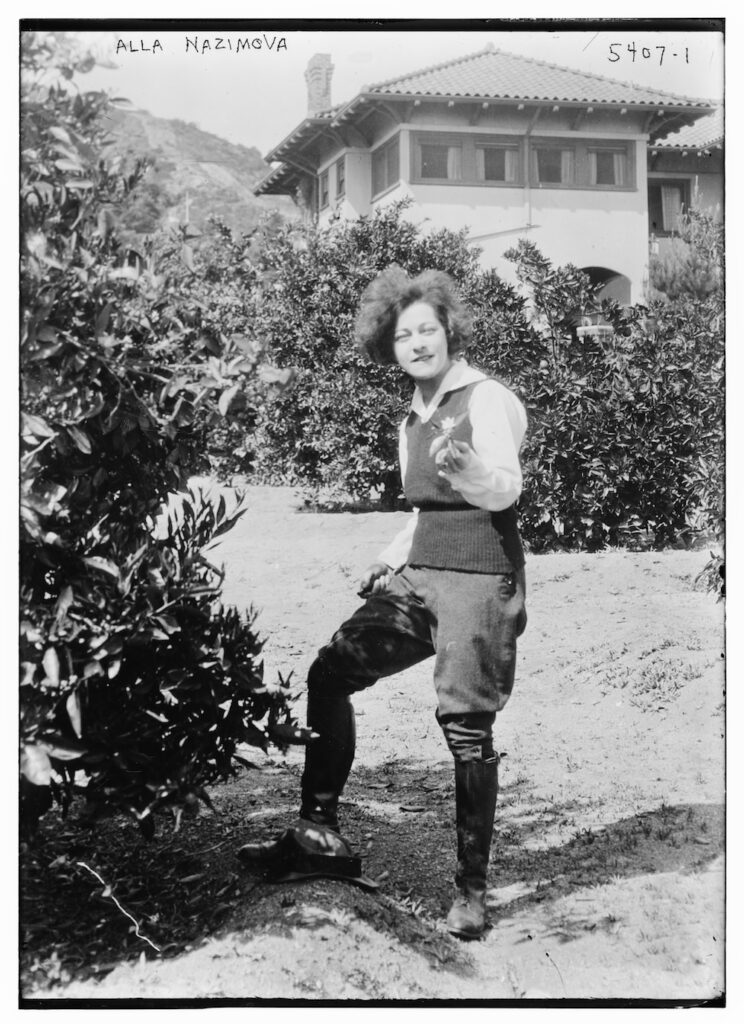
Library of Congress Catalog: https://lccn.loc.gov/2014712156. Image: https://cdn.loc.gov/master/pnp/ggbain/32000/32003u.tif
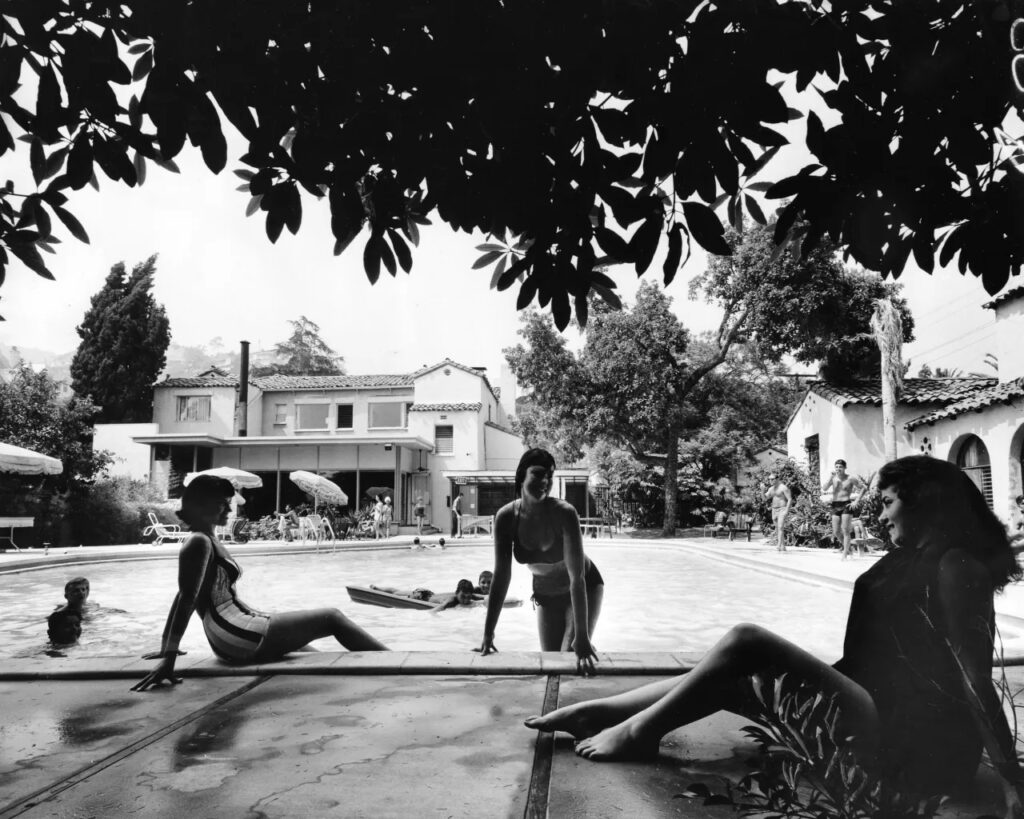
The Garden of Allah pool in 1959
Sadly, after losing its luster and falling into disrepair, the Garden of Allah was torn down in August of 1959, to be replaced with the Lytton Savings & Loan main branch. A pristine example of Googie architecture, the bank building was designated a historic cultural landmark in 2016. Nevertheless, it was condemned to demolition by a subsequent ruling, in order to make way for one of the ugly, disjointed monstrosities Frank Gehry’s architectural firm is known for.
Today, nothing remains of the Garden of Allah, except a place in history, the myth, and an imaginary landmark as one of the central locations in the Golden Era of Hollywood.
Hotel Guests
Various sources have linked the following names to stays at the Garden of Allah:
Lauren Bacall, Tallulah Bankhead, John Barrymore, Donn Beach, Lucius Beebe, Robert Benchley, Humphrey Bogart, Clara Bow, Louis Bromfield, Louise Brooks, Edgar Rice Burroughs, Charles Butterworth, Louis Calhern, John Carradine, Virginia Cherrill, Mickey Cohen, Buster Collier, Ronald Colman, Marc Connelly, Gary Cooper, Joan Crawford, Jean Dalrymple, Lili Damita, Vic Damone, Florence Desmond, Marlene Dietrich, F. Scott Fitzgerald, Errol Flynn, Greta Garbo, Ava Gardner, Dorothy Gish, Jackie Gleason, Jimmy Gleason, Elinor Glyn, Benny Goodman, Frances Goodrich, Ruth Gordon, Sheilah Graham, D.W. Griffith, Albert Hackett, Jon Hall, Jed Harris, Jascha Heifetz, Lillian Hellman, Ernest Hemingway, Woody Herman, Madeline Hurlock, Garson Kanin, George S. Kaufman, Buster Keaton, Muriel King, Eartha Kitt, Alexander Korda, Elsa Lanchester, Charles Laughton, Frank Lawton, Lila Lee, John Loder, Anita Louise, Bessie Love, Ernst Lubitsch, Charles MacArthur, Frances Marion, Harpo Marx, Zeppo Marx, Groucho Marx, Sam Marx, Glesca Marshall, Somerset Maugham, Patty McCormack, Ward Morehouse, Nita Naldi, Ramon Novarro, Alla Nazimova, David Niven, John O’Hara, Maureen O’Hara, Walter O’Keefe, Maureen O’Sullivan, Clifford Odets, Laurence Olivier, Dorothy Parker, Johnny Roselli, S.J. Perelman, Roland Petit, Tyrone Power, Sergei Rachmaninoff, Ronald Reagan, Flora Robson, Ginger Rogers, Harry Ruby, Natalie Schafer, Leon Shamroy, Artie Shaw, Mildred Shay, Arthur Sheekman, Robert E. Sherwood, Frank Sinatra, Red Skelton, Everett Sloane, Barbara Stanwyck, John Steinbeck, Donald Ogden Stewart, Leopold Stokowski, Igor Stravinsky, Gloria Stuart, Margaret Sullavan, Kay Thompson, Whitney Tower, Forrest Tucker, H.B. Warner, Orson Welles, Dame May Whitty, Herbert Wilcox, Hugh Williams, Hope Williams, John Hay “Jock” Whitney, Alexander Woollcott, Vincent Youmans.
Journalist and media professional currently based in Los Angeles, California. Focusing on science and technology.
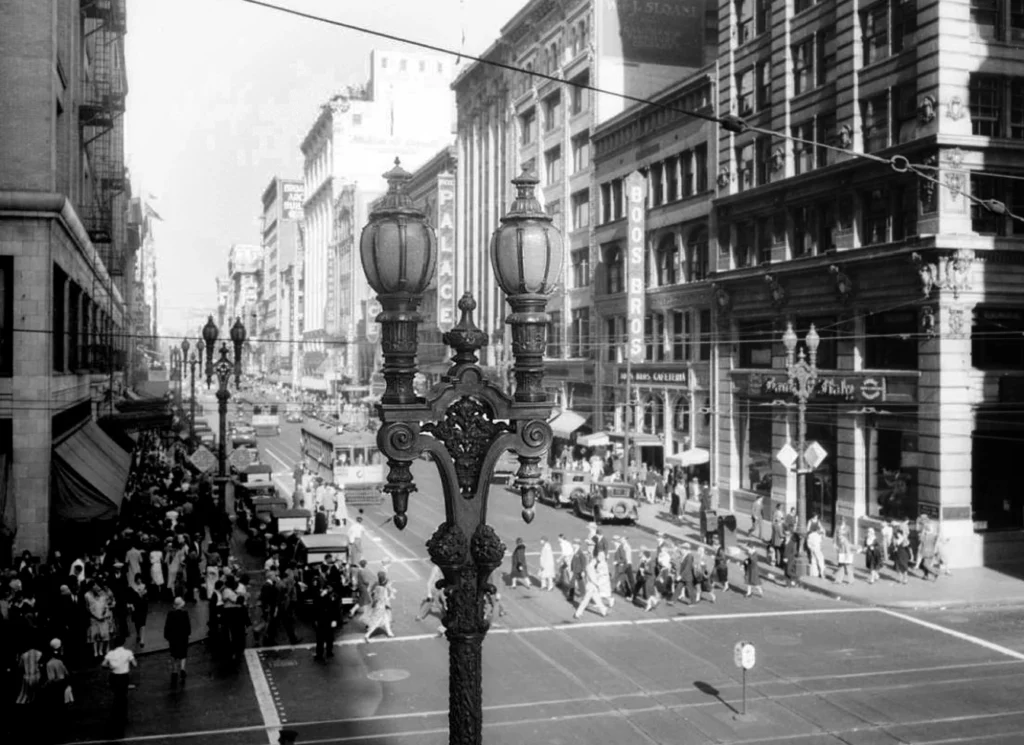
Here’s a picture of 6th Street (between Olive Street and Flower Street) in Downtown Los Angeles, 1930. It was part of this article about the history of street lights in Los Angeles.
Journalist and media professional currently based in Los Angeles, California. Focusing on science and technology.
Los Angeles from Ian Wood on Vimeo.
Journalist and media professional currently based in Los Angeles, California. Focusing on science and technology.
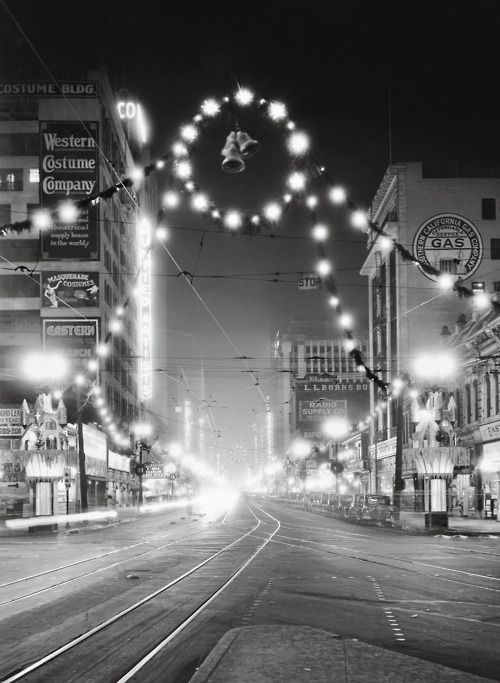
Downtown Los Angeles, 1930s?

Christmas on Broadway, Downtown Los Angeles, 1940s

Nov. 28, 1952: Police officer watches traffic on Hollywood Blvd. after holiday lights were turned on. Photo looking east from McCadden Place. (Los Angeles Times Archives)
Journalist and media professional currently based in Los Angeles, California. Focusing on science and technology.
Ever wondered what the concrete jungle of Downtown Los Angeles looks like to the birds? Ian Wood has captured this video using a small drone:
Journalist and media professional currently based in Los Angeles, California. Focusing on science and technology.