Category Archives: Astronomy

Easter

by Tim Tompson*

Easter Sunday will soon be upon us.

In the year 325 A.D. the First Council of Nicaea defined the date for Easter as the first Sunday following the first Full moon after the Vernal equinox. But astronomically selected dates can move around; e.g., the vernal equinox can happen on 20 March as well as 21 March, and the phases of the moon are not tied either to the civil calendar nor to the equinoxes. So, for the purposes of calculating the date for Easter, the Roman Catholic church defines its own equinox as always happening on 21 March, and they use their own “ecclesiastical full moon”, which by definition always occurs on the 14th day of the ecclesiastical lunar month on the ecclesiastical lunar calendar (which assumes by definition that 19 tropical years equals 235 synodic months exactly [the correct number is 234.997]). In this way, Roman Catholic Easter always falls in the window of 22 March to 25 April.

Roman Catholics use the Gregorian calendar, which was finalized in 1582 for the explicit purpose of returning the date of Easter to the same date it had when the First Council of Nicaea met. In the time between 325 and 1582, the vernal equinox had slipped backwards through the civil calendar to 11 March instead of 21 March, which it was in 325. So when the Gregorian calendar replaced the Julian calendar in 1582, ten days were skipped over, which moved Easter back to 21 March. And by the trick of skipping leap days in years ending in 00, unless they are evenly divisible by 400, the length of the average civil calendar year is shortened from 365.25 days (that is one “tropical year”) to 365.2425 days, the end result of which is that the civil calendar will fall behind the seasons by about one day come the year 3200 (a problem easily solved by skipping the leap day in 3200).

The actual time it takes to go from one vernal equinox to the next is 365.24219878125 days, which should result in an accumulated difference between the seasons and the civil calendar of 3 days, 17 minutes, 33 seconds over 10,000 years. But the mean tropical year is decreasing by 0.53 seconds per 100 years (a slow tidal transfer of energy from sun to Earth), and the mean length of day is decreasing by 0.0015 seconds per 100 years (a slow tidal transfer of energy from Earth to moon). That’s why the calendar can lose a whole day in only about 1200 years. One could cleanup the next few thousand years by skipping the leap day in the year 3200, keep the leap day in 3600 and 4000, and skipping the leap day in 4500 & 5000.

Eastern Christians (mostly the Eastern and Greek Orthodox churches, Eastern Catholic and Coptics) use the old Julian calendar, so they celebrate Easter basically a month later than do the Romans, in the window between 4 April to 8 May.

There are various good reasons for having a civil calendar that is locked to the seasons. But the one that has been most important has proven to be the need to have Easter fall on a fixed time of the civil calendar year.

* The writer is a physicist retired from NASA’s Jet Propulsion Laboratory. Among his main personal interests are astronomy, chess, languages and linguistics, and military history.

http://en.wikipedia.org/wiki/Easter
http://en.wikipedia.org/wiki/Ecclesiastical_full_moon
http://en.wikipedia.org/wiki/Computus


Related Articles:

TweetReinhard

Lowell Observatory: Fundraising To Save Clark Telescope

Percival Lowell observing Venus from the observer's chair of Clark telescope at the Lowell Observatory in 1910.

Percival Lowell observing Venus from the observer’s chair of Clark telescope at the Lowell Observatory in 1910.

Percival Lowell was convinced that there had to be life on Mars, and he spent much of his life trying to prove it. (I often wonder how excited he would be about our Mars rovers).Of course Lowell had no such help. In 1895, the astronomer commissioned a telescope he thought suitable for the visual examination of the surface of Mars. The refracting telescope was made by Alvin Clark & Sons (leading telescope makers of the time) and is housed at Lowell Observatory in Flagstaff. It is among the most important, historical science landmarks.

Today, the 117-year-old “Clark telescope” is in need of major restoration, and the Lowell Observatory is holding a crowdsourcing campaign to raise funds.

Related Articles:

TweetReinhard

You Are Here

Click to enlarge.

This is the current map of the Milky Way, as best we can make it out from our viewpoint inside. Our home galaxy has about 200 billion to perhaps 500 billion other stars beside our own. Orbiting them are billions to trillions of planets and moons. And that’s just one of billions of galaxies in the universe.

We cannot take pictures of our galaxy, so this image is a model. It is based primarily on results from the Galactic Legacy Infrared Mid-Plane Survey Extraordinaire (GLIMPSE) and the Multiband Imaging Photometer for Spitzer Galactic Plane Survey (MIPSGAL). Both are key projects for the infrared Spitzer Space Telescope. This particular image was released on June 3, 2008 at the 212th meeting of the American Astronomical Society.

I hope your head is spinning. (It should be).

Related Articles:

TweetReinhard

Transit Of Venus

Like thousands of other people, I watched the Venus transit on my computer, via webcast from the Keck Observatory on the summit of Mauna Kea on Hawaii. (It was amusing to see a bunch of excited scientists trying to keep a TV audience entertained for  6 hours).

There are plenty of great transit photographs taken by amateurs. (The L.A. Times has a nice collection of images from Southern California). But the best view was from space. My favorite image is this one, taken by the Japanese Hinode spacecraft.

(Click to enlarge).

Hinode is a collaboration between the Japanese space agency JAXA and various institutions in the US and the UK. Then known as “Solar-B”, the satellite was launched on a Japanese M-5 rocket in 2006. Earlier this year, Hinode returned  stunning images and data from the Lunar eclipse. Well done, Japan!


Related Articles:

TweetReinhard

Solar Eclipse

While hiking in the woods yesterday, I spontaneously decided to build an improvised pinhole camera to see the solar eclipse. Materials used: a roll of toilet paper, some aluminum foil I found in a trash can, a notepad from my backpack, and of course, my trusted Swiss army knife. Here is the resulting contraption and the image it produced:


If this does not impress you, here is a more professional image taken by the European Proba-2 microsatellite. (Hey, it cost a bit more). Credit: ESA/Pierre Carril.

Related Articles:

TweetReinhard

SOFIA

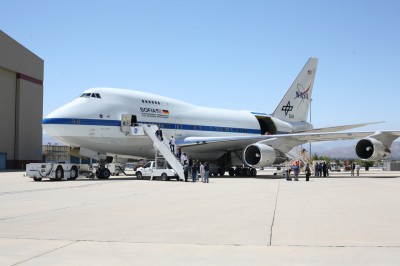
Last year I became one of the first journalists to fly on a science mission aboard SOFIA, the Stratospheric Observatory for Infrared Astronomy) developed and operated by by NASA and the German aerospace agency DLR.

In essence, SOFIA this is a giant, state-of-the-art infrared observatory packed into the aft fuselage of a highly modified Boeing 747SP. By making airborne observations high in the stratosphere, SOFIA’s instruments can gather light above 99% of our atmosphere’s water vapor. The flying observatory is now beginning to enter full scale scientific operations.

Our 10-hour long flight (dubbed Basic Science Flight 2) took off from U.S. Air Force Plant 42 in Palmdale, California. Most of our circuitous flight took place over the Pacific Ocean. After about 10 hours in the air, during which we reached altitudes of 43,000 feet, we returned safely to Palmdale.

The mission consisted of tests and observations on the GREAT instrument (the German Receiver for Astronomy at Terahertz Frequencies), which were successfully carried out.

It was a thrilling experience, and I was most impressed with the professional workmanship of the entire NASA crew. Keeping this highly complex, unique aircraft operational and flying in a reasonably safe manner is no easy task requiring much coordination and teamwork.

My detailed report was published in the January February 2012 issue of Gruner+Jahr’s popular German science magazine, P.M. Magazin. An excerpt (in German) can be read here. (The magazine will continue to be available online in both print and iPhone/iPad app editions).

Click the image below to see my photo album:


Links:

SOFIA on Wikipedia

NASA’s SOFIA Page

DLR’s SOFIA Page (English)

DLR’s SOFIA Seiten (Deutsch)

Deutsches SOFIA Institut (DSI)

SOFIA Science Center (USRA Page)


Related Articles:

TweetReinhard

Trouvelot: Astronomical Drawings And Invasive Species

In June 1881, a brilliant comet streaked across the skies of the northern hemisphere. This image is part of a recently digitized series of illustrations by the French-born artist Etienne Leopold Trouvelot (1827-1895).

Other images show Jupiter, Saturn and details of the Moon and Sun. Another records a meteor shower that lit up the skies one night in November 1868. [See Trouvelot’s Astronomy Illustrations]. All images were made available by the New York Public Library.

Trouvelot was less known for his astronnomical drawings, but more for his work as an amateur entomologist. This, however, had unintended results. As part of an attempt to produce silk in America, Trouvelot brought in gypsy moths from Europe — to be bred in the United States. Things went awfully wrong. Some larvae escaped and became an invasive species. To this day, gypsy moths are a devastating pest in America, destroying forest foliage in parts of the Southeast and Midwest, and in the northeastern United States.

I wish Trouvelot had stuck to drawing astronomical objects.

Related Articles:

TweetReinhard

Visiting Mount Palomar

Last weekend I was part of a group making a visit to the Mount Palomar Observatory.

When I was in school (voraciously sucking up astronomy books), Mount Palomar seemed to me like a place of magic and wonder. From its opening in 1949, and until 1992/93, the giant 5.1 m (200 inch) Hale Telescope was the largest and most important telescope in the world. (Actually, there was a larger Soviet telescope of a later design, but it is often omitted because it never functioned quite well).

The compound on the Southern California mountaintop also encompasses several smaller telescopes. Together, they account for most of the groundbreaking discoveries in the entire history of astronomy.

Here are some pictures. (Click to enlarge).

In front of the Hale Telescope dome, Mount Palomar. From left to right: Jed Laderman, Dave Yantis, Robert Lozano, Reinhard Kargl.

Standing under the massive, 200 inch primary mirror of the Hale Telescope.

Looking up to the secondary mirror, toward the top of the dome. In the old days, this is where the observer would have sat in a cage all night long, handling photographic materials. Today, the instruments are photo-electronic. Human observers no longer ride the elevator to the top).

The old control panel, preserved in a perfect vintage look. Doesn't it seem like something from Star Trek? (Today, the telescope operator sits in a heated cabin, insulated from the dome interior. This being on a mountain top, it gets extremely cold in the winter).

View from the Hale dome's circular catwalk. In the distance is the dome of the historic 18 inch Schmidt telescope. Beginning in the 1930s, Fritz Zwicky did his first surveys of supernovae here. The dome is no longer in use today.

More on Fritz Zwicky and the 18 inch Schmidt telescope.

Related Articles:

TweetReinhard

SOFIA: Flying High For Astronomy

I am rather excited about SOFIA, the airborne infrared telescope which is now flying its first scientific missions. I am hoping to do a lot of coverage on it in the future.

The program is a collaboration between NASA and the German aerospace agency, DLR. Much cheaper and more flexible than an infrared space telescope, it it hoped that the research flights will continue for 20 years or more.

I recently attended an in-depth press briefing at the Dryden Flight Research Center at U.S. Air Force Plant 42, where the aircraft is now based.

Among those present were NASA’s SOFIA Program Manager Robert R. Meyer, DLR’s Program Manager Alois Himmes, the Director of the Dryden Flight Research Center at Edwards AFB David D. McBride, Associate Center Director at NASA/Ames Steve Zornetzer, Director of Science at Ames Michael Bicay, SOFIA Project Scientist Pamela Marcum, Cornell University astronomer Terry Herter, Division Head for Submillimeter Technology at the Max-Planck Institut for Radioastronomie Rolf Güssen and Science Mission and Operations Director Erick Young.

Looking at the SOFIA aircraft from within its hangar at the Dryden facility at Air Force Plant 42. The door revealing the infrared telescope is open. Photo: Reinhard Kargl. Click to enlarge.

Telescope Assembly and SI Integration Manager Thomas Keiling probably got a sunburn while patiently explaining his "baby" to everyone wanting to know details. Photo: Reinhard Kargl. Click to enlarge.

Related Articles:

TweetReinhard

New Book On Multiple Universes

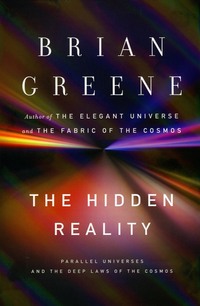
Brian Greene, the author of The Elegant Universe and The Fabric of the Cosmos, tackles the existence of multiple universes in his latest book, The Hidden Reality: Parallel Universes and the Deep Laws of the Cosmos.

Here is Brian Greene, interviewed by Terry Gross, for NPR’s Fresh Air.

The Hidden Reality: Parallel Universes and the Deep Laws of the Cosmos –
Hardcover: 384 pages
Publisher: Knopf (January 25, 2011)
Language: English
ISBN-10: 0307265633
ISBN-13: 978-0307265630
List price: $29.95

Related Articles:

TweetReinhard