Category Archives: English

Help Japan


Adventist Development and Relief Agency International’s Response to Japan Tsunami

All Hands Volunteers’s Response to Japan Tsunami

American Jewish Joint Distribution Committee’s Response to Japan Tsunami

American Red Cross International Services’s Response to Japan Tsunami

AmeriCares’s Response to Japan Tsunami

Ananda Marga Universal Relief Team (AMURT)’s Response to Japan Tsunami

Baptist World Alliance / Baptist World Aid’s Response to Japan Tsunami

Brother’s Brother Foundation’s Response to Japan Tsunami

Buddhist Tzu Chi Foundation’s Response to Japan Tsunami

Catholic Relief Services’s Response to Japan Tsunami

Christian Reformed World Relief Committee’s Response to Japan Tsunami

Church World Service’s Response to Japan Tsunami

Direct Relief International’s Response to Japan Tsunami

Giving Children Hope’s Response to Japan Tsunami

Habitat for Humanity International’s Response to Japan Tsunami

International Medical Corps’s Response to Japan Tsunami

International Rescue Committee’s Response to Japan Tsunami

Japanese Red Cross Society (English site)

Mercy Corps’s Response to Japan Tsunami

Medicines Sans Frontieres (Doctors Without Borders)
(has a medical team on the ground, but donations go into the general fund)

Operation Blessing’s Response to Japan Tsunami

Relief International’s Response to Japan Tsunami

Save the Children’s Response to Japan Tsunami

UNICEF (United States Fund)

World Vision, United States’s Response to Japan Tsunami

Please note:
Some have commented that Japan is wealthy and needs less assistance than poorer countries. This is a misconception. The nation of Japan has not asked (nor does it expect) financial assistance. However, the organizations listed above are currently expending their resources on helping victims in Japan. Unless these funds are replenished, less funding will be available for their global operations. In disasters on such a monstrous scale, we are all connected.

Related Articles:

TweetReinhard

Daylight Saving Time Makes No Sense

This Sunday we will again do the crazy switch: “Daylight Savings Time”. But the assertion that Daylight “Saving” Time “saves” energy is bunk. It is simply a stupid and anachronistic idea. It serves no documentable purpose and should be done away with.

Not only have the positive effects of DST never been conclusively documented. On the contrary! In recent years, there has been a growing body of scientific evidence showing an increase in energy consumption during DST.

The idea behind DST was that more daylight in the afternoon would reduce the need for artificial lighting, thus cutting down on energy costs.

But as it turns out, more light (and heat) in the afternoon also means an increased demand for air conditioning, which results in a net increase in energy usage. These are the findings of a 2008 study by two University of California, Santa Barbara researchers. “I’ve never had a paper with such a clear and unambiguous finding as this,” said lead researcher Matthew Kotchen.

Studies conducted in Japan, Australia and the State of Indiana have reached similar conclusions.

In the U.S., the situation is rather bizarre: some states switch to DST, others don’t. In the State of Indiana, some counties have DST. Others don’t. So if one drives though the state, the time jumps!

There is similar confusion around the globe. Some countries switch to DST, others don’t. Some (just to top everyone else in terms of absurdity) switch only one half hour forward and back.

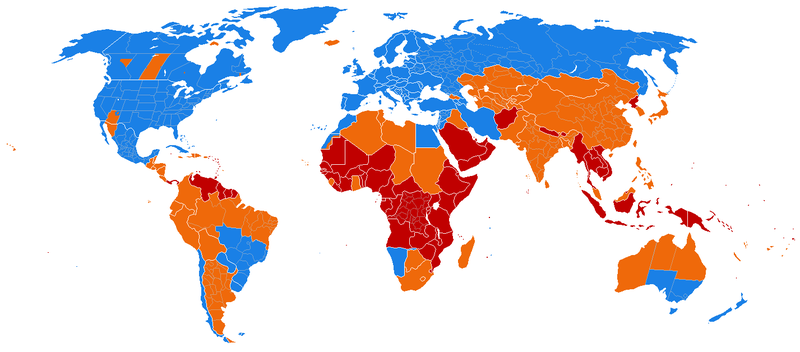
Here is a world map showing DST usage:

Legend: DST implemented (blue), DST not implemented (red), DST formerly used but now abolished (orange). Click to enlarge.

Of course, this impacts telecommunications, the travel industry, navigation and international business.

It is idiotic (to say the least!).

By the way: another false myth about DST is that Benjamin Franklin suggested it. Not true! Franklin merely suggested that getting up earlier (with the sun) and going to bed earlier would be more efficient – considering that most illumination in his days came from (expensive) candles and oil lamps.

Franklin is said to have remarked: “Early to bed, and early to rise, makes a man healthy, wealthy and wise”. In 1784, he also published an anonymous letter, which satirically suggested taxing shutters, rationing candles, and waking the public by ringing church bells and firing cannons at sunrise. Of course he was not serious. And he never suggested to move the clocks back and forth.

Here is an organization with the goal of abolishing DST for good: http://www.standardtime.com/

(Adapted from my blog post of 03/07, 2008)

Related Articles:

TweetReinhard

Fences

"Fence 1" - © Reinhard Kargl 2010. Click to enlarge.

"Fence 2" - © Reinhard Kargl 2010. Click to enlarge.

(The Rolling Stones: “Sittin’ On A Fence”, written by Mick Jagger & Keith Richards, 1965)

Related Articles:

TweetReinhard

Sharing Audio Files

I have long been wondering why there isn’t something like YouTube – but for high quality sound files instead of video. Now there is. The German firm SoundCloud has just opened offices in San Francisco.

SoundCloud allows users to upload just about any audio format, host it in the cloud, and share it over social networks, private sharing, or HTTP embedding. Listeners can be allowed to post comments, re-share a file, download or purchase files.

The service was originally created for musicians who wish to share their files, but I think it will also be extremely useful for radio reporters and those who want to embed sound files in their blogs or social media sites. In addition, direct web sharing can turn a small portable device into a sound recorder with virtually unlimited recording capacity.

SoundCloud is a lot simpler and more flexible than other audio file hosting services, for instance the one offered by AvidAudio, the makers of ProTools.

Unique is also that SoundCloud offers simple apps for portable devices. For instance, the iPhone app places a ‘record button’ on the iPhone, which allows direct recording to the cloud.

There are also plenty of related apps for the iPad, one of which turns the iPad into a portable recording and sound editing studio, which allows direct recording to the cloud.

Basic SoundCloud accounts are free.

http://www.SoundCloud.com

Related Articles:

TweetReinhard

The Los Angeles Air Raid

The Battle of Los Angeles, also known as ‘The Great Los Angeles Air Raid’, is the name given by contemporary sources to the rumored enemy attack and subsequent anti-aircraft artillery barrage which took place from late February 24 to early February 25, 1942 over Los Angeles, California.

Read more details here.

Related Articles:

TweetReinhard

R.I.P. Robert (“Bob”) Giel :.

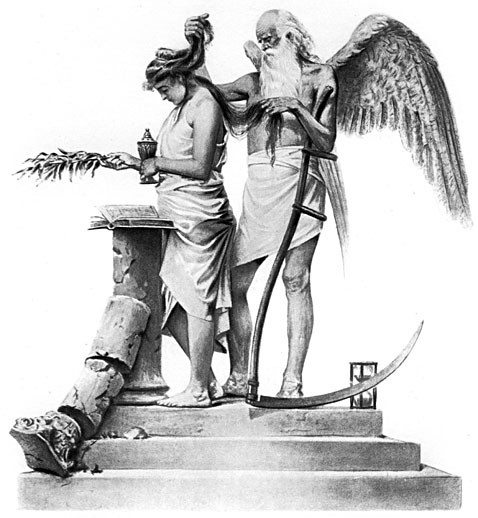
March 11, 1949 to February 16, 2011. After 61 years, 11 months and 5 days, the column is broken.

The Master’s Monument:
Three steps, the broken column, the urn and evergreen,
tears shed before the open book, the hourglass, scythe, and Father Time)

0
0
0
0
0
0
0
0
0
0
0
0
0
0
0
0
0

Related Articles:

TweetReinhard

Meeting Maria Altmann

Maria Altmann Portrait
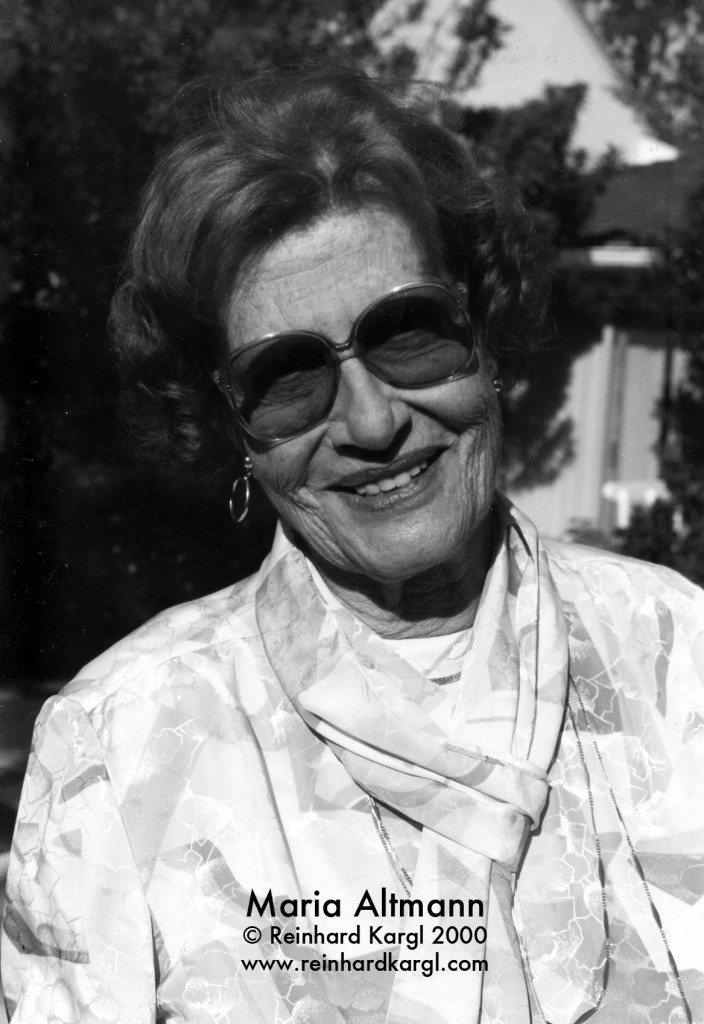
Maria Altmann in her garden. Click to enlarge. © Reinhard Kargl 2000

Maria Altmann, heiress to Gustav Klimt paintings which were later sold for $328 million, has died in Los Angeles on February 7, 2011. She was 94.

When the Austrian state TV network ORF asked me to do an in-depth interview with Maria Altmann in 2000 — after Altmann had sued the Republic of Austria — I was a little apprehensive at first. How would she react to a reporter raised in the country she was suing for the injustices she alleged were done to her family during the Nazi era?

So I phone Mrs. Altmann to test the waters. But my fears prove to be completely unfounded. On the countrary! The moment she hears I was born in Vienna (as she was), Altmann immediately falls into perfect German slightly tinged with a distinct Viennese upper-class accent: “Ach, dann können wir ja auch wienerisch reden!” And she proceeds to tell me enthusiastically of the “wonderful” youth memories she has of the old imperial city by the Danube, the delicious pastries, the architecture, and the music.

She was 84 years old at our first conversation, still very busy working as fashion consultant and designer, interested in art and classical music, well read, highly energetic and articulate. I knew then that I was about to meet a most interesting and remarkable lady.

Since then, Mrs. Altmann’s story has been well publicised. Born into a family of wealthy Jewish industrialists in 1916, she was 22 and freshly married when the First Austrian Republic (the German speaking remnant left over after the disintegration of the Austro-Hungarian Empire), joined the German Third Reich in the Anschluss of 1938. Like many other Jewish residents at the time, Altmann’s (and her husband’s) family assessed the situation correctly and subsequently scattered, leaving almost their entire fortune behind.

Among the family’s possessions were various pictures by the still relatively unknown Gustav Klimt; among them were portraits commissioned by Altmann’s family.
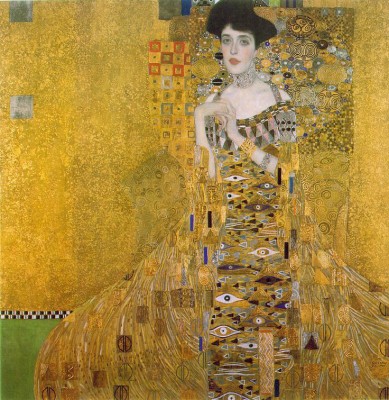
Adele Bloch-Bauer I, by Gustav Klimt, 1907. Oil and golden and silver foil on canvas. 138 × 138 cm. Click to enlarge.

Compared to what happened to others, Altmann considered herself “very lucky”. After her husband’s arrest, his brief detention and the couple’s covert flight from Vienna, the Altmanns were able to make a new, peaceful life in America, where they also achieved financial security.


Anyway, so we decide to shoot the interview at Altmann’s home in Cheviot Hill, a small and neat suburbian residential area in West Los Angeles, where the widowed mother of four children has lived for a long time. We agree to shoot everything in German.

Altmann is well groomed and dressed and exudes an aura of ladylike poise and charm. As usual, I let the cameraman pick the best setting (which he finds in the backyard) and while the crew is setting up, I follow the usual ritual: engage in a little small talk with the subject in private, then go over a broad description of my questions, have the microphones attached, do a light and sound check. Not easy to endure at the age of 84.

The interview goes very well. Altmann gives long answers (luckily I’m not the one who has to edit this) and turns out to be patient and charming. We change tapes several times.

But then, we run into a problem: every home in the area has a yard. And every yard seems to be maintained by Latino “mow and blow” crews. And they all arrive at the same time with their noisy lawnmowers, power cutting tools and leafblowers.

Oh, the ruckus! My sound guy is wringing his hands (and I have secret fantasies of wringing some necks). We decide to take a little break, but to no avail. As soon as one crew of yard workers is done, another starts up a lawnmower or damn leafblower somewhere else in the neighborhood. These things aren’t even legal.

I am beginning to get nervous. We have already shot two thirds of the interview; going inside now would be a continuity problem. Besides, I am under orders to ship the tapes off right away. Meanwhile, the sunlight is beginning to fade, and so does Altmann’s ability to concentrate. Great.

I call a break again (probably the for the 5th time) and go outside to talk to the yard workers. Of course, they pretend to understand no Ingles. I know the game, so I put on my crazy gringo act and somehow convince the workers to take a break for a few minutes. I don’t know if they agree to hold the work because of the bribe I offer (for which I have no expense account, of course), because they think I am nuts (and possibly dangerous) or because they genuinely feel bad about preventing me from doing my job.

Whew! The cameraman plays some tricks with the white balance to compensate for the different light temperature as much as possible, and we hurry to continue and finish up.

Altmann is “terribly sorry” for all the trouble even though she didn’t cause it. She invites me for coffee, which she prepares herself.

I send the crew on their way. They are eager to get on the freeway, since rush hour has begun. Altmann has lots of time, enjoys the company, and the opportunity to talk about Vienna auf Deutsch. I know (and appreciate) that people from Vienna take their Kaffeejause (coffee break) very seriously.

I am amazed that Altmann, through it all, still feels connected with Austria. I recall pictures of the Alps and mementos of Austrian cities in her home. Whatever ill feelings she might have are directed at the individuals whom she believes have wronged her, but not at the entire place or German culture as a whole. Most likely, this attitude is what allowed her to cope and carry on with her life. It’s not even about the money, she insists, but about justice. Money, she says, has never meant anything to her. “At this stage in my life, I would not even know what to buy with it.”

Altmann keeps pouring coffee and brings plates of food, and it is long after darkness has fallen when I finally get on my way. She invites me to come back some other time, “zum Kaffee” (for coffee).

I am sad to say that I never took her up on the offer. Like so many times in life, I often thought about making a phone call to follow up. But then, I am always extremely busy, and something else always came up. As so often, I now deeply regret that time has run out.

The story of the Klimt pictures and Maria Altmann, the old lady who fought the Republic of Austria (and won), exploded into the global headlines. In the end, the Österreichische Galerie Belvedere released the paintings to Altmann. I was able to see them at the Los Angeles County Museum of Art before they were sold off.

Altmann told me (and others) that she sincerely wished and hoped that the pictures would be visible to the public, but sadly this is only partially the case today.

The most famous of the paintings, Adele Bloch-Bauer I (1907) is one of several portraits of Altmann’s aunt. It was acquired by Ronald S. Lauder for $135 million in 2006. It was the highest price paid for a painting to date. Adele Bloch-Bauer I is currently at Lauder’s Neue Galerie in Manhattan, but the other pictures have disappeared from public view.

My favorite image from the group is currently in a private collection:

Birkenwald/Buchenwald (Birch Forest/Beech Forest), 1903. By Gustav Klimt (Austrian, 1862-1918). Oil on canvas. 110 x 110 cm. Private Collection. Click to enlarge.

I wonder what Klimt would have thought of all this. He died in 1918. I admire his words: “If you cannot please everyone with your deeds and your art, please a few. To please many is bad.” You see, Klimt was quite a rebel in his days.


Related Articles:

TweetReinhard

The Journalist Toll of Covering the Revolution in Egypt

76 journalists imprisoned
52 journalists physically attacked and injured
1 brutally beaten and gang raped (Lara Logan, CBS Television)
1 killed (Ahmad Mohamed Mahmoud of the Egyptian newspaper Al-Ta’awun)

Source: Committee to Protect Journalists, CBS and others.

Personal addendum: I find it objectionable, irresponsible and revolting that TV execs allow women to cover war zones. You are not convincing me that this is necessary to produce good reporting. I believe the motives are political correctness and, above everything else, the hope for better ratings.

Related Articles:

TweetReinhard

Valentine’s Day? Just Say NO!

Love is more important than things.
Kisses are more delicious than gourmet meals.
Relationships are more valuable than mansions.
Peace is more fulfilling than possessions.
Say “No” to Valentine’s Day …
if it is all about expectations and consumption.

Related Articles:

TweetReinhard