Category Archives: English

Sunrise in Egypt?

Like most journalists, I have been glued to the news, following the amazing events as they were unfolding in the Middle East (while secretly wishing I was in Cairo myself).

As a technocrat, I believe that this movement, sweeping over an entire region, was only made possible by the new information technologies. There were many factors, but the biggest of all were Internet-enabled, camera-equipped mobile phones in the hands of masses of young and tech-savvy people. The power and consequences of this technology is only now beginning to dawn on the older generation.

It took 18 days to derail a regime of 29 years.

I think the wave’s origins can be traced back to the Iranian elections of 2009. Although the massive protests afterwards were ultimately not successful, this event was a watershed moment and served as a “proof of concept”.

After Mubarak’s ouster today, people were not only celebrating in Egypt. According to BBC reports, there were people dancing in the streets of Tunisia (where Zine Ben Ali’s regime had been forced out weeks earlier). In Lebanon’s capital Beirut, people are setting off fireworks and flying the Egyptian flag. And in the Palestine, people are on the streets, singing the Egyptian anthem, and crowds are flocking to the streets in Jordan. As I am writing this, an avalanche of celebratory text messages is lighting up mobile phones all over the Middle East.

This information-driven movement is clearly not limited to one particular country, nor can it be contained by national borders. It would be a mistake to assume this is the end of it.

What will be next? Who will be next?

For now of course, the military has taken power in Egypt. The question is now whether this will lead to free elections and an independent government chosen by the people, free from foreign influence, based on the rule of law and subject to well regulated checks and balances.

Only then will we know if today’s events were a new sunrise or a sunset in Egypt.

Related Articles:

TweetReinhard

“Obviously A Major Malfunction”

25 years ago, on January 28, 1986 Space Shuttle Challenger was destroyed during launch, costing the lives of astronauts Francis “Dick” Scobee, Michael J. Smith, Ellison Onizuka, Judith Resnik, Ronald McNair, Sharon Christa McAuliffe and Gregory Jarvis. Their brief flight (STS-51-L) was the 25th shuttle launch.

By the time, shuttle flights had become routine and were hardly covered in the news. I was exiting the subway station Karlsplatz in Vienna, Austria when I heard the shocking news on a radio, which a storekeeper had sitting on the counter.

Related Articles:

TweetReinhard

Please Do Not Call Me “Caucasian”

There has been quite an uproar about an NPR (National Public Radio in the U.S.) commentator, who used the term “Gringo” for white Americans.

Personally, I don’t care if you call me “Gringo”. What I find offensive is the term “caucasian”. It is anthropologically and ethnologicially wrong and scientifically ignorant.

The term was probably invented by the German anthropologist Johann Friedrich Blumenbach. Around 1800, he theorized that all of the indigenous populations of Europe, North Africa, the Horn of Africa, West Asia, Central Asia, and South Asia originated in the Caucasus region. (Locate the Caucasus on a map. Most Europeans would not even consider it to be part of Europe).

In this region, so Blumenbach thought, God had created the “perfect man”. As they spread out in all directions, Blumenbach (and his fellow “monogenists”) believed, people degenerated in appearance.

Blumenbach wrote: “Caucasian variety – I have taken the name of this variety from Mount Caucasus, both because its neighborhood, and especially its southern slope, produces the most beautiful race of men, I mean the Georgian; and because all physiological reasons converge to this, that in that region, if anywhere, it seems we ought with the greatest probability to place the autochthones (birth place) of mankind.” [From: Blumenbach, De generis humani varietate nativa (3rd ed. 1795), trans. Bendyshe (1865)]

The 4th edition of Meyers Konversations-Lexikon (Leipzig, 1885-1890) shows the “caucasian race” as comprising Aryans, Semites and Hamites. Aryans are further subdivided into European Aryans and Indo-Aryans (the latter corresponding to the group later designated Indo-Iranians.

Blumenbach’s theories (most of which were derived from a bizarre pseudo science called “craniology” — the examination of skulls) are considered absurd by today’s standard of knowledge.

The term “caucasian” is anachronistic, misleading, scientifically wrong and should be dropped altogether. What should be used instead? “Caucasoid”, “Europid” and “Europoid” have been suggested, but are a similarly demented.

“European” would suffice. “European-American”, if you must. “Europeans” can be subcategorized into “Nordic” or “Germanic European” peoples, Slavic peoples, etc. — although in practice, these groups have been mixing in Europe for thousands of years. What matters more are the distinct cultural (and linguistic) differences, which have been preserved in Europe to this day.

In the U.S., the Supreme Court in 1923 decided that Asian Indians may be “caucasian” but not “white”. (United States v. Bhagat Singh Thind). In 1946, the court modified its opinion. The issue came to the court’s attention because of their relevance to immigration laws which, before 1965 favored white Europeans. As a result, the court was left to decide who was to be considered “white”.

Outside of American English and in science, the term “caucasian” has fallen out of use a long time ago, and it should be thrown out from everyday American language as well.

Related Articles:

TweetReinhard

New Book On Multiple Universes

Brian Greene, the author of The Elegant Universe and The Fabric of the Cosmos, tackles the existence of multiple universes in his latest book, The Hidden Reality: Parallel Universes and the Deep Laws of the Cosmos.

Here is Brian Greene, interviewed by Terry Gross, for NPR’s Fresh Air.

The Hidden Reality: Parallel Universes and the Deep Laws of the Cosmos –
Hardcover: 384 pages
Publisher: Knopf (January 25, 2011)
Language: English
ISBN-10: 0307265633
ISBN-13: 978-0307265630
List price: $29.95

Related Articles:

TweetReinhard

Today’s Rocket Launch

Today’s launch of a huge Delta IV Heavy lifted an NRO reconnaissance satellite into orbit. (Mission NRO-49). This was probably the largest rocket ever to launch from California so far. Here’s a picture I took from my window:

Plume of Delta IV Heavy as seen from my window. Photo: Reinhard Kargl

Related Articles:

TweetReinhard

Calling For Eddie Eagle

In a most tragic incident in the Los Angeles area, a 15-year old girl was shot in the head by an accidental gun discharge on Tuesday. She remains in critical condition and will be marred for life. The same bullet also wounded another student in the neck. It appears that the gun had been brought to school by a classmate, and gone off inside the student’s backpack.

Whenever we have a horrible event like this, it is fashionable to blame the schools, the “easy access to guns”, and to bash gun owner advocates — especially the National Rifle Association (NRA) — for allowing this to happen.

But what I hardly see mentioned is that the NRA is running a superb program warning kids of the dangers of guns. Continue reading

Related Articles:

TweetReinhard

Why We Must Hire Robots, Not Minimum Wage Workers

I encourage you to watch the following video entirely before allowing me to present my point of view:

As you can see, almost the entire manufacturing process in this film is handled by sophisticated machinery: robots.

I have long argued that instead of exploiting cheap Third World labor and lenient environmental regulations abroad, and instead of importing low wage workers en masse, the European Union and North America should focus on developing robotic manufacturing techniques for all consumer goods. Japan, unwilling to open its borders to foreign workers, is making great strides in this direction and will probably dominate the robotics industry, which it expects to see huge growth over the next few decades.

Robots could free mankind from the burden of most cumbersome, dangerous and boring toils. This would permit a restructuring of society to grant each individual more time for intellectual pursuits and pleasure. This in turn will fuel the education, media, travel and entertainment sectors of our economy, all of which are extremely difficult to outsource to cheap-labor countries.

Continue reading

Related Articles:

TweetReinhard

The Eisenhower Farewell Address

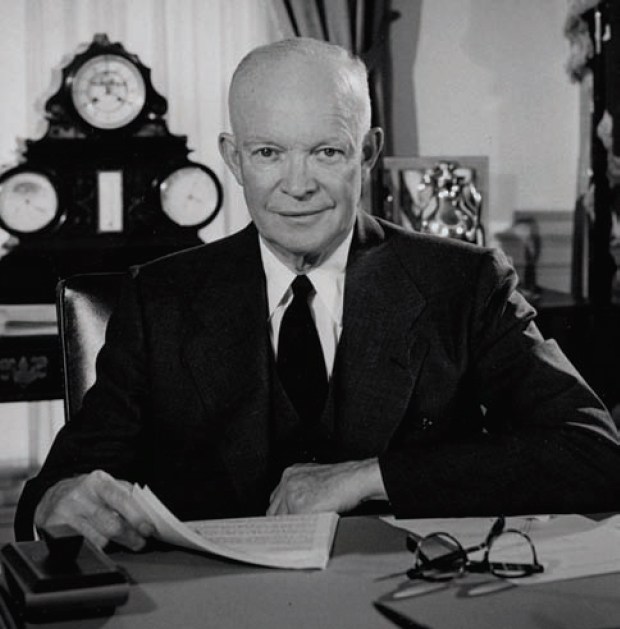
50 years ago today, Dwight D. Eisenhower, whose name is often mentioned among the greatest generals and U.S. presidents, gave a stern warning as part of his farewell address to the nation. I am amazed how astute Eisenhower’s observations were, and how they hold true five decades later.

Here is an excerpt from Eisenhower’s speech, delivered from the Oval Office of the White House:

[…] A vital element in keeping the peace is our military establishment. Our arms must be mighty, ready for instant action, so that no potential aggressor may be tempted to risk his own destruction.

Our military organization today bears little relation to that known by any of my predecessors in peacetime, or indeed by the fighting men of World War II or Korea.

Until the latest of our world conflicts, the United States had no armaments industry. American makers of plowshares could, with time and as required, make swords as well. But now we can no longer risk emergency improvisation of national defense; we have been compelled to create a permanent armaments industry of vast proportions. Added to this, three and a half million men and women are directly engaged in the defense establishment. We annually spend on military security more than the net income of all United States corporations.

This conjunction of an immense military establishment and a large arms industry is new in the American experience. The total influence — economic, political, even spiritual — is felt in every city, every State house, every office of the Federal government. We recognize the imperative need for this development. Yet we must not fail to comprehend its grave implications. Our toil, resources and livelihood are all involved; so is the very structure of our society.

In the councils of government, we must guard against the acquisition of unwarranted influence, whether sought or unsought, by the military-industrial complex. The potential for the disastrous rise of misplaced power exists and will persist.

We must never let the weight of this combination endanger our liberties or democratic processes. We should take nothing for granted. Only an alert and knowledgeable citizenry can compel the proper meshing of the huge industrial and military machinery of defense with our peaceful methods and goals, so that security and liberty may prosper together. […]

From:  Dwight D. Eisenhower’s farewell speech to the nation, January 17, 1961.

The complete transcript and audio file of the address are archived here, another transcript is here.

Related Articles:

TweetReinhard