Category Archives: English

From My Bookshelves

A fortnight ago I attended a lecture by Robert Piccioni. Rarely have I heard Einstein’s work and the fundamentals of modern cosmology explained in such a simple, entertaining and yet informative way. Much of the lecture’s content is echoed in Piccioni’s latest book, which I highly recommend for everyone.
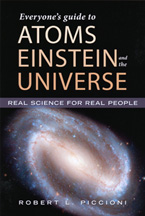
Learn the basics about how the universe works and understand the difference between Newton’s and Einstein’s view of gravity. Take a brief look at phenomena such as black holes, dark energy, gravitational lensing, redshift and the expanding universe! Piccioni’s work is a perfect blend of hard science and amusing anecdotes, making it very easy to follow. No advanced background in science is needed.

Everyone’s guide to Atoms, Einstein and the Universe, by Robert L. Piccioni (2nd Edition). ISBN 13: 978-0-9822780-7-9.

Talking about books: The Grand Designthe most recent book by Stephen Hawking (this time co-authored Leonard Mlodinow) just came out. (ISBN-13: 978-0553805376)

The wheelchair bound physicist from Britain is arguably the most famous scientist since Einstein. At his last lectures here at Caltech, people were lining up all night for a spot in the lecture hall. (It is amusing to see that even in this day and age, scientists can achieve rock-star fame).
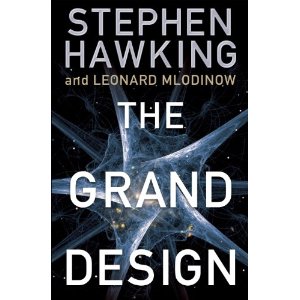
Immediately after the The Grand Design appeared earlier this month, some began to misquote it, saying Hawkins claimed that there was no God. But that’s not what Hawkins & Mlodinow are saying.

If we accept that nature is governed by laws, logical questions arise: What is the nature of these laws? Are there exceptions to them (the so-called “miracles”)? Is there really only one set of laws?

Ever since the beginning of mankind’s inquiry, there were those who accused “scientists (as the believers in “natural philosophy” began to be called in the 19th century) of plunging the world into moral and ethical darkness, as theirs was allegedly an attempt to demystify or even deny God’s involvement in nature.

Even this is a misunderstanding. Descartes, Galilei, Copernicus, Newton, Darwin and the like maintained their belief in a supreme being, while at the same time carrying on their investigations into the principles and laws governing everything in the universe.

Hawkins & Mlodinow contend that modern science has reached the point where the “mysterious hand of God” is perceivably no longer necessary to “explain” how the universe functions. Rather, our level of understanding of natural laws may have progressed to the point where we can (or will soon be) able to explain all the fundamental milestones of cosmology with pure reason.

The intellectual methods used in today’s science are in effect no different to those used by Aristarchus of Samos (310 BC – 230 BC, approx.) who, during the Ionian period, correctly calculated that the Earth orbits the Sun. Furthermore, that the Sun must be bigger than the Earth, which was not the center of the universe. (Of course, it took more than 1800 years until the heliocentric world view would become universally accepted). Here too, an “explanation” such as “God made it” is not sufficient, and neither is:

The sun is a luminary whose egress is an opening of heaven, which is (located) in the direction of the east, and whose ingress is (another) opening of heaven, (located) in the west. I saw six openings through which the sun rises and six openings through which it sets. The moon also rises and sets through the same openings, and they are guided by the stars; together with those whom they lead, they are six in the east and six in the west heaven. All of them (are arranged) one after another in a constant order. There are many windows (both) to the right and the left of these openings. First there goes out the great light whose name is the sun; its roundness is like the roundness of the sky; and it is totally filled with light and heat. The chariot in which it ascends is (driven by) the blowing wind. The sun sets in the sky (in the west) and returns by the northeast in order to go to the east; it is guided so that it shall reach the eastern gate and shine in the face of the sky. (1 Enoch 72:2–5)

And yet, science has never ruled out the possible existence of a supreme being, which may well lie beyond the abilities of our intellect, in the same manner as quantum physics is beyond what a chimp can rationally comprehend.

In human terms, as Piccioni rightfully pointed out in his talk, we live in the “golden age” of Astronomy. There have been more groundbreaking discoveries about our universe within the last 100 years, than in all the history of mankind before.


Related Articles:

TweetReinhard

Goodbye, Summer

Tonight at precisely 03:09 Universal Time (UTC) summer ends and fall begins on Earth. (Data source: U.S. Naval Observatory).

Fall or “autumn” starts with the “autumnal equinox”, an astronomical event during which the celestial equator and the ecliptic intersect. At this point in time, the tilt of the Earth’s axis is neither inclined away from nor toward the Sun, and the center of the Sun lines up with the Earth’s equator. When this happens, there is a point on the Equator where, if you stood there, the center of the Sun would be located exactly above you.

Two such moments (“equinoxes”) exist each year. In addition to the “solstices”, they mark the change of seasons.

Man’s knowledge of this goes back thousands of years, as we can tell from cult sites and edifices specifically constructed to mark these events.

The Ring of Brodgar, Orkney Islands, Scotland. This Neolithic site was built about 4,500 years ago.

Here is more about the Ring of Brodgar.

Related Articles:

TweetReinhard

More Dwarf Planets

I grumbled when the  International Astronomical Union erased Pluto from the list of “planets” in our solar system. Memorizing the names of the nine planets seemed simple enough when I was in school. Why make it any easier on today’s kids? Besides, I liked my old neighborhood just fine.

But in retrospect, I have to admit that the decision was right. Otherwise, school kids would now have to memorize the often bizarre names of  quite a few more “planets”. Many of the recently discovered “Trans-Neptunian” objects are very similar to Pluto and  should therefore be in the same class. One of them (“Eris”) is even larger than Pluto and has a moon (“Dysnomia”). Sedna, Makemake (in case you are wondering about the name, scroll to the bottom) and Quaoar are only slightly smaller.

Source: National Geographic. Click to enlarge.

Having lost its “planet” designation, Pluto (now a “dwarf planet”) has gained two more moons, making it three: CharonHydra and Nix.

National Geographic just published a brief article on the discovery of 14 new TNOs. Why are these cold worlds important? Because they represent building blocks from the early days of our Solar System, and we are interested in learning how (and from what) it formed. NASA’s New Horizon space probe will help to address this question. It is now about halfway to Pluto’s neighborhood.

PS: Makemake was discovered at Easter. Following tradition and IAU rules, it was given the name of a creator deity. Makemake, the creator of humanity and god of fertility in the mythos of the Rapanui, the native people of Easter Island, was chosen in part to preserve the object’s connection with Easter.

Related Articles:

TweetReinhard

The Great (Smoking) Divide

The overall percentage of smokers in Los Angeles County has reached a new low of 14.3% on average. But recently released reports illustrate a sharp difference in smoking rates along racial, cultural and geographic divides.

The lowest smoking rates were found in expensive, white areas with high education levels, such as San Marino (5.3%), Malibu (5.8%) and LaCanada-Flintridge (6.4%).

Broken down into ethnicity and gender, the highest rates of smoking were found to be among:

Korean-American males: 44.8%
African-American males: 32.1%
Vietnamese-American males: 24.8%
African-American females: 19.6%
Latino-American males: 17.7%
Filipino-American males: 17.1%
Chinese-American males: 16.4%

It is believed that in 1 of 7 deaths, smoking was a major contributing cause. Smoking remains the leading preventable cause of death and disability.

Although lacking necessary funding in every area of operation, Los Angeles County agencies are currently spending $4.3 billion in tax money to pay for the costs of tobacco related diseases. Of this amount, the County is sinking $2.3 billion into direct health care expenditures.

Download the report here.

Related Articles:

TweetReinhard

R.I.P. Mrs. Death

I must confess that I like old cemeteries. I don’t perceive them as eerie, but as peaceful and tranquil. To those with open minds and eyes, cemeteries offer a glimpse into the lives of people who have long gone.

Here is a picture I took in a Southern California graveyard. Mrs. Death passed away 98 years ago, at the age of 81. Who was she? And how did she get that name? Surely, introductions at social gatherings would have resulted in some comical consternation.

I assume that Mrs. Death must have possessed a sense of humor — otherwise she would have changed her name at some point. (Quite easily accomplished in America, name changes are a time honored tradition among immigrants).

Peace be upon her.

R.I.P., Mrs. Death. Photo: Reinhard Kargl, 2010. Click to enlarge.

Related Articles:

TweetReinhard

A Video Tour Through the International Space Station

It looks even more messy than my place!

Related Articles:

TweetReinhard

Big Buddha Is Watching You

A post office I know in West Los Angeles has more security cameras than postal workers. (The cameras are monitoring the long line of waiting customers, but not the postal workers who usually move slower than sloths. Then again, since the price of postage keeps rising by the month, they must guard against the distinct possibility of armed stamp robberies).

These days, surveillance cameras are watching us in the most bizarre of places. Here is a picture I took at the entrance to a Buddhist temple.

Cameras are monitoring the entrance to a Buddhist temple.
Photo: Reinhard Kargl, 2010. Click to enlarge.

Related Articles:

TweetReinhard

U.S. Politicians Serving Life Terms

Last June, when Senator Robert Byrd from West Virginia passed away at the age of 92, after 6 years in Congress and 58 (!) years in the U.S. Senate, he was laid to rest with all honors — and nobody seemed to blink an eye.

It is safe to say that Americans generally seem rather angry and frustrated with their elected officials these days. On the other hand, I am always perplexed at the high rate at which incumbents keep getting reelected over and over again.

Since 1964, the average rate of re-election has been 93.3 percent for members of the House, and 81.6 percent for members of the Senate. In the last decade, the rate of re-election has even been rather high for Congressmen: 96%!

The American Founding Fathers surely did not anticipate today’s situation. They never intended to set up permanent houses of parliamentary government in Washington D.C., nor did it occur to them that someone would be able to make a career out of running for public office for most of his life. Most of the Founders were deeply suspicious of representatives staying in their positions for decade after decade. Rather, the Founders objected to the idea of a ruling class, which they knew would eventually maneuver itself into positions where they would be exempt from laws and programs imposed on others, where they would be shielded from the effects of their policies, and where they would be receiving perks and a better life simply because they were in government.

And yet, I find it vexing that the Founders failed to establish term limits or some other mechanism to encourage rotation.

So today, there are no term limits for federal U.S. representatives. Not few of them remain in their positions until death, or until senility or physical ailments prevent basic bodily functions.

Despite all the much discussed public anger showing up in polls, this year does not appear unusual at all. So far, 282 federal incumbents have been up for reelection. Only six of them have lost their seats (two senators and four congressmen). That’s a dismissal rate of only 2% over the 6-year terms of office for senators and the 2-year terms for congressmen.

Most of us can only dream of this kind of job security (which also happens to come with full pension, health care and other benefits).

Related Articles:

TweetReinhard

Late Night Lemon Drop

So far, this year’s summer has been rather chilly and cloudy in Southern California. I can only dream of cold cocktails on hot summer nights.

Related Articles:

TweetReinhard