Category Archives: English

You Talk Like a Vuvuzela

What’s that incessant, deafening honking noise heard all the way from South Africa’s soccer stadiums?

It’s the vuvuzela, of course. World Cup teams are complaining bitterly (players can’t hear each other or the referee’s whistle). Stadium ticket holders are blown deaf on one or both ears. TV directors are throwing up their arms in despair. Flooded with viewer complaints, the BBC is now looking into ways to cancel the noise from its World Cup broadcasts.

South African officials have suggested that foreigners should just embrace the South African way of celebrating. No, it’s not a traditional instrument any more than a car horn is. Instruments make music. The vuvuzela just honks. And it’s not traditional either. Vuvuzelas have only become popular in the 1990s, and the cheap plastic models are nothing but a recent fad. Probably made in China.

Vuvuzela. Vuvuzela! Just about the only nice thing to say about it is the word itself! I absolutely love it!

So much so that I propose we adopt secondary uses of the word as it enters the English language, such as:

Don’t talk like a vuvuzela! (Used in arguments).

Sarah Palin is such a vuvuzela. (I’m not trying to make a political statement here).

Don’t vuvuzela us! (Said to Sarah Palin).

My editor just gave me the vuvuzela because I missed my manuscript deadline.

Oops …

Related Articles:

TweetReinhard

NASA Boss Charles Bolden Shows Personality

The new NASA Administrator, Charles Bolden showed a passionate side in his radio interview with Patt Morrison today.

He gets teary-eyes about the retirement of the Space Shuttle but then turns his eyes toward the future. Bolden, a retired U.S. Marine Corps major general, is a former astronaut who flew on 4 shuttle missions. But despite his feelings, Bolden seems content with the notion that it is time to retire the shuttle and move on by limiting NASA’s role in Earth-orbit launch operations. Which must happen by default anyway, since NASA has no shuttle successor anywhere near the launchpad at this time.

Taking a big step, Bolden conceded that future NASA astronauts will be flying on spacecraft mostly developed and built by private firms.

You can listen to the interview below:

To download the entire audio file, click on Download.

Related Articles:

TweetReinhard

Send Pictures as Postcards

The Austrian postal service is launching an innovative smart phone app.

First, take a picture on your smart phone and upload it. Then, add a recipient mailing address and a personal message. The postal service in Austria will generate a postcard, print it on paper and send it (via domestic or international mail) to the recipient.

The cost (1.99 euro for postage and postcard) can be paid via credit card or other payment options).

Now you can send your aunt Mimi a postcard from Austria, with a picture of you in Las Vegas. Just for the heck of it.

No smart phone? You can also upload pictures from a computer with Internet access. No special software is required.

http://app.post.at/e-postkarte/site/karte

Related Articles:

TweetReinhard

Now Tweeting “auf Deutsch”

Receive my Twitter feeds in German!

Nun können Sie meine Twitter-Nachrichten auch auf Deutsch bekommen:

http://twitter.com/TwitReinhard

Twitter ist eine kostenlose Plattform für das Publizieren von Kurznachrichten, die sich seit einigen Jahren rasant verbreitet. Diese Kurznachrichten (“Tweets”) sind maximal 140 Anschläge lang und daher auch ideal für den Empfang auf Mobiltelefonen geeignet.

Hier finden Sie mehr informationen über Twitter.

Related Articles:

TweetReinhard

Falcon 9 Successful – Lessons From Formula One

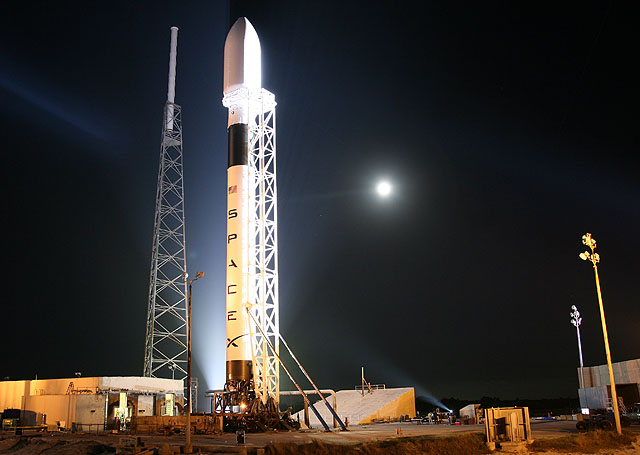
Hawthorne / Los Angeles County based SpaceX is celebrating a monumental breakthrough today after a successful first launch of its Falcon 9 rocket.
I followed the launch via video feed from Cape Canaveral this morning. At first I was disappointed when the initial launch attempt resulted in a lock-down just at the moment of ignition. I thought for sure it was a scrub. But the launch window was still open. After the countdown clock was reset, everything worked well on the second try. About 10 minutes later, the upper stage with a mock-up of the proposed Dragon crew capsule entered into a low Earth orbit.

This was the inaugural flight of Falcon 9, intended for testing only. What does it mean?

First of all, SpaceX is again proving the doubters wrong. It has shown that a relatively new, relatively small company can successfully design, build and fly a launch vehicle into space. It does so better, faster and cheaper than NASA, which is so stuck in a quagmire of politics, personal maneuvering and a bureaucratic approach to engineering and innovation that it has completely failed to come up with any new launch vehicle in 25 years.

As if it were big news that the remaining three Space Shuttles, with their system history of 25 years of service (and 2 fatal accidents) are more than ready for their final flights to a museum. Nor should it be a big surprise that without the Shuttle and without any alternatives, the U.S. again lacks the capacity for manned flights to space. This means that the U.S. has no autonomous access to the ISS. In 25 years of shuttle operations, NASA could not come up with anything flightworthy?

And the aerospace giants, such as Boeing and Lockheed-Martin? They had no motivation to design anything new and cheaper. For what? To make their existing satellite launch hardware obsolete? Conveniently, they have a captive market for satellite launches. That’s because U.S. law prohibits the launch of many U.S. payloads on foreign launch vehicles. It’s a matter of “national security”, we are told. How come the Europeans are less concerned about that? They all partner with each other and with Russia to launch their payloads.

Manned flights? A crew capsule? Perhaps the aerospace giants could have been given funding to make their satellite launch vehicles (or derivatives) safe enough for human flight. (I suspect NASA and its political backers wanted none of that).

There is an interesting parallel in Formula 1 motor racing. History has shown that small, agile racing teams, with factory sponsorship and with a small, dynamic workforce are overall outperforming teams run by large car manufacturers.

In the crazy world of high-tech motorsports, there is intense competition. Teams must work around the clock to continuously innovate, learn from mistakes, outmaneuver the opponents and adapt to changes. Every race is different, and new challenges (and regulations) appear all the time.

Whoever can adapt the fastest is the most likely to arrive first at the finish line. On the racing circuit, the big car companies are like bulls racing against greyhounds. Not even Fiat-owned Ferrari is an exception. Aware that Ferrari is a national obsession and sacred to Italians, Fiat bosses are smart enough to leave it largely alone. Ferrari’s engineers and technical managers have broad decision making powers and are not micromanaged by the Fiat-Board and bean counters.

Yes, one will often find the name plates of well known automobile manufacturers on engines and other critical components. But this does not mean that Mercedes-Benz or Ford really do the R&D for these highly specialized machines. They often hire contractors — small, agile teams of experts — to solve specific problems and come up with engineering solutions, in the least amount of time. Examples of such specialty engineering firms are Cosworth and Ilmor, both in the UK, and Dallara in Italy.

This kind of structure and engineering management is exactly what is needed if we want to achieve a drop in cost, along with more reliability, in space transportation. NASA, I am afraid, is in its current state incapable of this kind of agile management and risk-taking approach. I speculate that if NASA entered a team in Formula 1, it could be initially competitive by hiring experts from other teams. But it would spend a multiple of other teams to do so and fall behind after a few years. (Oh, how I wish to see everyone on the race track!)

Meanwhile, the future for SpaceX glistens with rocket fuel right now. Of course, one successful launch doth not make a reliable launch vehicle. A lot of further tests will be needed until Falcon 9 could be deemed safe enough to fly humans to the ISS, which is the eventual goal.

If successful, SpaceX will be able to do this in less time and for a lot less money than NASA’s ill conceived Constellation program which, in typical NASA fashion, remains stuck in the mud.

Addendum June 7, 2010: In a press release today, SpaceX claims that it developed the entire Falcon 9 system, the Dragon spacecraft and the launch hardware for what it would cost NASA to build just the Ares 1 launch tower. SpaceX has only about 1,000 employees to date.

Please also see my earlier, related post on NASA’s lingering Constellation program.

Related Articles:

TweetReinhard

12 Events That Would Change Everything

Someone at Scientific American had a magnificent idea: come up with a list of 12 plausible events with the biggest potential to shake up our world.

It is not difficult to identify such monumental events in the past, but harder than it seems when we try to gauge the relative importance (and likelihood) of things to come.

Here is what Scientific American came up with for an interactive web-only special:

1. Polar meltdown
2. The proof for additional dimensions
3. Proof for extraterrestrial life
4. An exchange of nuclear strikes
5. The creation of fully synthetic life
6. Superconducitvity at room temperature
7.  Machines demonstrating self-awareness
8. Cloning of a human
9. A really large earthquake along the Pacific Rim
10. Usable fusion reactors
11. A collision with a large asteroid
12. A deadly pandemic

A great list! Except, I don’t think human cloning is a big deal. We already have nature’s way of producing genetically identical humans (identical twins). So perhaps I would replace No. 8 with any of the following:

• Ability to switch off the biological aging mechanism
• Construction of a bionic uterus; extra-corporal gestation
• A working theory uniting Relativity & Quantum Mechanics
• Drugs which significantly decrease the need for sleep
• Fully reversible vasectomies and tubal ligations
• Ability to grow organs and tissues from stem cells
• Solid evidence for / against the life of Jesus Christ
• Technical applications for Quantum Entanglement

Now that I think about it, I’d like to expand the entire list! Food for thought? What would you add or remove?

For more in-depth information on the items on Scientific American’s list, please follow the link below. I seriously doubt that it will run equally well on all systems and browsers, but it is well worth the try.

http://www.scientificamerican.com/article.cfm?id=interactive-12-events

Related Articles:

TweetReinhard

Beast of Burden

"Beast of Burden", Reinhard Kargl 2007. Click to enlarge.

One late afternoon, I observed this scene in a supermarket parking lot. The dog’s owner, a retired college professor was shopping in the store while his canine pillion rider was guarding their vintage BMW motorcycle. (The two of them routinely ride together).

Related Articles:

TweetReinhard

One Big Hole

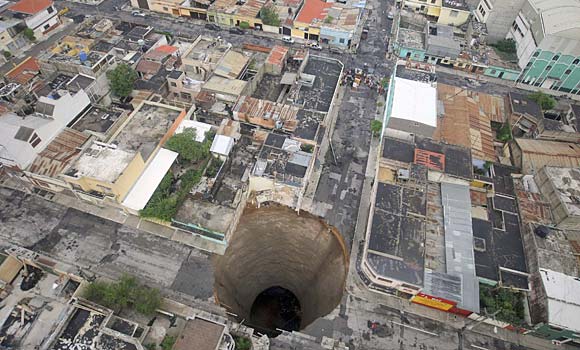
Click to enlarge. Photo: Reuters

Since I was a boy, I’ve had a fascination with earth holes, tunnels, lava tubes and caves. I think I’ve always been curious to find out what lies beneath. This Reuters picture from yesterday is simply amazing!

Over the weekend, a giant sinkhole opened up in Guatamala City as a result of Tropical Storm Agatha. The sinkhole swallowed a whole garment factory, but apparently nobody was hurt. All in all, Guatemala is not faring well. More than 125,000 people were evacuated, 152 are dead and 100 are reported missing. The Los Angeles Times has the story.

Related Articles:

TweetReinhard

Memorial Day – On Sale?

Today, the United States of America calls upon its citizens to honor its lost military service members. This should be a somber occasion, and I deeply loathe the obsession with partying and “Memorial Day sales” at the malls that have come to dominate the majority’s attention.

Do we really need to stick a “for sale” sign on everything?

The U.S. is currently engaged in two military campaigns, dubbed “Iraqi Freedom” and “Enduring Freedom”. According to U.S. Central Command, the number of American casualties resulting from these campaigns is 5461 until today. (A complete database of the fallen can be found at http://militarytimes.com/valor/).

Here is more about the history of Memorial Day.

Too often, we learn about military conflict as a collective narrative as told by statistics and numbers, and recorded in history books written and edited by those who emerged victoriously. But as Mark Twain did, I believe that it is more important to write about the stories of men, rather than about the story of mankind.

As a journalist, I am concerned that we are not doing enough to record the personal stories of those who were directly engaged and affected. We are in danger of losing these stories forever.

The number of living World War I veterans is now down to a handful of ancient people spread out over the world. Most of them are infirm. Whatever has not been recorded so far is now lost forever.

We still have a chance with World War II veterans. The U.S. once had 16 million of them. Today, there are only about 2.5 million left. Of those, 1,000 are dying every day, and this rate will accelerate sharply in the coming years.

We must keep in mind that the annual death rate for veterans is connected to the military rank they held at the time of their service. The reason is that military rank is usually associated with age and experience. Therefore, the higher a veteran’s military rank (and the higher his decision making powers and scope of experiences) were at the time of service, the older he would be today. This would place him in an age group with a higher death rate.

What this means for us as documentarians is that we are rapidly losing access to the decision makers, and that we will be limited to interviewing enlisted men and lower ranking veterans only. Unless we act quickly, their stories too will never be told again.

Several venerable organizations, such as the Veterans History Project at the Library of Congress and National World War II Museum in New Orleans are trying hard to preserve the personal histories of veterans, but their efforts are a drop in the bucket.

I think private initiative is the key. Those of us who have family members or personal friends who served should do our very best to get them to write down or record their stories by electronic means.

We should become repositories and custodians of their experiences and memorabilia. Luckily, modern information technology makes all this much easier and cheaper. Almost anyone can now make digital video or audio recordings, and it is very easy to share these with the entire world.

I know from personal experience that it is often very difficult to get old veterans to talk about their wartime experience, particularly if they were full of losses and trauma. But there is too much to be lost not to try!

Related Articles:

TweetReinhard