Author Archives: Reinhard Kargl

About Reinhard Kargl

Journalist and media professional currently based in Los Angeles, California. Focusing on science and technology.

Refueling the Spirit

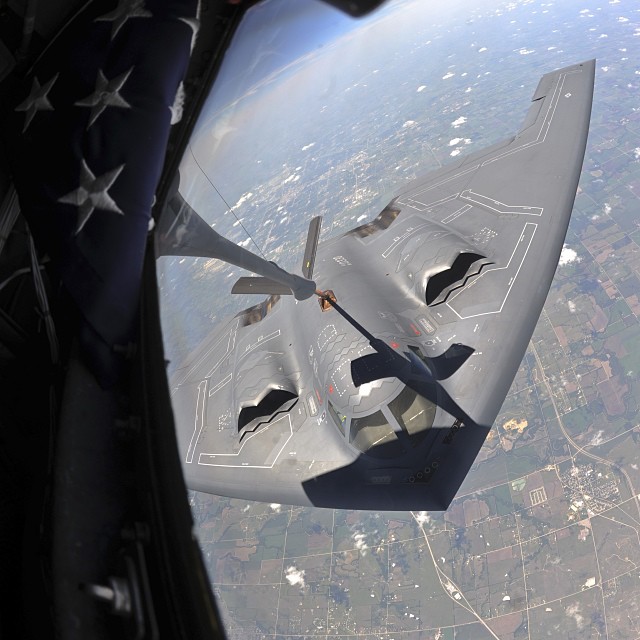
I love this picture! Here, a B-2 Spirit from Whiteman Air Force Base Mo., detaches from the boom of a KC-135 Stratotanker, assigned to the 22nd Air Refueling Wing McConnell Air Force Base Kan., after being refueled. The photo was taken by Airman First Class John Linzmeier, USAF.

257310ec37fd11e382fd22000a9d0df2_8

Related Articles:

TweetReinhard

Airdrop

This video shows a California Air National Guard C130J of the 146th Airlift Wing performing an approach and airdrop of fire retardant on the Rim Fire in the Yosemite area. Such maneuvers are very risky, and the professional skill these aircrews are displaying are immense. Here is what it looks like from the cockpit:


The aircraft is coming is so low that the automatic landing gear warning is going off repeatedly. (Normally, this warning is supposed to alert the pilot that the wheels are not deployed during a landing approach). In this instance, the warning is probably annoying, but it cannot be disabled easily.

Related Articles:

TweetReinhard

Autopsy

Is it just my imagination, or do some of the students look like they are nauseous?

John Bannister, Lecture with Dissection , England, 16th century. Click to enlarge.

John Bannister, Lecture with Dissection , England, 16th century. Click to enlarge.

Related Articles:

TweetReinhard

Earth As Seen From Saturn

This picture shows us. All of us on planet Earth. All 7 billion human beings contained one tiny dot of light.
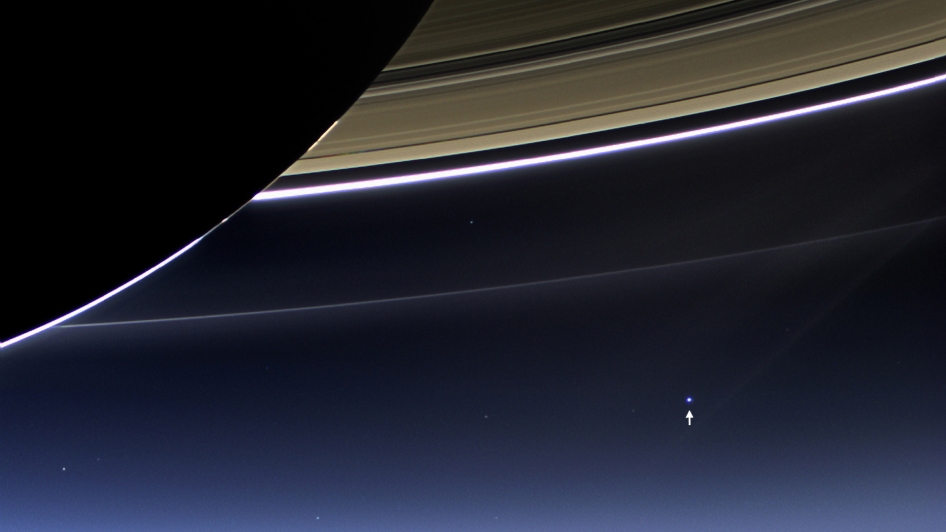
Earth from Saturn

(Click to enlarge)

In this rare image taken on July 19, 2013, the wide-angle camera on NASA’s Cassini spacecraft has captured Saturn’s rings and our planet Earth and its moon in the same frame. It is only one footprint in a mosaic of 33 footprints covering the entire Saturn ring system (including Saturn itself).  At each footprint, images were taken in different spectral filters for a total of 323 images: some were taken for scientific purposes and some to produce a natural color mosaic.  This is the only wide-angle footprint that has the Earth-moon system in it.

The dark side of Saturn, its bright limb, the main rings, the F ring, and the G and E rings are clearly seen; the limb of Saturn and the F ring are overexposed. The “breaks” in the brightness of Saturn’s limb are due to the shadows of the rings on the globe of Saturn, preventing sunlight from shining through the atmosphere in those regions.  The E and G rings have been brightened for better visibility.

Earth, which is 898 million miles (1.44 billion kilometers) away in this image, appears as a blue dot at center right; the moon can be seen as a fainter protrusion off its right side. An arrow indicates their location in the annotated version. (The two are clearly seen as separate objects in the accompanying narrow angle frame: PIA14949.) The other bright dots nearby are stars.

This is only the third time ever that Earth has been imaged from the outer solar system. Continue reading

Related Articles:

TweetReinhard

Nineteen Eighty-Four

1984Fascinating. George Orwell‘s novel, “Nineteen eighty-four” (sometimes spelled as “1984”) has been catapulted back into the US bestseller lists!

Practically overnight, sales have risen almost 5800%.

There are several editions of the original works published in 1949, so it is not quite clear how the numbers are compiled. I wonder what Mr. Orwell would have to say. (Unfortunately he died in 1950).

Don’t forget, Prols:

WAR IS PEACE!

FREEDOM IS SLAVERY!

IGNORANCE IS STRENGTH!

Related Articles:

TweetReinhard

The Nine Principles Of Miyamoto Musashi

1. Think of what is right and true.
2. Practice and cultivate the sciences.
3. Become acquainted with the arts.
4. Know the principles of the crafts.
5. Understand the harm and benefit in everything.
6. Learn to see everything accurately.
7. Become aware of what is not obvious.
8. Be careful even in small matters.
9. Do not do anything useless.

Miyamoto Musashi (宮本 武蔵), Bushi, Master Swordsman, Japan, c. 1584 – June 13, 1645)

Miyamoto Musashi wielding two bokken. Woodblock print by Utagawa Kuniyoshi.

Miyamoto Musashi wielding two bokken. Woodblock print by Utagawa Kuniyoshi.

Related Articles:

TweetReinhard

Color Footage of London, 1927

This is archive footage based on images captured by Claude Frisse-Greene, an early British pioneer of film. Nearly 90 years ago, he created a series of travelogues using a color process developed by his father William Frisse-Greene, a British portrait photographer and a well known inventor. His experiments in the field of motion pictures led him to be known as one of the fathers of cinematography.

One of William’s inventions was an additive color film process known as “Biocolour”, a rather cumbersome early color process. It works by exposing every other frame of standard black-and-white film through a different-colored filter, and then staining the resulting monochrome prints either red or green. In a motion picture projection, the combined frames create an illusion of real color.

Using computer enhancement, the British Film Institute reduced the flickering seen in the original footage.

Related Articles:

TweetReinhard

Roger Ebert Dead

Roger Ebert, my favorite film critic passed away from complications of cancer today. Given today’s fragmented media market, he will never be outdone. There’s much that could be said about his career and influence, but I will gladly leave this to others who are more knowledgeable.

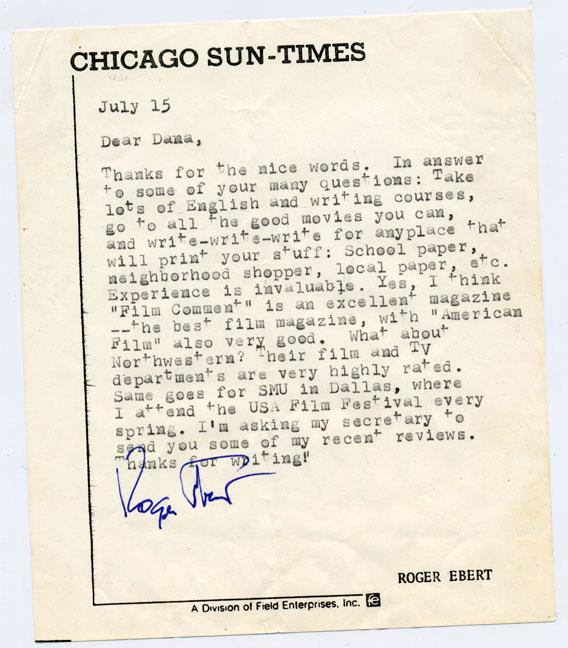
But I wanted to post this letter Ebert sent to an student who was about 11 or 13 at the time.

RogerEbertLetter

Dana Stevens went on to study comparative literature at UC Berkeley, started a blog and is now a professional film critic. She has written for the New York Times, the Atlantic and the Washington Book World, among others.

Proof that real letters are more inspiring than e-mail!

Related Articles:

TweetReinhard

Flying Over the Earth at Night

This video is so amazing that I had to repost it as it came. This was originally posted on “Astronomy Picture of the Day“, a daily blog site highly recommended for everyone with an interest in astronomy.

Video Credit: Gateway to Astronaut PhotographyNASA ; Compilation: David Peterson (YouTube);
Music: Freedom Fighters (Two Steps from Hell)

Explanation: Many wonders are visible when flying over the Earth at night. A compilation of such visual spectacles was captured recently from the International Space Station (ISS) and set to rousing music. Passing below are white cloudsorange city lightslightning flashes in thunderstorms, and dark blue seas. On the horizon is the golden haze of Earth’s thin atmosphere, frequently decorated by dancing auroras as the video progresses. The green parts of auroras typically remain below the space station, but the station flies right through the red and purple auroral peaks. Solar panels of the ISS are seen around the frame edges. The ominous wave of approaching brightness at the end of each sequence is just the dawn of the sunlit half of Earth, a dawn that occurs every 90 minutes.


Related Articles:

TweetReinhard